QUESTION IMAGE
Question
select the correct answer from each drop - down menu.
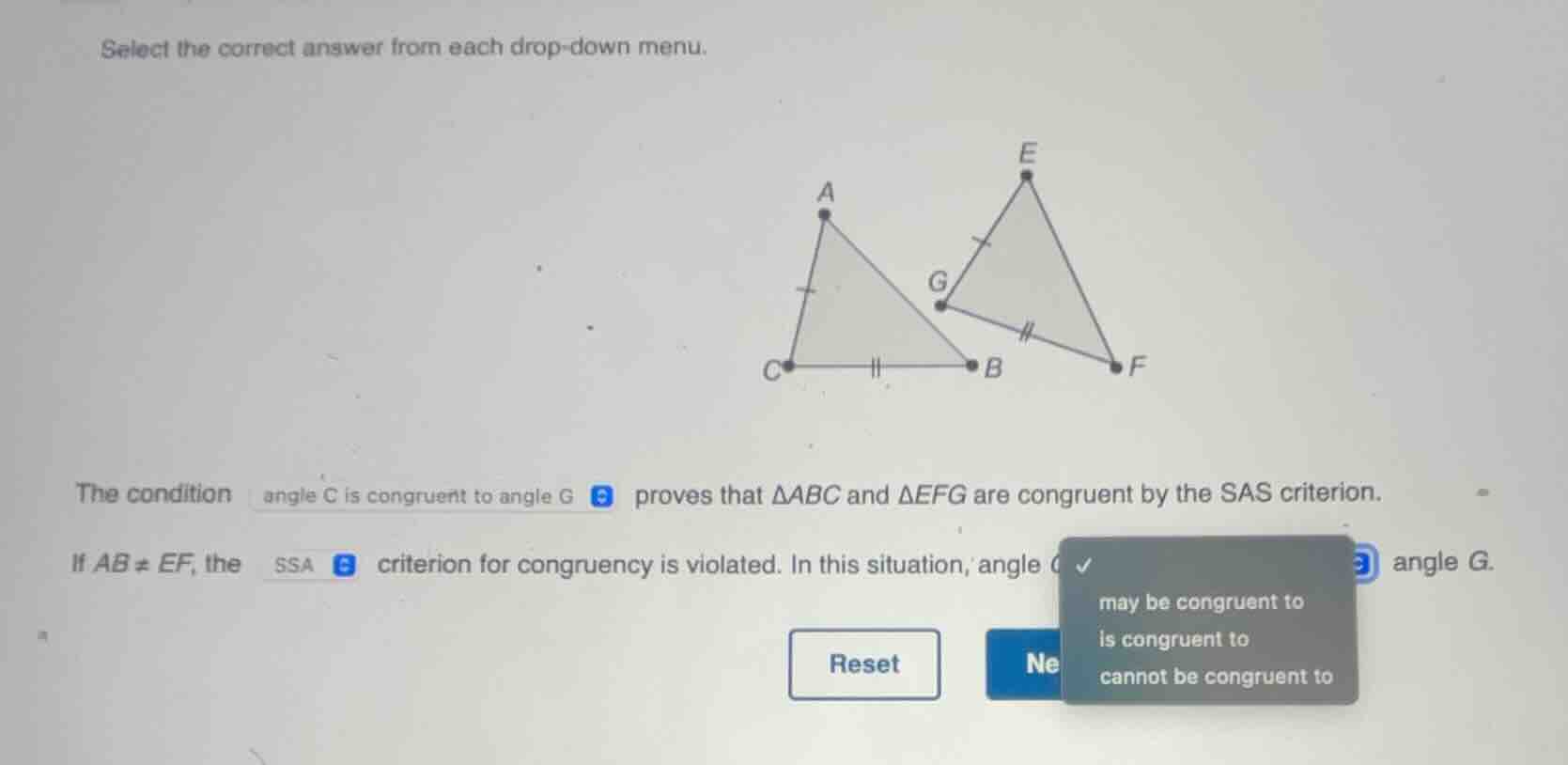
the condition angle c is congruent to angle g proves that $\triangle abc$ and $\triangle efg$ are congruent by the sas criterion.
if $ab\
eq ef$, the ssa criterion for congruency is violated. in this situation, angle g
may be congruent to
is congruent to
cannot be congruent to angle g.
Step1: Analyze SAS congruence
SAS requires two sides and the included angle of one triangle to be congruent to the corresponding two sides and included angle of the other triangle. For $\triangle ABC$ and $\triangle EFG$, marked sides: $AC \cong EG$, $BC \cong FG$. The included angle for $\triangle ABC$ is $\angle C$, for $\triangle EFG$ is $\angle G$. So $\angle C \cong \angle G$ satisfies SAS.
Step2: Analyze violated criterion
If $AB
eq EF$, we have two sides ($AC \cong EG$, $BC \cong FG$) and a non-included angle (the angle opposite $AB/EF$), which is the SSA scenario. SSA does not guarantee congruence, so the angles $\angle C$ and $\angle G$ may be congruent (since SSA can have two possible triangle configurations, one where angles match and one where they don't).

Snap & solve any problem in the app
Get step-by-step solutions on Sovi AI
Photo-based solutions with guided steps
Explore more problems and detailed explanations
- The condition $\boldsymbol{\angle C \cong \angle G}$ proves that $\triangle ABC$ and $\triangle EFG$ are congruent by the SAS criterion.
- If $AB
eq EF$, the $\boldsymbol{SSA}$ criterion for congruency is violated. In this situation, angle $C$ **may be congruent to** angle $G$.