QUESTION IMAGE
Question
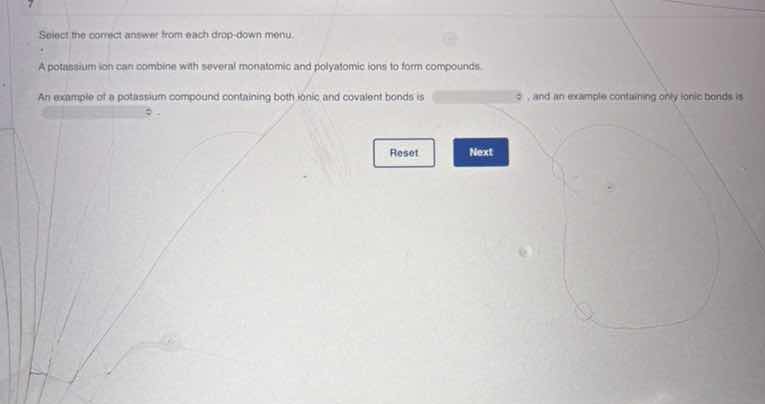
select the correct answer from each drop - down menu.
a potassium ion can combine with several monatomic and polyatomic ions to form compounds.
an example of a potassium compound containing both ionic and covalent bonds is, and an example containing only ionic bonds is.
To solve this, we analyze ionic and covalent bonding in potassium compounds:
For the first drop - down (compound with both ionic and covalent bonds):
A compound like $\ce{KNO3}$ (potassium nitrate) works. The $\ce{K+}$ ion forms an ionic bond with the polyatomic $\ce{NO3-}$ ion. Within the $\ce{NO3-}$ ion, the N and O atoms are held together by covalent bonds (since they share electrons to complete their octets). Other examples could be $\ce{K2SO4}$ (potassium sulfate, with covalent bonds in $\ce{SO4^{2 - }}$) or $\ce{KHCO3}$ (potassium bicarbonate, with covalent bonds in $\ce{HCO3-}$).
For the second drop - down (compound with only ionic bonds):
A compound like $\ce{KCl}$ (potassium chloride) is suitable. Here, the $\ce{K+}$ ion and $\ce{Cl-}$ ion form an ionic bond (as they are a metal cation and non - metal anion, and the bond is formed by the transfer of an electron from K to Cl). Other examples include $\ce{KI}$ (potassium iodide) or $\ce{KBr}$ (potassium bromide).
If we take the most common examples:
- The compound with both ionic and covalent bonds: $\boldsymbol{\ce{KNO3}}$ (or $\ce{K2SO4}$, $\ce{KHCO3}$, etc.)
- The compound with only ionic bonds: $\boldsymbol{\ce{KCl}}$ (or $\ce{KI}$, $\ce{KBr}$, etc.)

Snap & solve any problem in the app
Get step-by-step solutions on Sovi AI
Photo-based solutions with guided steps
Explore more problems and detailed explanations
To solve this, we analyze ionic and covalent bonding in potassium compounds:
For the first drop - down (compound with both ionic and covalent bonds):
A compound like $\ce{KNO3}$ (potassium nitrate) works. The $\ce{K+}$ ion forms an ionic bond with the polyatomic $\ce{NO3-}$ ion. Within the $\ce{NO3-}$ ion, the N and O atoms are held together by covalent bonds (since they share electrons to complete their octets). Other examples could be $\ce{K2SO4}$ (potassium sulfate, with covalent bonds in $\ce{SO4^{2 - }}$) or $\ce{KHCO3}$ (potassium bicarbonate, with covalent bonds in $\ce{HCO3-}$).
For the second drop - down (compound with only ionic bonds):
A compound like $\ce{KCl}$ (potassium chloride) is suitable. Here, the $\ce{K+}$ ion and $\ce{Cl-}$ ion form an ionic bond (as they are a metal cation and non - metal anion, and the bond is formed by the transfer of an electron from K to Cl). Other examples include $\ce{KI}$ (potassium iodide) or $\ce{KBr}$ (potassium bromide).
If we take the most common examples:
- The compound with both ionic and covalent bonds: $\boldsymbol{\ce{KNO3}}$ (or $\ce{K2SO4}$, $\ce{KHCO3}$, etc.)
- The compound with only ionic bonds: $\boldsymbol{\ce{KCl}}$ (or $\ce{KI}$, $\ce{KBr}$, etc.)