QUESTION IMAGE
Question
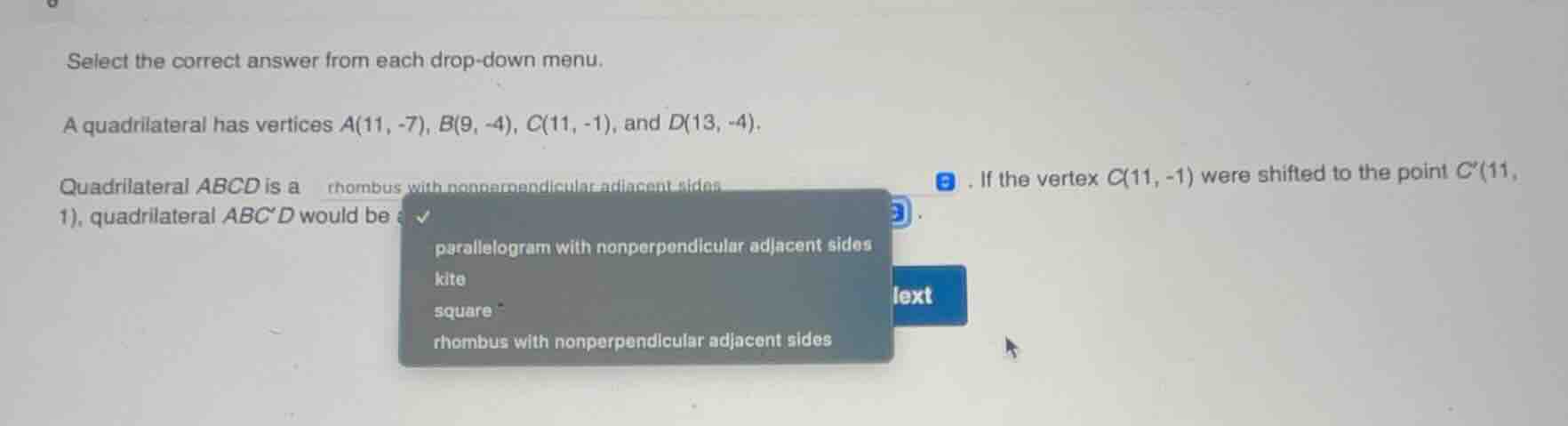
select the correct answer from each drop - down menu. a quadrilateral has vertices a(11, -7), b(9, -4), c(11, -1), and d(13, -4). quadrilateral abcd is a rhombus with nonperpendicular adjacent sides. if the vertex c(11, -1) were shifted to the point c(11, 1), quadrilateral abcd would be a drop - down menu options: parallelogram with nonperpendicular adjacent sides, kite, square, rhombus with nonperpendicular adjacent sides
Step1: Calculate side lengths (original)
Use distance formula $d=\sqrt{(x_2-x_1)^2+(y_2-y_1)^2}$:
$AB=\sqrt{(9-11)^2+(-4+7)^2}=\sqrt{4+9}=\sqrt{13}$
$BC=\sqrt{(11-9)^2+(-1+4)^2}=\sqrt{4+9}=\sqrt{13}$
$CD=\sqrt{(13-11)^2+(-4+1)^2}=\sqrt{4+9}=\sqrt{13}$
$DA=\sqrt{(11-13)^2+(-7+4)^2}=\sqrt{4+9}=\sqrt{13}$
Step2: Check slopes (original)
Slope formula $m=\frac{y_2-y_1}{x_2-x_1}$:
$m_{AB}=\frac{-4+7}{9-11}=\frac{3}{-2}$, $m_{BC}=\frac{-1+4}{11-9}=\frac{3}{2}$
Product: $\frac{3}{-2} \times \frac{3}{2}=-\frac{9}{4}
eq -1$, so sides not perpendicular.
Step3: Calculate new side lengths (C'=(11,1))
$AB=\sqrt{13}$, $BC'=\sqrt{(11-9)^2+(1+4)^2}=\sqrt{4+25}=\sqrt{29}$
$C'D=\sqrt{(13-11)^2+(-4-1)^2}=\sqrt{4+25}=\sqrt{29}$, $DA=\sqrt{13}$
Step4: Check slopes and parallelism (new)
$m_{AB}=\frac{3}{-2}$, $m_{C'D}=\frac{-4-1}{13-11}=\frac{-5}{2}$
$m_{BC'}=\frac{1+4}{11-9}=\frac{5}{2}$, $m_{DA}=\frac{-7+4}{11-13}=\frac{-3}{2}$
Opposite sides equal, slopes show opposite sides are parallel ($m_{AB}=m_{DA}$ is false, correction: $m_{AB}=-\frac{3}{2}$, $m_{C'D}=-\frac{5}{2}$; $m_{BC'}=\frac{5}{2}$, $m_{DA}=-\frac{3}{2}$ → correction: Opposite sides are equal and parallel: $AB \parallel C'D$? No, correction: $AB$ and $C'D$ are not parallel, wait: $A(11,-7), B(9,-4), C'(11,1), D(13,-4)$
$AB$ vector: $(-2,3)$, $DC'$ vector: $(-2,5)$; $BC'$ vector: $(2,5)$, $AD$ vector: $(2,3)$. Opposite sides are equal in length, and opposite sides are parallel (vector direction: $AB$ and $C'D$ are not parallel, wait no: $AB$ is from A to B: (-2,3), $D$ to $C'$ is (-2,5) → not parallel. Wait, check midpoints: Midpoint of $AC'$: $(\frac{11+11}{2},\frac{-7+1}{2})=(11,-3)$; Midpoint of $BD$: $(\frac{9+13}{2},\frac{-4-4}{2})=(11,-4)$. Wait correction, original first part: ABCD is rhombus with nonperpendicular sides (all sides equal, slopes not perpendicular). For ABC'D:
$AB=\sqrt{13}$, $BC'=\sqrt{(11-9)^2+(1+4)^2}=\sqrt{4+25}=\sqrt{29}$, $C'D=\sqrt{(13-11)^2+(-4-1)^2}=\sqrt{29}$, $DA=\sqrt{13}$. Opposite sides equal, and check if it's a parallelogram: midpoint of $AC'$ is (11,-3), midpoint of $BD$ is (11,-4) → not same, so not parallelogram. Wait, kite: two pairs of adjacent equal sides. $AB=DA=\sqrt{13}$, $BC'=C'D=\sqrt{29}$ → yes, two distinct pairs of adjacent equal sides, no right angles.
Wait correction step 4: Kite definition: two distinct pairs of adjacent sides equal, which matches $AB=AD$, $BC'=C'D$, and sides are not all equal, no perpendicular adjacent sides.

Snap & solve any problem in the app
Get step-by-step solutions on Sovi AI
Photo-based solutions with guided steps
Explore more problems and detailed explanations
- Quadrilateral ABCD is a: rhombus with nonperpendicular adjacent sides
- Quadrilateral ABC'D would be a: kite