QUESTION IMAGE
Question
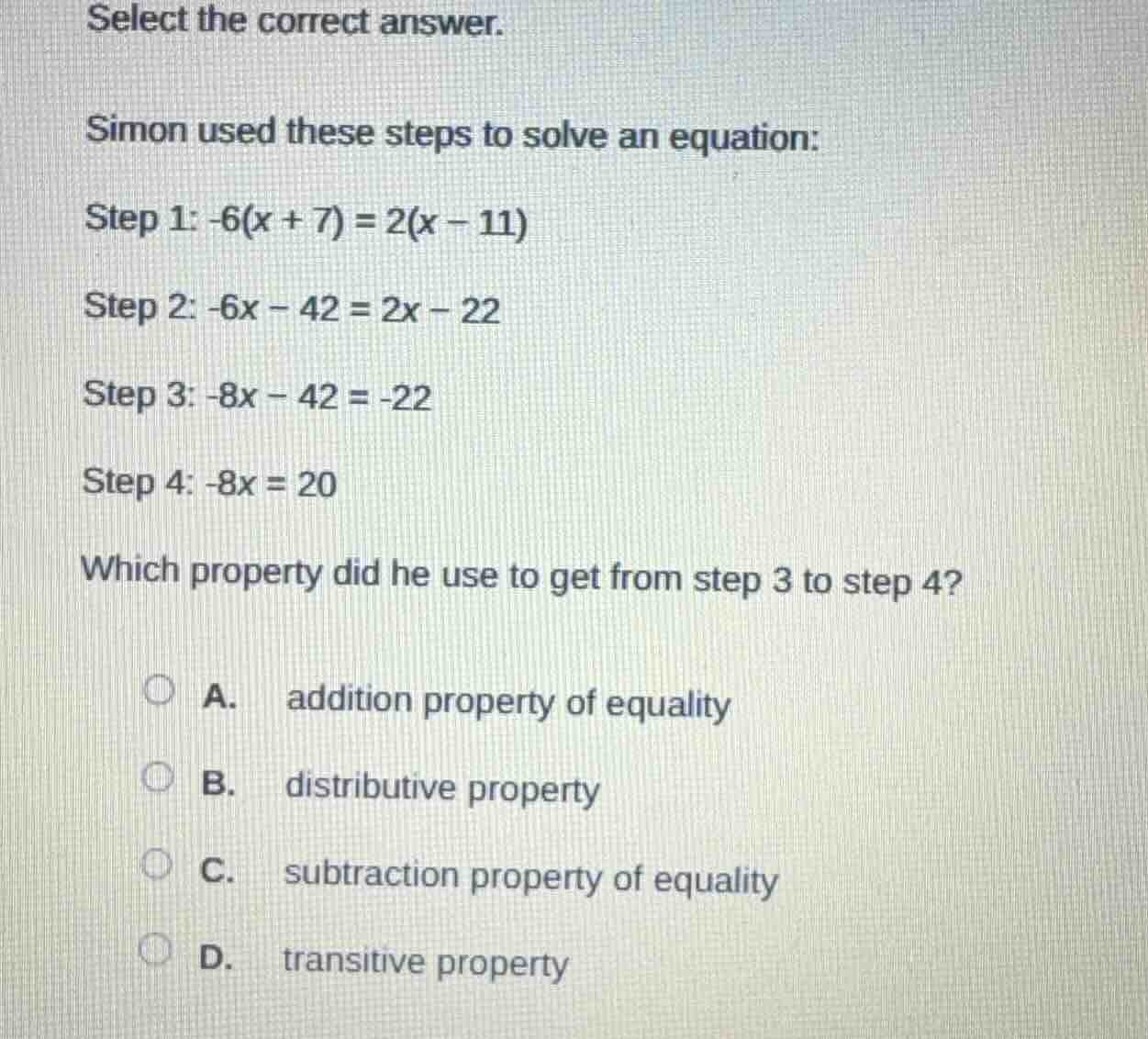
select the correct answer.
simon used these steps to solve an equation:
step 1: -6(x + 7) = 2(x - 11)
step 2: -6x - 42 = 2x - 22
step 3: -8x - 42 = -22
step 4: -8x = 20
which property did he use to get from step 3 to step 4?
a. addition property of equality
b. distributive property
c. subtraction property of equality
d. transitive property
To determine the property used from Step 3 to Step 4, we analyze the equations:
- Step 3: \(-8x - 42 = -22\)
- Step 4: \(-8x = 20\)
To get from Step 3 to Step 4, we add 42 to both sides of the equation. The addition property of equality states that if \(a = b\), then \(a + c = b + c\) for any real number \(c\). Here, we added 42 to both sides: \((-8x - 42)+42=(-22)+42\), which simplifies to \(-8x = 20\).
The distributive property (Option B) is used for expanding expressions (like in Step 1 to Step 2), not for solving equations in this way. The subtraction property of equality (Option C) would involve subtracting a number from both sides, but here we added. The transitive property (Option D) relates to if \(a = b\) and \(b = c\), then \(a = c\), which is not applicable here. So the correct property is the addition property of equality.

Snap & solve any problem in the app
Get step-by-step solutions on Sovi AI
Photo-based solutions with guided steps
Explore more problems and detailed explanations
A. addition property of equality