QUESTION IMAGE
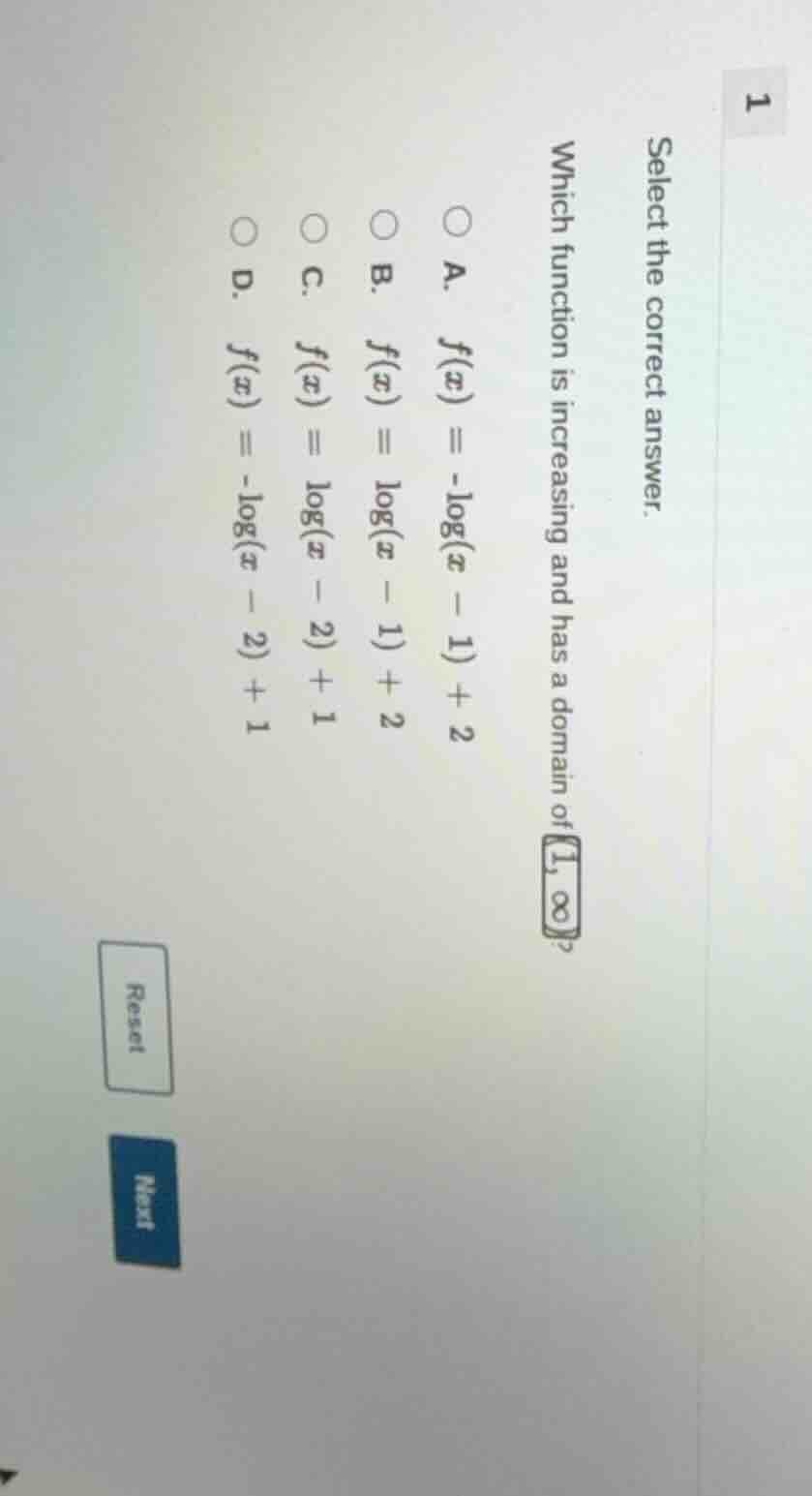
Question
select the correct answer. which function is increasing and has a domain of (1, ∞)? a. $f(x) = -log(x - 1) + 2$ b. $f(x) = log(x - 1) + 2$ c. $f(x) = log(x - 2) + 1$ d. $f(x) = -log(x - 2) + 1$
Step1: Analyze the domain condition
For a logarithmic function \( \log(g(x)) \), the argument \( g(x) > 0 \). We need the domain to be \( (1, \infty) \), so we check the argument of each log function:
- For option A: \( f(x)=-\log(x - 1)+2 \), argument \( x - 1>0\Rightarrow x > 1 \), domain \( (1, \infty) \).
- For option B: \( f(x)=\log(x - 1)+2 \), argument \( x - 1>0\Rightarrow x > 1 \), domain \( (1, \infty) \).
- For option C: \( f(x)=\log(x - 2)+1 \), argument \( x - 2>0\Rightarrow x > 2 \), domain \( (2, \infty) \) (not \( (1, \infty) \), eliminate).
- For option D: \( f(x)=-\log(x - 2)+1 \), argument \( x - 2>0\Rightarrow x > 2 \), domain \( (2, \infty) \) (not \( (1, \infty) \), eliminate).
Step2: Analyze the increasing/decreasing nature
The parent function \( y = \log(x) \) is increasing (since the base of the common log is \( 10>1 \)). The transformation \( y = -\log(x) \) reflects over the x - axis, so it is decreasing.
- Option A: \( f(x)=-\log(x - 1)+2 \), the \( -\log \) part means it is a reflection of the increasing log function, so it is decreasing (eliminate).
- Option B: \( f(x)=\log(x - 1)+2 \), since the parent \( \log(x) \) is increasing and the transformation \( \log(x - 1) \) is a horizontal shift (which doesn't change the increasing/decreasing nature), and then a vertical shift. So this function is increasing.

Snap & solve any problem in the app
Get step-by-step solutions on Sovi AI
Photo-based solutions with guided steps
Explore more problems and detailed explanations
B. \( f(x) = \log(x - 1) + 2 \)