QUESTION IMAGE
Question
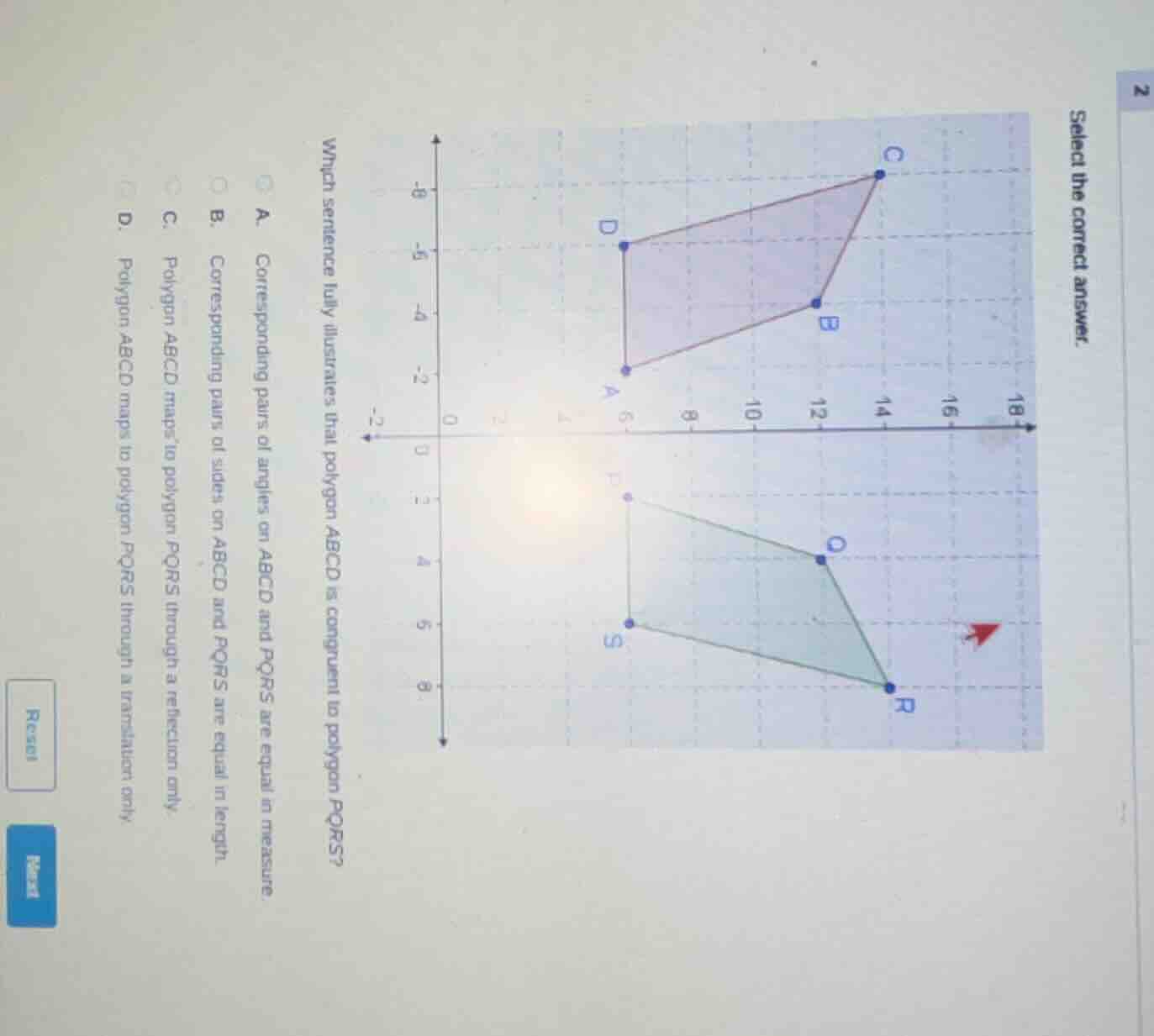
select the correct answer.which sentence fully illustrates that polygon abcd is congruent to polygon pqrs?a. corresponding pairs of angles on abcd and pqrs are equal in measure.b. corresponding pairs of sides on abcd and pqrs are equal in length.c. polygon abcd maps to polygon pqrs through a reflection only.d. polygon abcd maps to polygon pqrs through a translation only.
Congruent polygons have all corresponding angles equal in measure and all corresponding sides equal in length. Additionally, congruent polygons can be mapped to each other via rigid transformations (reflection, translation, rotation, or a combination). The statements in options A and B together define polygon congruence, but option A alone is a necessary condition for congruence, and when combined with the mapping context, the full illustration of congruence includes that corresponding angles are equal, corresponding sides are equal, and a rigid transformation maps one to the other. However, the statement that fully illustrates congruence must include the angle and side correspondence, but among the options, the set of correct conditions for congruence is covered by the fact that corresponding angles are equal (A) and sides are equal (B), but the question asks which sentence fully illustrates it. Wait, no—actually, congruent polygons have corresponding angles equal and corresponding sides equal, and can be mapped via rigid motions. The option that fully captures this is that corresponding angles are equal (A) and sides equal (B), but since these are separate options, the correct full illustration is that both A and B are true, but looking at the mapping: the polygon PQRS is a reflection and translation of ABCD, which is a rigid transformation, so congruent. The sentence that fully illustrates congruence is that corresponding angles are equal (A) AND corresponding sides are equal (B), but since these are separate options, the correct answer that fully illustrates is that both A and B are part of it, but the option that states the mapping via rigid motion (reflection only? No, it's a reflection and translation. Wait no, looking at the coordinates:
ABCD has points:
A(6, -2), B(12, -4), C(14, -8), D(8, -6)
PQRS has points:
P(6, 2), Q(12, 4), R(14, 8), S(8, 6)
This is a reflection over the x-axis (y-coordinate sign flipped) which is a rigid transformation, so the polygons are congruent. Corresponding angles are equal, corresponding sides are equal, and it's mapped via reflection (and no translation, since x-coordinates are same, y flipped). Wait, the x-coordinates are identical, y is opposite, so it's a reflection over the x-axis. So option C says "Polygon ABCD maps to polygon PQRS through a reflection only." which is a rigid transformation, proving congruence, and options A and B are properties of congruent polygons. But the question asks "Which sentence fully illustrates that polygon ABCD is congruent to polygon PQRS?"
A congruence is fully illustrated if either we state the corresponding angles and sides are equal, or that a rigid transformation maps one to the other. Since option C says it maps via reflection (a rigid transformation), that proves congruence, and options A and B are individual properties, not full illustrations. Wait no: the definition of congruent polygons is that all corresponding sides are equal and all corresponding angles are equal, which is covered by A and B together, but since they are separate options, the correct answer is that both A and B are true, but since we have to pick one, the option that states the rigid transformation (C) is a way to show congruence, because rigid transformations preserve size and shape, hence congruence.
Wait, let's recheck:
- Option A: only states angle correspondence, not sides, so not full.
- Option B: only states side correspondence, not angles, so not full.
- Option C: states it maps via reflection (rigid transformation), which preserves all angles and sides, so this fully…

Snap & solve any problem in the app
Get step-by-step solutions on Sovi AI
Photo-based solutions with guided steps
Explore more problems and detailed explanations
C. Polygon ABCD maps to polygon PQRS through a reflection only.