QUESTION IMAGE
Question
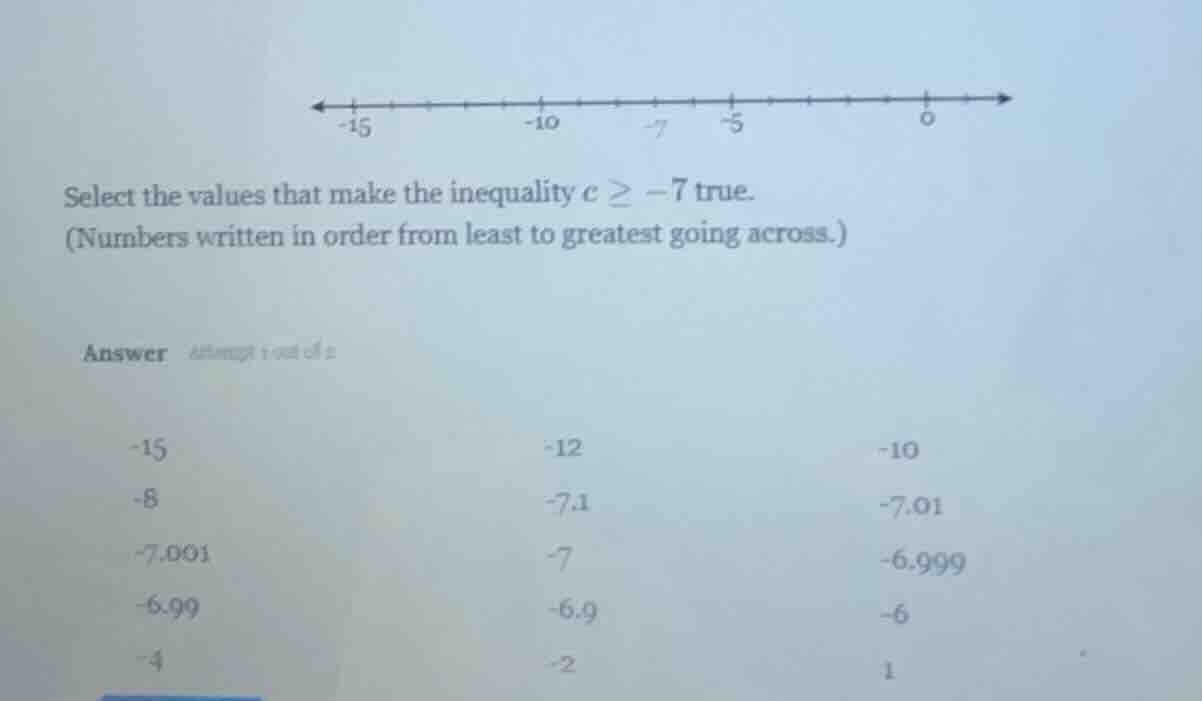
select the values that make the inequality $c \geq -7$ true. (numbers written in order from least to greatest going across.) answer attempt 1 out of 2 -15 -12 -10 -8 -7.1 -7.01 -7.001 -7 -6.999 -6.99 -6.9 -6 -4 -2 1
Step1: Understand the inequality
The inequality is \( c \geq -7 \), which means \( c \) can be equal to \(-7\) or any number greater than \(-7\). On the number line, numbers to the right of \(-7\) (including \(-7\) itself) satisfy this inequality.
Step2: Compare each number with \(-7\)
- For \(-15\): \(-15 < -7\) (does not satisfy)
- For \(-12\): \(-12 < -7\) (does not satisfy)
- For \(-10\): \(-10 < -7\) (does not satisfy)
- For \(-8\): \(-8 < -7\) (does not satisfy)
- For \(-7.1\): \(-7.1 < -7\) (does not satisfy)
- For \(-7.01\): \(-7.01 < -7\) (does not satisfy)
- For \(-7.001\): \(-7.001 < -7\) (does not satisfy? Wait, no: \(-7.001\) is \(-7 - 0.001\), so it's less than \(-7\)? Wait, no, wait: \(-7.001\) is \(-7.001\), and \(-7\) is \(-7.000\). So \(-7.001 < -7.000\), so \(-7.001 < -7\) (does not satisfy). Wait, but wait, let's check again:
Wait, \(-7.001\) is more negative than \(-7\), so it's less. Then \(-7\): equal to \(-7\) (satisfies). \(-6.999\): \(-6.999 > -7\) (since it's closer to 0 than \(-7\)), so satisfies. \(-6.99\): \(-6.99 > -7\) (satisfies). \(-6.9\): \(-6.9 > -7\) (satisfies). \(-6\): \(-6 > -7\) (satisfies). \(-4\): \(-4 > -7\) (satisfies). \(-2\): \(-2 > -7\) (satisfies). \(1\): \(1 > -7\) (satisfies). Wait, I made a mistake earlier with \(-7.001\): let's list all numbers and compare:
Wait the numbers are:
-15, -12, -10, -8, -7.1, -7.01, -7.001, -7, -6.999, -6.99, -6.9, -6, -4, -2, 1.
Now, let's sort them from least to greatest to see:
-15, -12, -10, -8, -7.1, -7.01, -7.001, -7, -6.999, -6.99, -6.9, -6, -4, -2, 1.
Now, \( c \geq -7 \) means \( c \) is greater than or equal to \(-7\). So numbers from \(-7\) onwards (to the right on the number line). So:
- \(-7\): equals \(-7\) (satisfies)
- \(-6.999\): greater than \(-7\) (since \(-6.999 = -7 + 0.001\)) (satisfies)
- \(-6.99\): greater than \(-7\) (satisfies)
- \(-6.9\): greater than \(-7\) (satisfies)
- \(-6\): greater than \(-7\) (satisfies)
- \(-4\): greater than \(-7\) (satisfies)
- \(-2\): greater than \(-7\) (satisfies)
- \(1\): greater than \(-7\) (satisfies)
Wait, but what about \(-7.001\): is \(-7.001 \geq -7\)? Let's compute the difference: \(-7.001 - (-7) = -7.001 + 7 = -0.001\), which is negative. So \(-7.001 < -7\), so it does not satisfy. Similarly, \(-7.01\): \(-7.01 - (-7) = -0.01 < 0\), so less. \(-7.1\): \(-7.1 - (-7) = -0.1 < 0\), less. \(-8\): \(-8 - (-7) = -1 < 0\), less. \(-10\): \(-10 - (-7) = -3 < 0\), less. \(-12\): \(-12 - (-7) = -5 < 0\), less. \(-15\): \(-15 - (-7) = -8 < 0\), less.
So the numbers that satisfy \( c \geq -7 \) are:
-7, -6.999, -6.99, -6.9, -6, -4, -2, 1.
Wait, let's check each:
- \(-7\): \( -7 \geq -7 \) → true.
- \(-6.999\): \( -6.999 \geq -7 \) → true (since -6.999 is greater than -7).
- \(-6.99\): \( -6.99 \geq -7 \) → true.
- \(-6.9\): \( -6.9 \geq -7 \) → true.
- \(-6\): \( -6 \geq -7 \) → true.
- \(-4\): \( -4 \geq -7 \) → true.
- \(-2\): \( -2 \geq -7 \) → true.
- \(1\): \( 1 \geq -7 \) → true.
Wait, but also, is there any other? Let's check the list again. The numbers given are:
First row: -15, -12, -10
Second row: -8, -7.1, -7.01
Third row: -7.001, -7, -6.999
Fourth row: -6.99, -6.9, -6
Fifth row: -4, -2, 1
So from third row, -7 (satisfies), -6.999 (satisfies). Fourth row: -6.99 (satisfies), -6.9 (satisfies), -6 (satisfies). Fifth row: -4 (satisfies), -2 (satisfies), 1 (satisfies).
Wait, but what about -7.001? As we saw, it's less than -7, so no. -7.01: less. -7.1: less. -8: less. -10: less. -12: less. -15: less.
So the values are: -7, -6.999, -6.99, -6.9, -6, -4, -2, 1.

Snap & solve any problem in the app
Get step-by-step solutions on Sovi AI
Photo-based solutions with guided steps
Explore more problems and detailed explanations
The values that make \( c \geq -7 \) true are \(-7\), \(-6.999\), \(-6.99\), \(-6.9\), \(-6\), \(-4\), \(-2\), and \(1\).