QUESTION IMAGE
Question
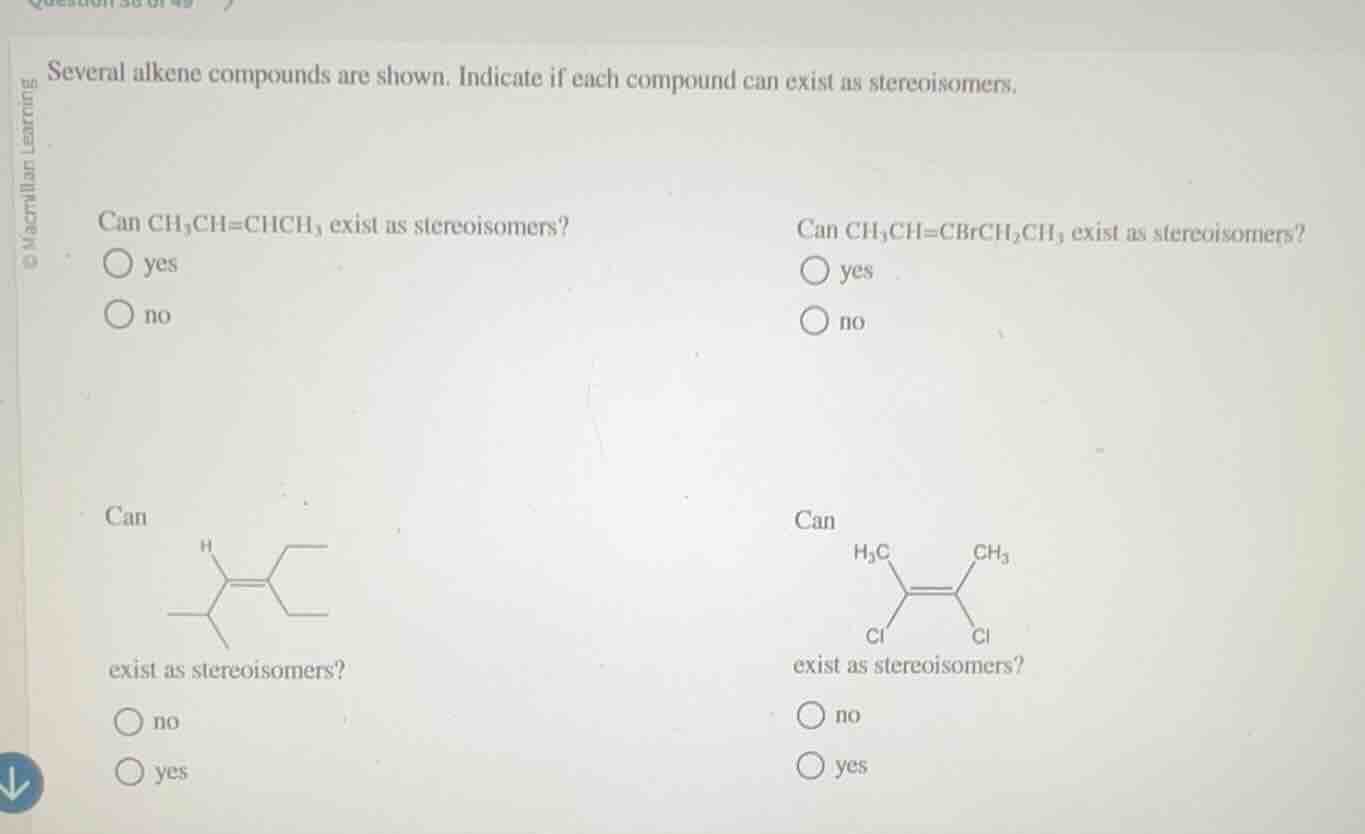
several alkene compounds are shown. indicate if each compound can exist as stereoisomers.
can $\ce{ch3ch=chch3}$ exist as stereoisomers?
$\bigcirc$ yes
$\bigcirc$ no
can $\ce{ch3ch=cbrch2ch3}$ exist as stereoisomers?
$\bigcirc$ yes
$\bigcirc$ no
can
\
$$\begin{matrix}
\\ce{h} & & & \\\\
& \\ce{c}=\\ce{c} & & \\\\
& & & \\\\
\\end{matrix}$$
(with appropriate substituents as shown in the image) exist as stereoisomers?
$\bigcirc$ no
$\bigcirc$ yes
can
\
$$\begin{matrix}
\\ce{h3c} & & \\ce{ch3} \\\\
& \\ce{c}=\\ce{c} & \\\\
\\ce{cl} & & \\ce{cl}
\\end{matrix}$$
exist as stereoisomers?
$\bigcirc$ no
$\bigcirc$ yes
Brief Explanations
For an alkene to exist as stereoisomers (cis-trans isomers), each carbon in the double bond must be bonded to two distinct groups.
- For $\text{CH}_3\text{CH=CHCH}_3$: Each double-bonded C has $\text{CH}_3$ and H. Both carbons have two unique groups, so stereoisomers exist.
- For $\text{CH}_3\text{CH=CBrCH}_2\text{CH}_3$: The first double-bonded C has $\text{CH}_3$ and H; the second has $\text{Br}$ and $\text{CH}_2\text{CH}_3$. All groups are distinct per C, so stereoisomers exist.
- For the drawn alkene: One double-bonded C has two ethyl groups, so it does not have two distinct groups. No stereoisomers exist.
- For $\text{(CH}_3\text{)CCl=CCl(CH}_3\text{)}$: Each double-bonded C has $\text{CH}_3$ and $\text{Cl}$. Both carbons have two unique groups, so stereoisomers exist.

Snap & solve any problem in the app
Get step-by-step solutions on Sovi AI
Photo-based solutions with guided steps
Explore more problems and detailed explanations
- Can $\text{CH}_3\text{CH=CHCH}_3$ exist as stereoisomers? yes
- Can $\text{CH}_3\text{CH=CBrCH}_2\text{CH}_3$ exist as stereoisomers? yes
- Can the drawn branched alkene exist as stereoisomers? no
- Can $\text{(CH}_3\text{)CCl=CCl(CH}_3\text{)}$ exist as stereoisomers? yes