QUESTION IMAGE
Question
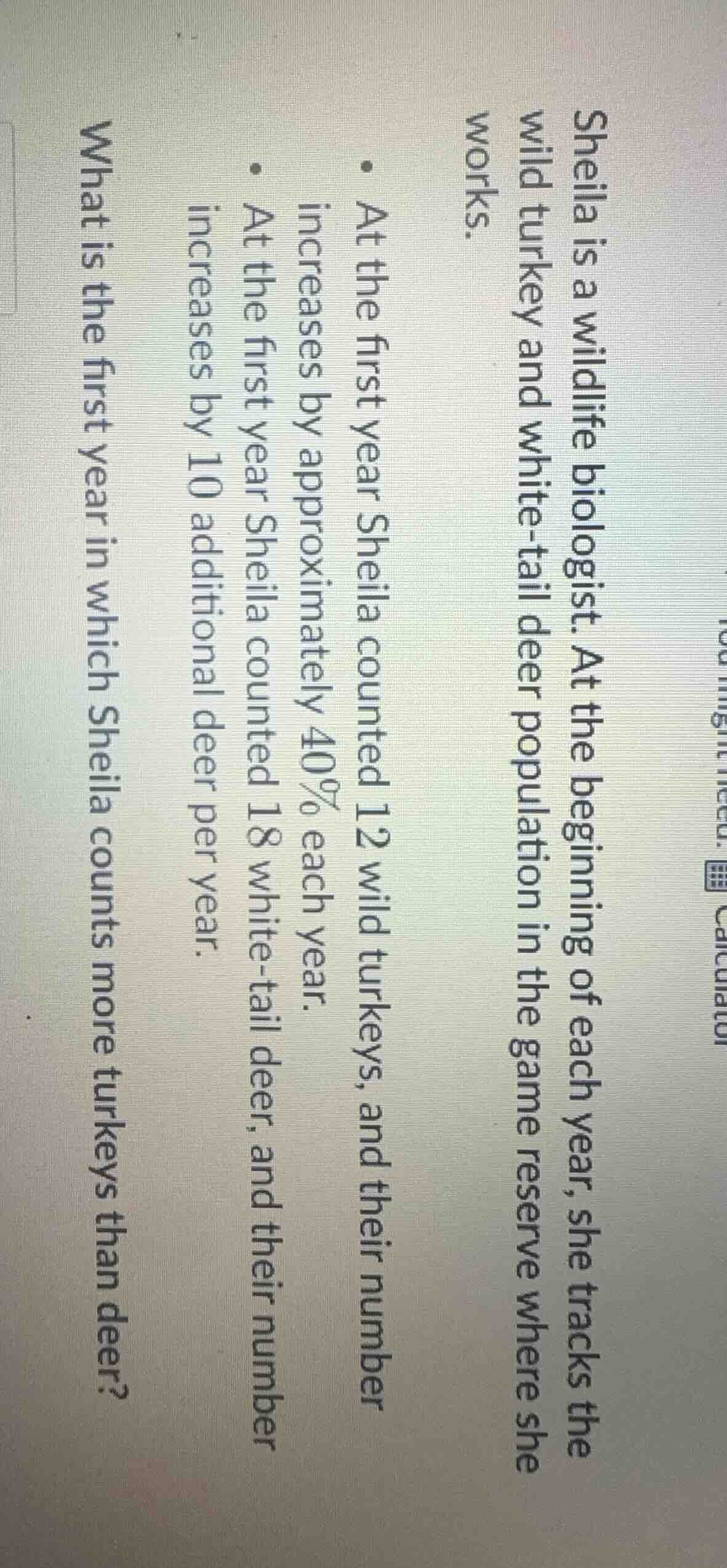
sheila is a wildlife biologist. at the beginning of each year, she tracks the wild turkey and white - tail deer population in the game reserve where she works. - at the first year sheila counted 12 wild turkeys, and their number increases by approximately 40% each year. - at the first year sheila counted 18 white - tail deer, and their number increases by 10 additional deer per year. what is the first year in which sheila counts more turkeys than deer?
Step1: Define the population functions
Let \( t \) be the number of years after the first year. The number of wild turkeys \( T(t) \) follows an exponential growth model: \( T(t)=12\times(1 + 0.4)^{t}=12\times1.4^{t}\) (since it increases by 40% each year). The number of white - tail deer \( D(t) \) follows a linear growth model: \( D(t)=18 + 10t\) (since it starts at 18 and increases by 10 each year).
Step2: Set up the inequality
We want to find the smallest \( t\geq0 \) (where \( t = 0 \) is the first year) such that \( T(t)>D(t) \), i.e., \( 12\times1.4^{t}>18 + 10t \).
Step3: Test \( t = 0 \)
For \( t = 0 \):
\( T(0)=12\times1.4^{0}=12\times1 = 12 \)
\( D(0)=18+10\times0 = 18 \)
Since \( 12<18 \), the inequality is not satisfied at \( t = 0 \).
Step4: Test \( t = 1 \)
For \( t = 1 \):
\( T(1)=12\times1.4^{1}=12\times1.4 = 16.8 \)
\( D(1)=18 + 10\times1=28 \)
Since \( 16.8<28 \), the inequality is not satisfied at \( t = 1 \).
Step5: Test \( t = 2 \)
For \( t = 2 \):
\( T(2)=12\times1.4^{2}=12\times1.96 = 23.52 \)
\( D(2)=18+10\times2 = 38 \)
Since \( 23.52<38 \), the inequality is not satisfied at \( t = 2 \).
Step6: Test \( t = 3 \)
For \( t = 3 \):
\( T(3)=12\times1.4^{3}=12\times2.744 = 32.928 \)
\( D(3)=18+10\times3 = 48 \)
Since \( 32.928<48 \), the inequality is not satisfied at \( t = 3 \).
Step7: Test \( t = 4 \)
For \( t = 4 \):
\( T(4)=12\times1.4^{4}=12\times3.8416 = 46.0992 \)
\( D(4)=18+10\times4 = 58 \)
Since \( 46.0992<58 \), the inequality is not satisfied at \( t = 4 \).
Step8: Test \( t = 5 \)
For \( t = 5 \):
\( T(5)=12\times1.4^{5}=12\times5.37824 = 64.53888 \)
\( D(5)=18+10\times5 = 68 \)
Since \( 64.53888<68 \), the inequality is not satisfied at \( t = 5 \).
Step9: Test \( t = 6 \)
For \( t = 6 \):
\( T(6)=12\times1.4^{6}=12\times7.529536 = 90.354432 \)
\( D(6)=18+10\times6 = 78 \)
Since \( 90.354432>78 \), the inequality is satisfied at \( t = 6 \). But we need to check if we made a mistake in the starting point. Wait, \( t = 0 \) is the first year. Let's re - express the years. When \( t = 0 \), it's year 1, \( t = 1 \) is year 2, \(\cdots\), \( t = 5 \) is year 6, \( t = 6 \) is year 7? Wait, no. Wait, our initial definition: when \( t = 0 \), it's the first year of counting. Let's re - evaluate the equations with the correct interpretation.
Wait, maybe a better way: Let's let \( n \) be the year number, starting at \( n = 1 \) (first year), \( n = 2 \) (second year), etc.
For year \( n \):
Number of turkeys: \( T(n)=12\times1.4^{n - 1}\) (because at \( n = 1 \), \( T(1)=12\times1.4^{0}=12 \))
Number of deer: \( D(n)=18+10\times(n - 1)\) (because at \( n = 1 \), \( D(1)=18+10\times0 = 18 \))
We want \( T(n)>D(n) \), so \( 12\times1.4^{n - 1}>18 + 10(n - 1)=8 + 10n \)
Test \( n = 1 \):
\( T(1)=12\times1.4^{0}=12 \), \( D(1)=18 \), \( 12<18 \)
Test \( n = 2 \):
\( T(2)=12\times1.4^{1}=16.8 \), \( D(2)=18 + 10\times1=28 \), \( 16.8<28 \)
Test \( n = 3 \):
\( T(3)=12\times1.4^{2}=23.52 \), \( D(3)=18+10\times2 = 38 \), \( 23.52<38 \)
Test \( n = 4 \):
\( T(4)=12\times1.4^{3}=32.928 \), \( D(4)=18+10\times3 = 48 \), \( 32.928<48 \)
Test \( n = 5 \):
\( T(5)=12\times1.4^{4}=46.0992 \), \( D(5)=18+10\times4 = 58 \), \( 46.0992<58 \)
Test \( n = 6 \):
\( T(6)=12\times1.4^{5}=64.53888 \), \( D(6)=18+10\times5 = 68 \), \( 64.53888<68 \)
Test \( n = 7 \):
\( T(7)=12\times1.4^{6}=90.354432 \), \( D(7)=18+10\times6 = 78 \), \( 90.354432>78 \)
Wait, there was a mistake in the previous variable definition. Let's do it correctly:
Let \( n \) be the year, \( n = 1,2,3,\cdots…

Snap & solve any problem in the app
Get step-by-step solutions on Sovi AI
Photo-based solutions with guided steps
Explore more problems and detailed explanations
The first year in which Sheila counts more turkeys than deer is the 7th year.