QUESTION IMAGE
Question
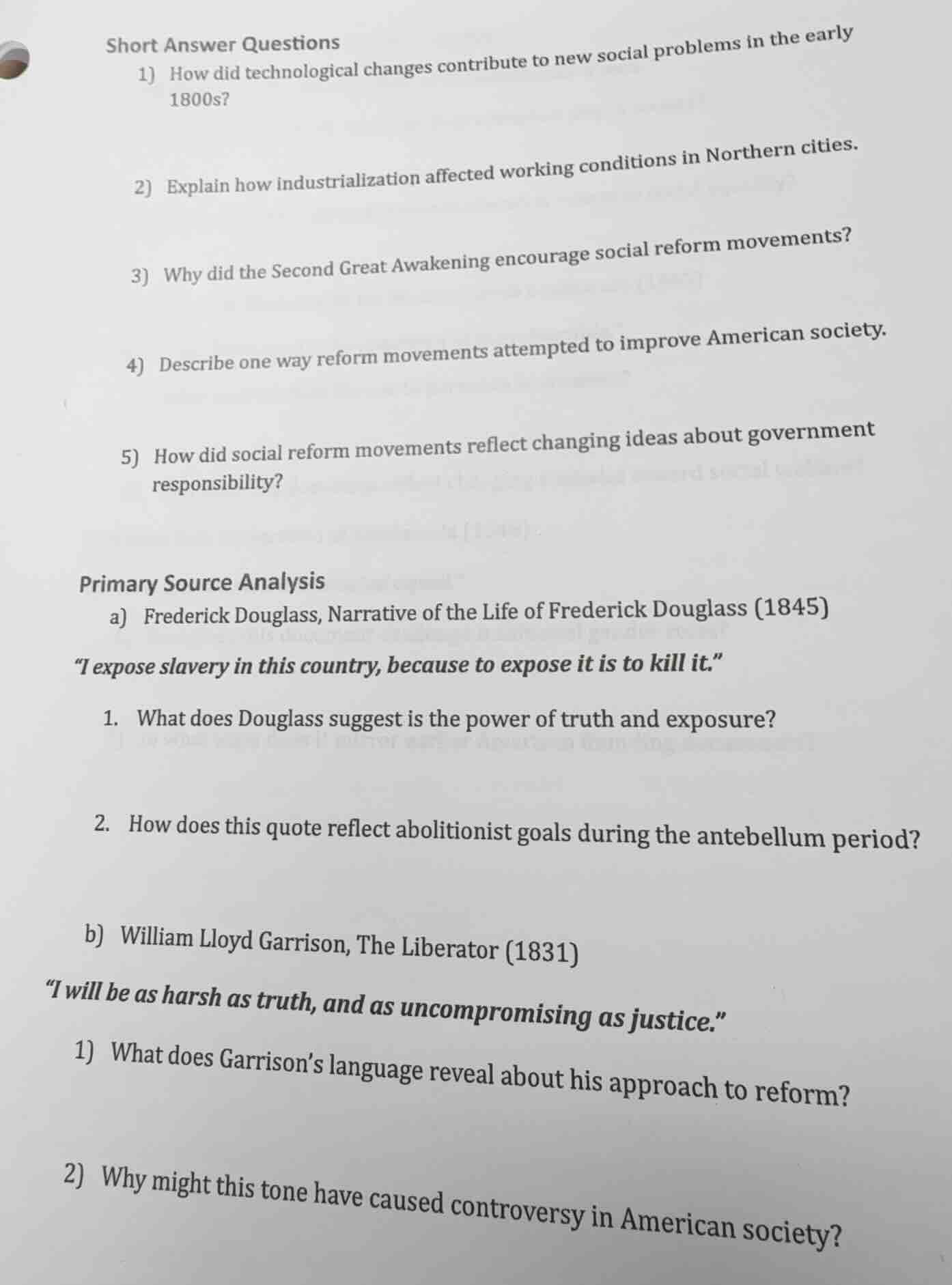
short answer questions
- how did technological changes contribute to new social problems in the early 1800s?
- explain how industrialization affected working conditions in northern cities.
- why did the second great awakening encourage social reform movements?
- describe one way reform movements attempted to improve american society.
- how did social reform movements reflect changing ideas about government responsibility?
primary source analysis
a) frederick douglass, narrative of the life of frederick douglass (1845)
\i expose slavery in this country, because to expose it is to kill it.\
- what does douglass suggest is the power of truth and exposure?
- how does this quote reflect abolitionist goals during the antebellum period?
b) william lloyd garrison, the liberator (1831)
\i will be as harsh as truth, and as uncompromising as justice.\
- what does garrisons language reveal about his approach to reform?
- why might this tone have caused controversy in american society?
Brief Explanations
Short Answer Questions
- New industrial tech displaced skilled workers, created overcrowded, unsanitary urban slums, and led to exploitative child labor as factories sought cheap labor.
- Industrialization led to 12-16 hour workdays, unsafe factory floors with no safety regulations, low wages, and no job security for Northern city workers.
- The Second Great Awakening emphasized individual moral responsibility and spiritual renewal, encouraging followers to fix societal ills like slavery and alcohol abuse.
- The temperance movement pushed for laws banning alcohol to reduce domestic violence, poverty, and workplace issues linked to drinking.
- Reform movements shifted ideas to argue government should act to address societal problems, such as regulating working conditions or banning slavery, rather than only protecting property.
Primary Source Analysis
a) Frederick Douglass
- Douglass argues exposing the truth of slavery to the public will destroy it, as widespread awareness of its cruelty will build opposition.
- It reflects the abolitionist goal of ending chattel slavery by educating the public about its horrors, rather than just advocating for gradual emancipation.
b) William Lloyd Garrison
- Garrison's language reveals an uncompromising, confrontational approach to reform; he refused to soften his message to accommodate opponents.
- His harsh tone alienated moderate Americans, including some who opposed slavery but favored gradual change, and angered pro-slavery groups who saw his message as an attack on their way of life.

Snap & solve any problem in the app
Get step-by-step solutions on Sovi AI
Photo-based solutions with guided steps
Explore more problems and detailed explanations
Short Answer Questions
- Technological changes (e.g., factory machinery) displaced skilled artisans, created overcrowded, unsanitary urban slums from rural migration, and enabled exploitative child labor as factories sought cheap, unskilled workers.
- Industrialization led to long (12-16 hour) workdays, unsafe factory environments with no safety standards, very low wages, and no job security for Northern urban workers.
- The Second Great Awakening emphasized individual moral accountability and spiritual transformation, inspiring followers to actively address societal injustices like slavery, alcoholism, and poor prison conditions.
- The temperance movement advocated for and secured local/state laws restricting or banning alcohol, aiming to reduce domestic violence, poverty, and workplace inefficiency tied to drinking.
- Reform movements shifted public thought to demand government take active responsibility for addressing social ills, such as regulating working conditions, funding public education, or abolishing slavery, rather than only protecting individual property rights.
Primary Source Analysis
a) Frederick Douglass
- Douglass suggests that exposing the true, brutal realities of slavery to the broader public has the power to destroy the institution, as widespread awareness will galvanize opposition.
- It reflects the core antebellum abolitionist goal of immediate, full emancipation of enslaved people, by using truthful, personal accounts to counter pro-slavery propaganda and build public support for ending chattel slavery.
b) William Lloyd Garrison
- Garrison's language reveals an uncompromising, confrontational approach to reform; he refused to moderate his message to appease opponents of abolition.
- His harsh, unyielding tone caused controversy because it alienated moderate Americans (including some anti-slavery advocates who favored gradual emancipation) and enraged pro-slavery groups in the South, who viewed his uncompromising stance as an existential threat to their economic and social system.