QUESTION IMAGE
Question
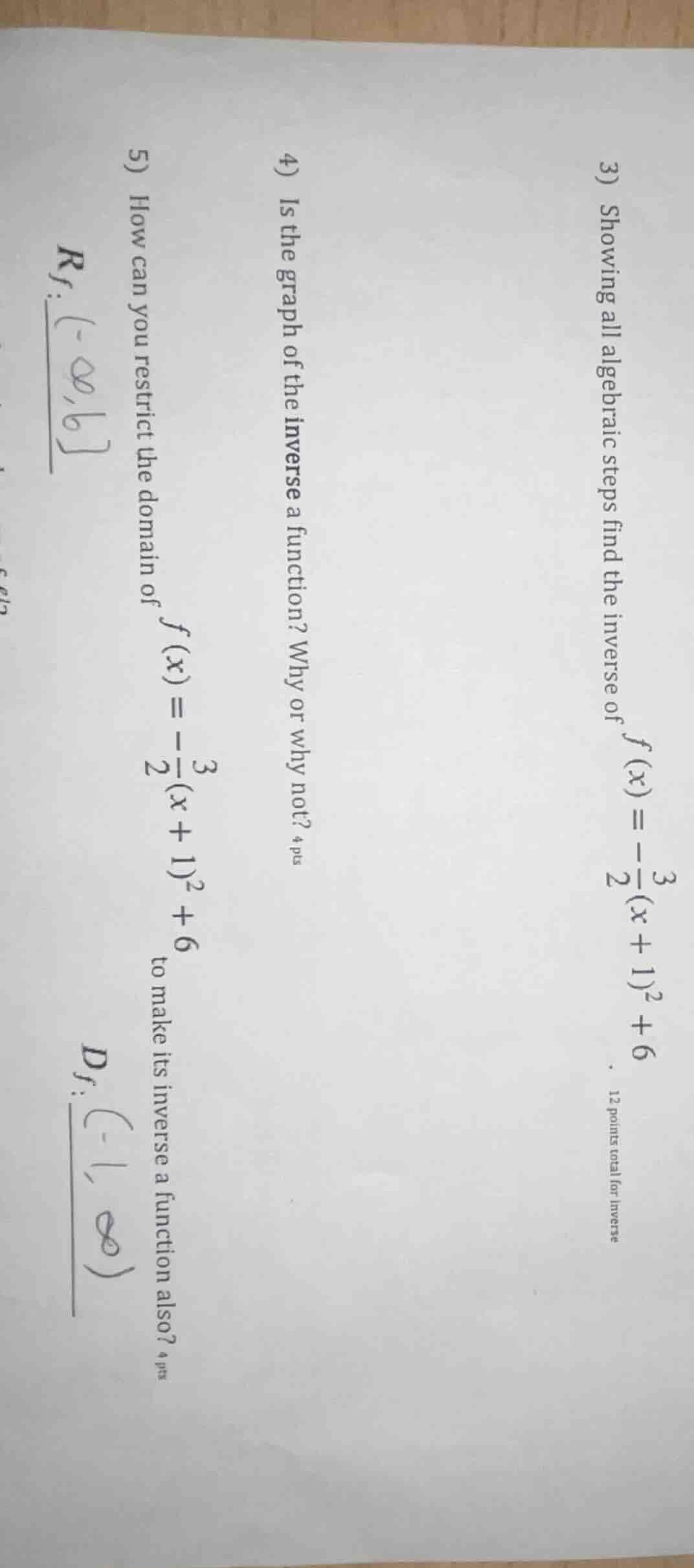
- showing all algebraic steps find the inverse of $f(x) = -\frac{3}{2}(x + 1)^2 + 6$ . 12 points total for inverse
- is the graph of the inverse a function? why or why not? 4 pts
- how can you restrict the domain of $f(x) = -\frac{3}{2}(x + 1)^2 + 6$ to make its inverse a function also? 4 pts
$r_f: (-infty, 6$
$d_f: (-1, infty)$
Question 3: Find the inverse of \( f(x) = -\frac{3}{2}(x + 1)^2 + 6 \)
Step 1: Replace \( f(x) \) with \( y \)
We start by writing the function as \( y = -\frac{3}{2}(x + 1)^2 + 6 \).
Step 2: Swap \( x \) and \( y \)
To find the inverse, we interchange \( x \) and \( y \): \( x = -\frac{3}{2}(y + 1)^2 + 6 \).
Step 3: Solve for \( y \)
First, subtract 6 from both sides: \( x - 6 = -\frac{3}{2}(y + 1)^2 \).
Then, multiply both sides by \( -\frac{2}{3} \): \( -\frac{2}{3}(x - 6) = (y + 1)^2 \).
Simplify the left side: \( \frac{2(6 - x)}{3} = (y + 1)^2 \).
Take the square root of both sides: \( y + 1 = \pm\sqrt{\frac{2(6 - x)}{3}} \).
Finally, subtract 1 from both sides: \( y = -1 \pm\sqrt{\frac{2(6 - x)}{3}} \).
So the inverse relation is \( f^{-1}(x) = -1 \pm\sqrt{\frac{2(6 - x)}{3}} \). Note that this is not a function (it's a relation) because of the \( \pm \) sign, which means for some \( x \)-values, there are two \( y \)-values.
To determine if the inverse is a function, we use the vertical line test. The original function \( f(x) = -\frac{3}{2}(x + 1)^2 + 6 \) is a parabola (quadratic function) opening downward with vertex at \( (-1, 6) \). A parabola fails the horizontal line test (since it's a quadratic, it's not one - to - one over its entire domain), so its inverse relation will fail the vertical line test. From the inverse we found in question 3, \( f^{-1}(x)=-1\pm\sqrt{\frac{2(6 - x)}{3}} \), for a single input \( x \) (in the domain of the inverse), there can be two outputs (because of the \( \pm \) sign). So the graph of the inverse (the inverse relation) is not a function.
A function has an inverse that is also a function if and only if the original function is one - to - one (passes the horizontal line test). The function \( f(x)=-\frac{3}{2}(x + 1)^2 + 6 \) is a parabola with vertex at \( (-1, 6) \) and opening downward. To make it one - to - one, we can restrict the domain to either the left - hand side of the vertex or the right - hand side of the vertex. That is, we can restrict the domain to \( x\geq - 1 \) (the right half of the parabola) or \( x\leq - 1 \) (the left half of the parabola). When we restrict the domain to \( x\geq - 1 \), the function is decreasing (since the parabola opens downward, to the right of the vertex \( x=-1 \), as \( x \) increases, \( f(x) \) decreases), and it will pass the horizontal line test. Similarly, when we restrict the domain to \( x\leq - 1 \), the function is increasing (to the left of the vertex \( x = - 1 \), as \( x \) increases, \( f(x) \) increases) and will also pass the horizontal line test.

Snap & solve any problem in the app
Get step-by-step solutions on Sovi AI
Photo-based solutions with guided steps
Explore more problems and detailed explanations
The inverse relation is \( f^{-1}(x) = -1 \pm\sqrt{\frac{2(6 - x)}{3}} \) (it is a relation, not a function in its full domain).