QUESTION IMAGE
Question
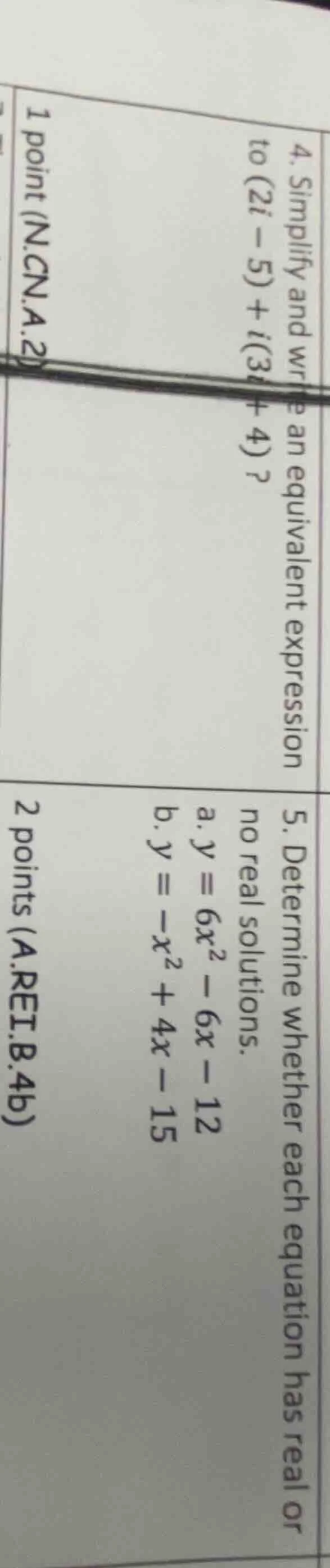
- simplify and write an equivalent expression to (2i - 5) + i(3i + 4)? 1 point (n.cn.a.2) 5. determine whether each equation has real or no real solutions. a. y = 6x² - 6x - 12 b. y = -x² + 4x - 15 2 points (a.rei.b.4b)
Problem 4: Simplify \((2i - 5) + i(3i + 4)\)
Step 1: Distribute \(i\) in \(i(3i + 4)\)
Using the distributive property \(a(b + c)=ab + ac\), we have \(i(3i + 4)=3i^2+4i\). Recall that \(i^2=- 1\), so \(3i^2 = 3\times(-1)=-3\). Thus, \(i(3i + 4)=-3 + 4i\).
Step 2: Combine like terms with \((2i-5)\)
Now we add \((2i - 5)\) and \(-3 + 4i\): \((2i-5)+(-3 + 4i)=( - 5-3)+(2i + 4i)\).
Step 3: Simplify the real and imaginary parts
For the real parts: \(-5-3=-8\). For the imaginary parts: \(2i+4i = 6i\). So the simplified form is \(-8 + 6i\).
Step 1: Calculate the discriminant
\(\Delta=(-6)^2-4\times6\times(-12)=36 + 288=324\).
Step 2: Analyze the discriminant
Since \(\Delta = 324>0\), the quadratic equation \(6x^2-6x - 12 = 0\) has two distinct real solutions.
Step 1: Calculate the discriminant
Using the discriminant formula \(\Delta=b^2-4ac\), we have \(\Delta=(-4)^2-4\times1\times15=16 - 60=-44\).
Step 2: Analyze the discriminant
Since \(\Delta=-44<0\), the quadratic equation \(-x^2 + 4x-15 = 0\) has no real solutions.

Snap & solve any problem in the app
Get step-by-step solutions on Sovi AI
Photo-based solutions with guided steps
Explore more problems and detailed explanations
\(-8 + 6i\)
Problem 5: Determine if each quadratic equation has real or no real solutions
Part (a): \(y = 6x^2-6x - 12\)
For a quadratic equation \(ax^2+bx + c = 0\) (here \(a = 6\), \(b=-6\), \(c = - 12\)), we use the discriminant formula \(\Delta=b^2-4ac\).