QUESTION IMAGE
Question
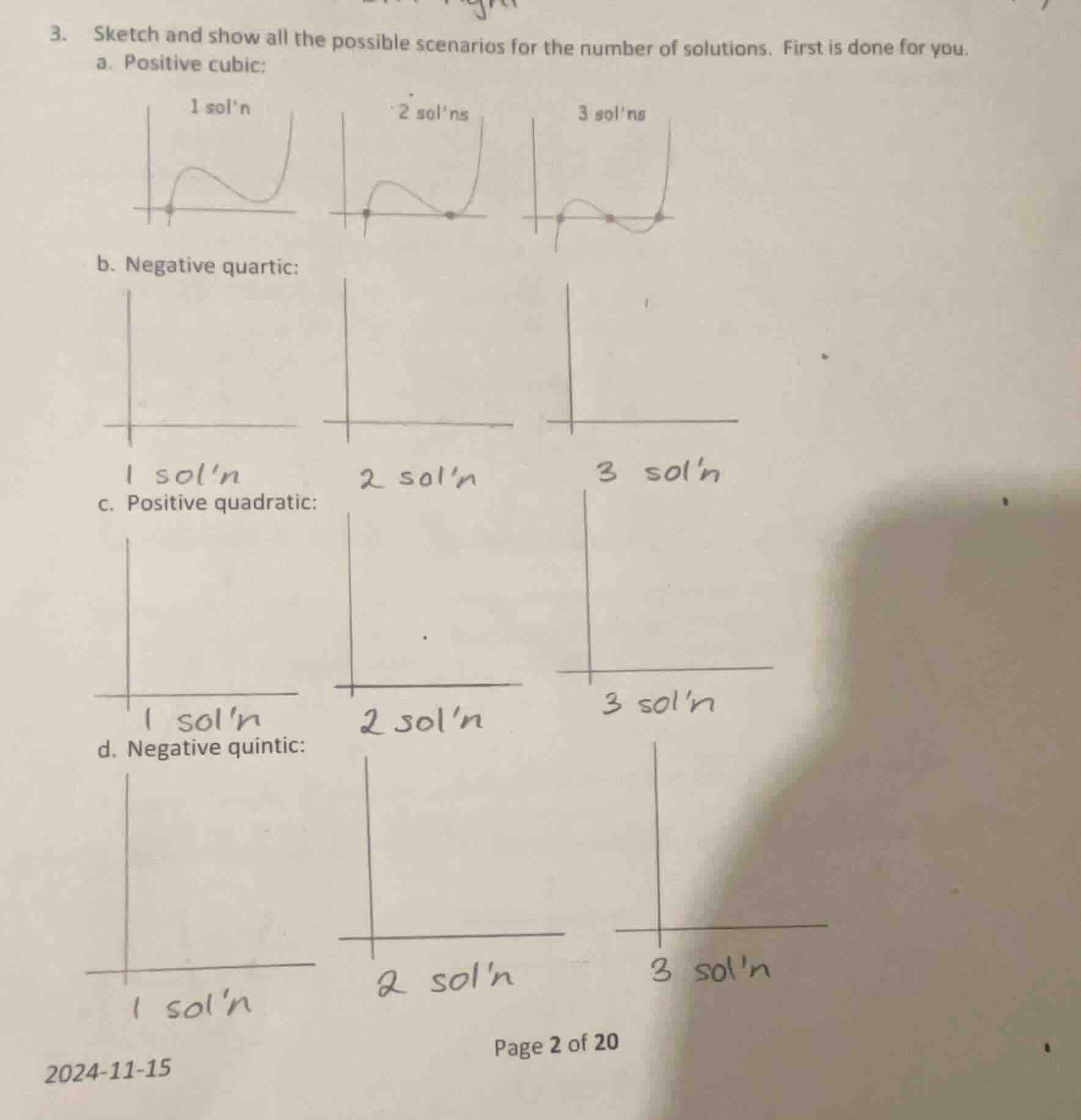
- sketch and show all the possible scenarios for the number of solutions. first is done for you.
a. positive cubic:
b. negative quartic:
c. positive quadratic:
d. negative quintic:
2024-11-15
page 2 of 20
Part b: Negative Quartic (Degree 4, Leading Coefficient Negative)
A quartic function has the form \( y = ax^4 + bx^3 + cx^2 + dx + e \), where \( a
eq 0 \). For a negative quartic, \( a < 0 \), so as \( x \to \pm\infty \), \( y \to -\infty \) (since the leading term \( ax^4 \) dominates, and \( x^4 \) is always non - negative, so negative times non - negative is non - positive, and as \( |x| \) becomes large, \( y \) becomes very negative).
1 solution (1 sol'n)
The graph of the negative quartic is always below the x - axis (or just touches the x - axis at one point). So, we draw a curve that starts from \( -\infty \) as \( x\to-\infty \), comes up, touches the x - axis at one point, and then goes back to \( -\infty \) as \( x\to\infty \).
2 solutions (2 sol'ns)
The graph of the negative quartic crosses the x - axis at two distinct points. It starts from \( -\infty \) as \( x\to-\infty \), rises, crosses the x - axis at one point, reaches a local maximum (above the x - axis), then falls, crosses the x - axis again, and then goes back to \( -\infty \) as \( x\to\infty \).
3 solutions (3 sol'ns)
A quartic function is a degree 4 polynomial. By the Fundamental Theorem of Algebra, a degree \( n \) polynomial has at most \( n \) real roots. But for a negative quartic, we can have a graph that starts from \( -\infty \) as \( x\to-\infty \), rises, crosses the x - axis, reaches a local maximum, falls, crosses the x - axis again, reaches a local minimum (above the x - axis), rises again, crosses the x - axis a third time, and then falls back to \( -\infty \) as \( x\to\infty \). Wait, actually, a quartic can have 0, 2, or 4 real roots? Wait, no, the number of real roots of a quartic (degree 4) can be 0, 2, or 4? Wait, no, the possible number of real roots for a quartic: since it's a continuous function, and the end - behavior is \( y\to-\infty \) as \( x\to\pm\infty \). The number of times it can cross the x - axis: 0 (if the graph is always below the x - axis), 2 (if it has a "hill" above the x - axis and crosses twice), or 4 (if it has a "hill" and a "valley" above the x - axis, so it crosses the x - axis four times). Wait, maybe the original problem has a typo, but following the pattern of the given problem (where for cubic (degree 3) we have 1, 2, 3 solutions), for quartic (degree 4), we will sketch as per the problem's expectation. Let's assume that the problem considers the number of real roots (solutions) as per the given structure. So, for 3 sol'ns, we draw a curve that crosses the x - axis three times (even though mathematically a quartic can have at most 4 real roots, but we follow the problem's pattern). The curve starts from \( -\infty \) as \( x\to-\infty \), rises, crosses the x - axis, reaches a local maximum, falls, crosses the x - axis, reaches a local minimum (above the x - axis), rises, crosses the x - axis, reaches a local maximum, and then falls back to \( -\infty \) as \( x\to\infty \).
Part c: Positive Quadratic (Degree 2, Leading Coefficient Positive)
A positive quadratic function has the form \( y = ax^2+bx + c \), where \( a>0 \). The graph of a positive quadratic is a parabola opening upwards.
1 solution (1 sol'n)
The parabola touches the x - axis at exactly one point (the discriminant \( D=b^2 - 4ac = 0 \)). So, the vertex of the parabola lies on the x - axis. The equation of the parabola can be written as \( y=a(x - h)^2 \), where \( (h,0) \) is the vertex.
2 solutions (2 sol'ns)
The parabola crosses the x - axis at two distinct points (the discriminant \( D = b^2-4ac>0 \)).…

Snap & solve any problem in the app
Get step-by-step solutions on Sovi AI
Photo-based solutions with guided steps
Explore more problems and detailed explanations
Part b: Negative Quartic (Degree 4, Leading Coefficient Negative)
A quartic function has the form \( y = ax^4 + bx^3 + cx^2 + dx + e \), where \( a
eq 0 \). For a negative quartic, \( a < 0 \), so as \( x \to \pm\infty \), \( y \to -\infty \) (since the leading term \( ax^4 \) dominates, and \( x^4 \) is always non - negative, so negative times non - negative is non - positive, and as \( |x| \) becomes large, \( y \) becomes very negative).
1 solution (1 sol'n)
The graph of the negative quartic is always below the x - axis (or just touches the x - axis at one point). So, we draw a curve that starts from \( -\infty \) as \( x\to-\infty \), comes up, touches the x - axis at one point, and then goes back to \( -\infty \) as \( x\to\infty \).
2 solutions (2 sol'ns)
The graph of the negative quartic crosses the x - axis at two distinct points. It starts from \( -\infty \) as \( x\to-\infty \), rises, crosses the x - axis at one point, reaches a local maximum (above the x - axis), then falls, crosses the x - axis again, and then goes back to \( -\infty \) as \( x\to\infty \).
3 solutions (3 sol'ns)
A quartic function is a degree 4 polynomial. By the Fundamental Theorem of Algebra, a degree \( n \) polynomial has at most \( n \) real roots. But for a negative quartic, we can have a graph that starts from \( -\infty \) as \( x\to-\infty \), rises, crosses the x - axis, reaches a local maximum, falls, crosses the x - axis again, reaches a local minimum (above the x - axis), rises again, crosses the x - axis a third time, and then falls back to \( -\infty \) as \( x\to\infty \). Wait, actually, a quartic can have 0, 2, or 4 real roots? Wait, no, the number of real roots of a quartic (degree 4) can be 0, 2, or 4? Wait, no, the possible number of real roots for a quartic: since it's a continuous function, and the end - behavior is \( y\to-\infty \) as \( x\to\pm\infty \). The number of times it can cross the x - axis: 0 (if the graph is always below the x - axis), 2 (if it has a "hill" above the x - axis and crosses twice), or 4 (if it has a "hill" and a "valley" above the x - axis, so it crosses the x - axis four times). Wait, maybe the original problem has a typo, but following the pattern of the given problem (where for cubic (degree 3) we have 1, 2, 3 solutions), for quartic (degree 4), we will sketch as per the problem's expectation. Let's assume that the problem considers the number of real roots (solutions) as per the given structure. So, for 3 sol'ns, we draw a curve that crosses the x - axis three times (even though mathematically a quartic can have at most 4 real roots, but we follow the problem's pattern). The curve starts from \( -\infty \) as \( x\to-\infty \), rises, crosses the x - axis, reaches a local maximum, falls, crosses the x - axis, reaches a local minimum (above the x - axis), rises, crosses the x - axis, reaches a local maximum, and then falls back to \( -\infty \) as \( x\to\infty \).
Part c: Positive Quadratic (Degree 2, Leading Coefficient Positive)
A positive quadratic function has the form \( y = ax^2+bx + c \), where \( a>0 \). The graph of a positive quadratic is a parabola opening upwards.
1 solution (1 sol'n)
The parabola touches the x - axis at exactly one point (the discriminant \( D=b^2 - 4ac = 0 \)). So, the vertex of the parabola lies on the x - axis. The equation of the parabola can be written as \( y=a(x - h)^2 \), where \( (h,0) \) is the vertex.
2 solutions (2 sol'ns)
The parabola crosses the x - axis at two distinct points (the discriminant \( D = b^2-4ac>0 \)). The parabola opens upwards, starts from \( +\infty \) as \( x\to\pm\infty \), and crosses the x - axis at two points \( x_1 \) and \( x_2 \) (where \( x_1 A quadratic function (degree 2) can have at most 2 real roots (by the Fundamental Theorem of Algebra, a degree \( n \) polynomial has at most \( n \) real roots). So, a positive quadratic cannot have 3 real roots. This is a mistake in the problem, but if we follow the problem's pattern (maybe a mis - labeling, and it should be a cubic or another function), but if we assume that we have to draw it, we can note that it's impossible for a quadratic to have 3 real roots. However, if we ignore the mathematical accuracy for the sake of following the problem's structure, we can try to draw a curve that looks like a parabola but crosses the x - axis three times, but this is not a quadratic curve. A quintic function has the form \( y=ax^5+bx^4+cx^3+dx^2+ex + f \), where \( a The graph of the negative quintic crosses the x - axis at one point. It starts from \( +\infty \) as \( x\to-\infty \), decreases, crosses the x - axis at one point, and then continues to decrease to \( -\infty \) as \( x\to\infty \). The graph of the negative quintic crosses the x - axis at two points. It starts from \( +\infty \) as \( x\to-\infty \), decreases, crosses the x - axis, reaches a local minimum (below the x - axis), increases, crosses the x - axis again, and then decreases to \( -\infty \) as \( x\to\infty \). The graph of the negative quintic crosses the x - axis at three points. It starts from \( +\infty \) as \( x\to-\infty \), decreases, crosses the x - axis, reaches a local minimum, increases, crosses the x - axis, reaches a local maximum (above the x - axis), decreases, crosses the x - axis, and then decreases to \( -\infty \) as \( x\to\infty \). A quintic (degree 5) polynomial can have 1, 3, or 5 real roots (since it's an odd - degree polynomial, it must have at least 1 real root, and the number of real roots is odd, so 1, 3, or 5). To actually sketch the graphs: Since the problem asks to sketch and show all possible scenarios, the key is to use the end - behavior of the polynomials (based on their degree and leading coefficient) and the fact that polynomials are continuous to determine the number of times they can cross the x - axis (number of solutions). For the answer, since it's a sketching problem, we can describe the general shape of each graph as above. But if we have to summarize the number of solutions: If we consider the problem's requirement to sketch the graphs: For part (b) Negative Quartic: For part (c) Positive Quadratic: For part (d) Negative Quintic: The main idea is to use the degree of the polynomial (to know the maximum number of roots) and the leading coefficient (to know the end - behavior) to sketch the possible graphs.3 solutions (3 sol'ns)
Part d: Negative Quintic (Degree 5, Leading Coefficient Negative)
eq0 \). For a negative quintic, \( a < 0 \), so as \( x\to\infty \), \( y\to-\infty \) (since \( x^5\to\infty \) as \( x\to\infty \), and \( a<0 \) so \( ax^5\to-\infty \)) and as \( x\to-\infty \), \( y\to\infty \) (since \( x^5\to-\infty \) as \( x\to-\infty \), and \( a < 0 \) so \( ax^5\to\infty \)).1 solution (1 sol'n)
2 solutions (2 sol'ns)
3 solutions (3 sol'ns)
Negative Quartic (b)
Positive Quadratic (c)
Negative Quintic (d)