QUESTION IMAGE
Question
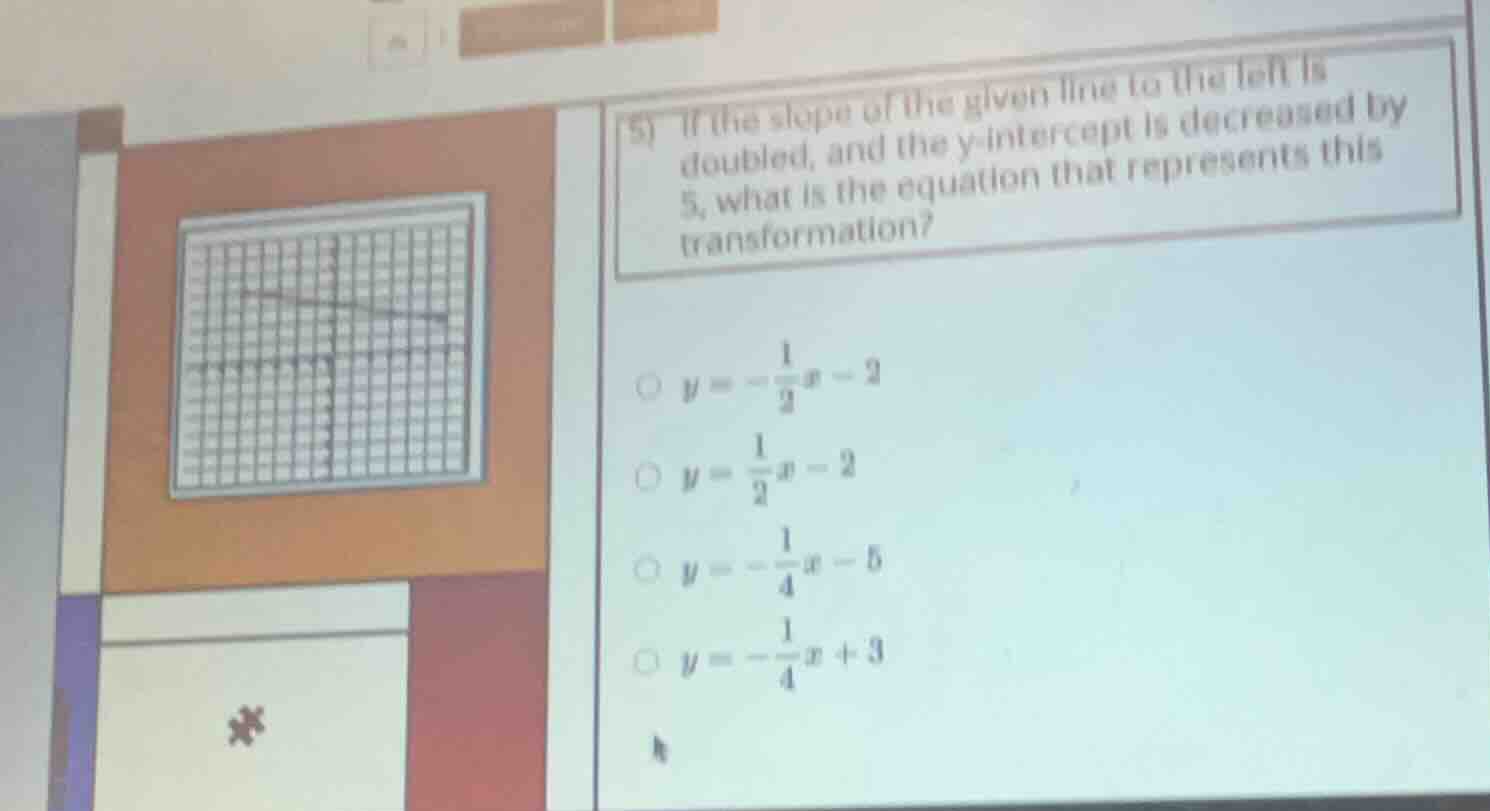
- if the slope of the given line to the left is doubled, and the y - intercept is decreased by 5, what is the equation that represents this transformation?
\\( y = -\frac{1}{2}x - 2 \\)
\\( y = \frac{1}{2}x - 2 \\)
\\( y = -\frac{1}{4}x - 5 \\)
\\( y = -\frac{1}{4}x + 3 \\)
To solve this, we first need to find the original equation of the line from the graph (though we can infer steps). Let's assume the original line has a slope and y - intercept. But from the options, we can work backward or analyze the transformation.
Step 1: Recall the slope - intercept form
The slope - intercept form of a line is \(y=mx + b\), where \(m\) is the slope and \(b\) is the y - intercept.
Step 2: Analyze the transformation
Let the original slope be \(m\) and the original y - intercept be \(b\). After the transformation:
- The slope is doubled, so the new slope \(m_{new}=2m\)
- The y - intercept is decreased by 5, so the new y - intercept \(b_{new}=b - 5\)
Let's assume the original line (from the graph, we can see it has a negative slope). Let's check the options.
Suppose the original slope is \(-\frac{1}{4}\). When we double it, the new slope is \(2\times(-\frac{1}{4})=-\frac{1}{2}\)
Suppose the original y - intercept is \(3\) (since \(3-5=-2\)). So the new equation would be \(y =-\frac{1}{2}x-2\) which matches the first option.
Let's verify with other options:
- For option B (\(y=\frac{1}{2}x - 2\)), the slope is positive, but the original line (from the graph) should have a negative slope (since it's decreasing), so B is incorrect.
- For option C (\(y =-\frac{1}{4}x-5\)), the slope is not doubled (if original slope was \(-\frac{1}{4}\), doubled slope is \(-\frac{1}{2}\)), so C is incorrect.
- For option D (\(y=-\frac{1}{4}x + 3\)), the slope is not doubled and the y - intercept is not decreased by 5, so D is incorrect.

Snap & solve any problem in the app
Get step-by-step solutions on Sovi AI
Photo-based solutions with guided steps
Explore more problems and detailed explanations
A. \(y =-\frac{1}{2}x-2\)