QUESTION IMAGE
Question
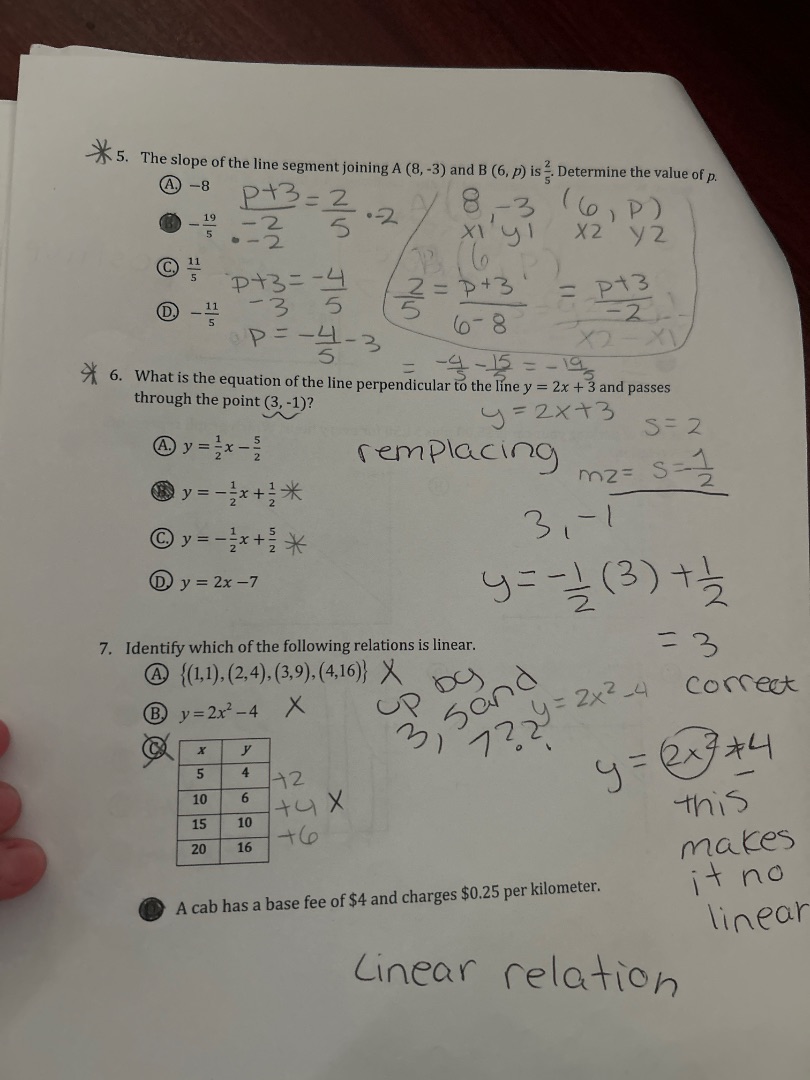
- the slope of the line segment joining a (8, -3) and b (6, p) is \\(\frac{2}{5}\\). determine the value of p.\
a \\(-8\\)\
b \\(-\frac{19}{5}\\)\
c \\(\frac{11}{5}\\)\
d \\(-\frac{11}{5}\\)\
- what is the equation of the line perpendicular to the line \\(y = 2x + 3\\) and passes through the point (3, -1)?\
a \\(y = \frac{1}{2}x - \frac{5}{2}\\)\
b \\(y = -\frac{1}{2}x + \frac{1}{2}\\)\
c \\(y = -\frac{1}{2}x + \frac{5}{2}\\)\
d \\(y = 2x - 7\\)\
- identify which of the following relations is linear.\
a \\(\\{(1,1), (2,4), (3,9), (4,16)\\}\\)\
b \\(y = 2x^2 - 4\\)\
c (a table with x: 5, 10, 15, 20 and y: 4, 6, 10, 16)\
d a cab has a base fee of $4 and charges $0.25 per kilometer.
Question 5
Step1: Recall slope formula
The slope \( m \) between two points \((x_1, y_1)\) and \((x_2, y_2)\) is \( m=\frac{y_2 - y_1}{x_2 - x_1} \). Here, \( A(8, - 3) \), \( B(6,p) \), so \( x_1 = 8,y_1=-3,x_2 = 6,y_2 = p \), and \( m=\frac{2}{5} \).
Step2: Substitute into slope formula
Substitute into the formula: \( \frac{2}{5}=\frac{p - (-3)}{6 - 8}=\frac{p + 3}{-2} \)
Step3: Solve for \( p \)
Cross - multiply: \( 2\times(-2)=5\times(p + 3) \)
\( - 4 = 5p+15 \)
Subtract 15 from both sides: \( 5p=-4 - 15=-19 \)
Divide by 5: \( p =-\frac{19}{5} \)
Step1: Find the slope of the perpendicular line
The slope of the line \( y = 2x+3 \) is \( m_1 = 2 \). If two lines are perpendicular, the product of their slopes is \( - 1 \), so the slope \( m_2 \) of the perpendicular line is \( m_2=-\frac{1}{2} \) (since \( 2\times(-\frac{1}{2})=-1 \))
Step2: Use point - slope form
The point - slope form of a line is \( y - y_0=m(x - x_0) \), where \((x_0,y_0)=(3,-1)\) and \( m =-\frac{1}{2} \)
Substitute: \( y-(-1)=-\frac{1}{2}(x - 3) \)
Step3: Simplify the equation
\( y + 1=-\frac{1}{2}x+\frac{3}{2} \)
Subtract 1 from both sides: \( y=-\frac{1}{2}x+\frac{3}{2}-1=-\frac{1}{2}x+\frac{1}{2} \)
- Option A: The relation \(\{(1,1),(2,4),(3,9),(4,16)\}\) can be seen as \( y=x^{2} \) (since \( 1 = 1^{2},4 = 2^{2},9 = 3^{2},16 = 4^{2} \)), which is a quadratic (non - linear) relation.
- Option B: The equation \( y = 2x^{2}-4 \) is a quadratic equation (the highest power of \( x \) is 2), so it is non - linear.
- Option C: For the table, when \( x \) changes from 5 to 10 (an increase of 5), \( y \) changes from 4 to 6 (an increase of 2); when \( x \) changes from 10 to 15 (an increase of 5), \( y \) changes from 6 to 10 (an increase of 4); when \( x \) changes from 15 to 20 (an increase of 5), \( y \) changes from 10 to 16 (an increase of 6). The rate of change of \( y \) with respect to \( x \) is not constant, so it is non - linear.
- Option D: Let the cost of the cab be \( y \) and the number of kilometers be \( x \). The cost function is \( y = 0.25x+4 \), which is in the form \( y=mx + b \) (where \( m = 0.25 \) and \( b = 4 \)), so it is a linear relation.

Snap & solve any problem in the app
Get step-by-step solutions on Sovi AI
Photo-based solutions with guided steps
Explore more problems and detailed explanations
B. \( -\frac{19}{5} \)