QUESTION IMAGE
Question
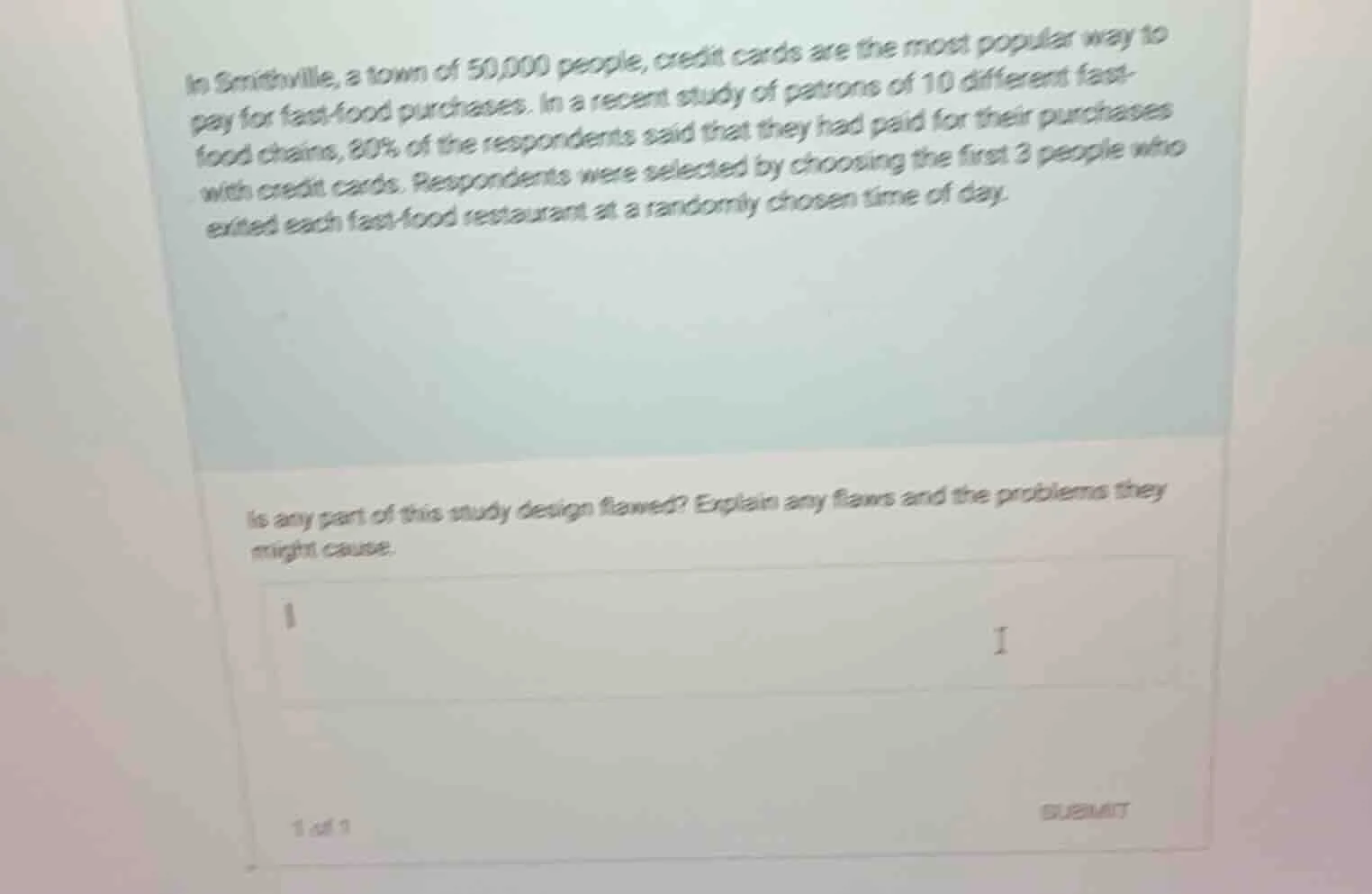
in smithville, a town of 50,000 people, credit cards are the most popular way to pay for fast-food purchases. in a recent study of patrons of 10 different fast-food chains, 80% of the respondents said that they had paid for their purchases with credit cards. respondents were selected by choosing the first 3 people who exited each fast-food restaurant at a randomly chosen time of day.
is any part of this study design flawed? explain any flaws and the problems they might cause.
1 of 1
submit
Brief Explanations
- Sampling Bias Flaw: Selecting only the first 3 people exiting at a single random time creates a non-representative sample. The time chosen might skew results (e.g., a lunch rush could have more customers using credit cards for quick payments, or a late-night slot might have fewer credit card users). This group does not reflect the full range of fast-food patrons across different times, days, or customer demographics.
- Small Sample Size Flaw: Only 3 people per restaurant (30 total respondents) is too small a sample to reliably generalize to the 50,000 people in Smithville, or even to the broader population of fast-food patrons in the area. A small sample increases the risk of random error making the 80% result unreflective of the true rate of credit card use.
- Generalization Flaw: Even if the sampling were sound, the study only looks at 10 fast-food chains; this limits the ability to generalize the result to all fast-food purchases in Smithville, as different chains might have different payment preferences among their customers.

Snap & solve any problem in the app
Get step-by-step solutions on Sovi AI
Photo-based solutions with guided steps
Explore more problems and detailed explanations
Yes, the study design has multiple flaws:
- Convenience Sampling Bias: Choosing only the first 3 people exiting at one random time means the sample is not representative of all fast-food patrons (e.g., it misses customers from different times, who may have different payment habits). This can lead to an over- or under-estimation of actual credit card usage rates.
- Undersized Sample: With only 3 respondents per restaurant (30 total), the sample is too small to draw reliable conclusions about the entire town's population. Small samples are prone to random variation, making the 80% result an unreliable measure of true credit card use.
- Limited Scope: Focusing only on 10 fast-food chains means results cannot be generalized to all fast-food purchases in Smithville, as payment preferences may vary between different chains.