QUESTION IMAGE
Question
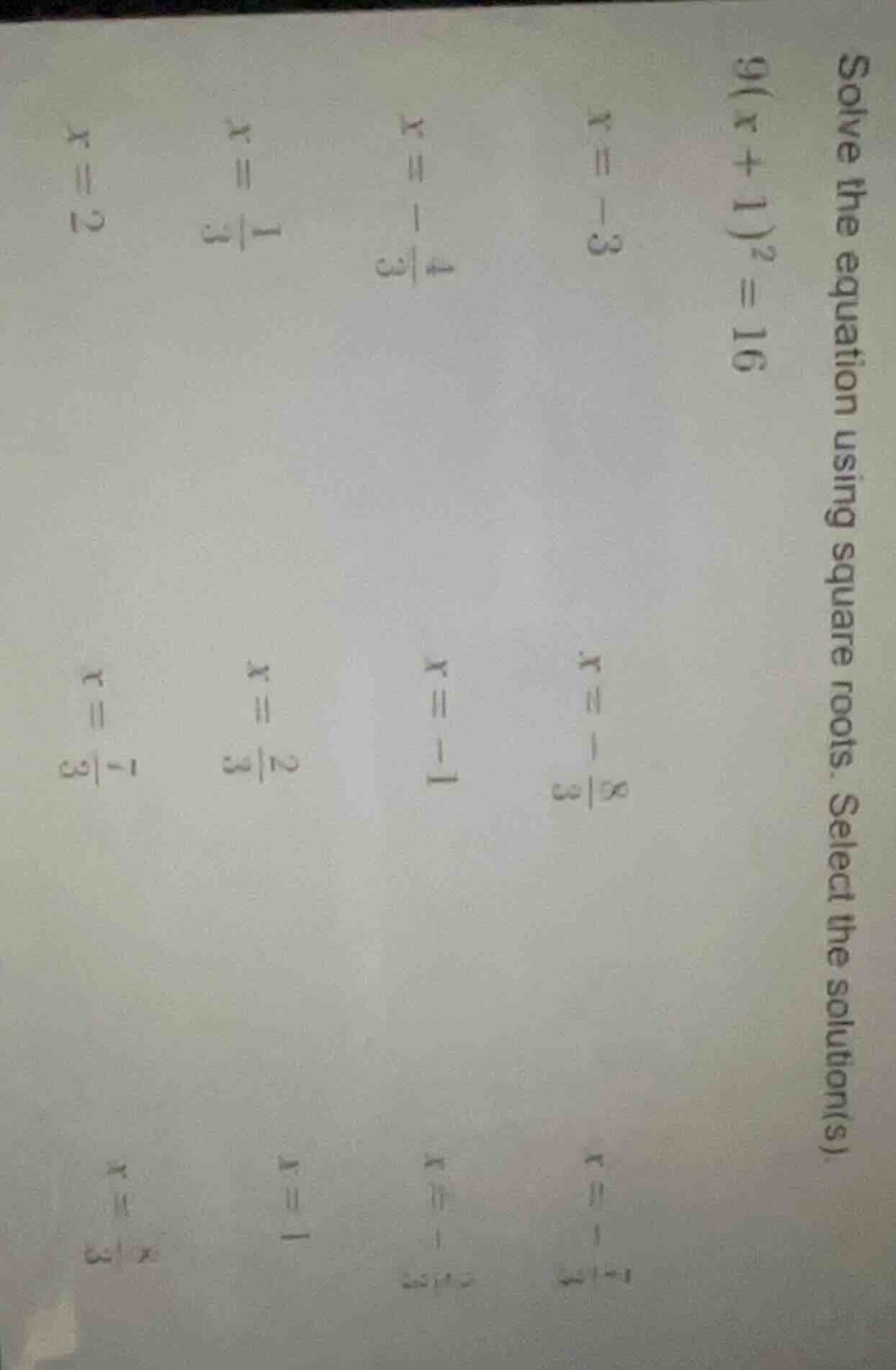
solve the equation using square roots. select the solution(s). 9(x + 1)^2 = 16 options: x = -3, x = -\frac{8}{3}, x = -\frac{7}{3}, x = -\frac{4}{3}, x = -1, x = -\frac{5}{3}, x = \frac{1}{3}, x = \frac{2}{3}, x = 1, x = 2, x = \frac{7}{3}, x = \frac{8}{3}
Step1: Divide both sides by 9
To isolate the squared term, we divide both sides of the equation \(9(x + 1)^2 = 16\) by 9. This gives us \((x + 1)^2=\frac{16}{9}\).
Step2: Take square roots on both sides
Taking the square root of both sides, we know that if \(y^2 = a\), then \(y=\pm\sqrt{a}\). So, \(x + 1=\pm\sqrt{\frac{16}{9}}\). Since \(\sqrt{\frac{16}{9}}=\frac{4}{3}\), we have \(x + 1=\pm\frac{4}{3}\).
Step3: Solve for x (case 1: positive root)
For the positive root, \(x + 1=\frac{4}{3}\). Subtract 1 from both sides. Since \(1=\frac{3}{3}\), we get \(x=\frac{4}{3}-\frac{3}{3}=\frac{1}{3}\).
Step4: Solve for x (case 2: negative root)
For the negative root, \(x + 1=-\frac{4}{3}\). Subtract 1 from both sides. Again, \(1 = \frac{3}{3}\), so \(x=-\frac{4}{3}-\frac{3}{3}=-\frac{7}{3}\)? Wait, no, wait. Wait, let's re - check. Wait, \(x+1 =-\frac{4}{3}\), then \(x=-\frac{4}{3}-1=-\frac{4}{3}-\frac{3}{3}=-\frac{7}{3}\)? But wait, maybe I made a mistake. Wait, the original equation: \(9(x + 1)^2=16\), \((x + 1)^2=\frac{16}{9}\), \(x + 1=\pm\frac{4}{3}\). So when \(x + 1=\frac{4}{3}\), \(x=\frac{4}{3}-1=\frac{4 - 3}{3}=\frac{1}{3}\). When \(x + 1=-\frac{4}{3}\), \(x=-\frac{4}{3}-1=-\frac{4+3}{3}=-\frac{7}{3}\)? But looking at the options, there is \(x = \frac{1}{3}\) and let's check the other options. Wait, maybe I misread the options. Wait, the options given: Let's list the options again as per the image (from what I can see):
First column (top to bottom): \(x=-3\), \(x =-\frac{4}{3}\), \(x=\frac{1}{3}\), \(x = 2\)
Second column: \(x=-\frac{8}{3}\), \(x=-1\), \(x=\frac{2}{3}\), \(x=\frac{7}{3}\)
Third column: (maybe some more, but from our solution, \(x=\frac{1}{3}\) and \(x=-\frac{7}{3}\)? Wait, no, wait, \(-\frac{7}{3}\) is equal to \(-2\frac{1}{3}\), but in the options, there is \(x =-\frac{7}{3}\)? Wait, maybe I made a mistake in calculation. Wait, \(9(x + 1)^2=16\)
Divide both sides by 9: \((x + 1)^2=\frac{16}{9}\)
Take square roots: \(x + 1=\pm\frac{4}{3}\)
Case 1: \(x+1=\frac{4}{3}\)
\(x=\frac{4}{3}-1=\frac{4 - 3}{3}=\frac{1}{3}\)
Case 2: \(x + 1=-\frac{4}{3}\)
\(x=-\frac{4}{3}-1=-\frac{4+3}{3}=-\frac{7}{3}\)
Now, looking at the options, \(x=\frac{1}{3}\) is one of the options (in the first column, third row: \(x=\frac{1}{3}\)) and \(x =-\frac{7}{3}\) (if there is an option like that). Wait, maybe the options were mis - transcribed. But from the calculation, the solutions are \(x=\frac{1}{3}\) and \(x=-\frac{7}{3}\). But among the given options, \(x=\frac{1}{3}\) is present. Wait, maybe I made a mistake in the sign. Wait, let's re - do the negative case:
\(x + 1=-\frac{4}{3}\)
Subtract 1: \(x=-\frac{4}{3}-1=-\frac{4}{3}-\frac{3}{3}=-\frac{7}{3}\), which is equal to \(-2\frac{1}{3}\). Alternatively, maybe the original equation was \(9(x - 1)^2=16\)? No, the equation is \(9(x + 1)^2=16\).
Wait, maybe the options have \(x=\frac{1}{3}\) and \(x =-\frac{7}{3}\). But from the given options in the image (as per the user's image), let's check:
First column (top to bottom):
- \(x=-3\)
- \(x =-\frac{4}{3}\)
- \(x=\frac{1}{3}\)
- \(x = 2\)
Second column (top to bottom):
- \(x=-\frac{8}{3}\)
- \(x=-1\)
- \(x=\frac{2}{3}\)
- \(x=\frac{7}{3}\)
Third column (maybe):
- \(x=-...\) (not clear)
- \(x=-...\) (not clear)
- \(x = 1\)
- \(x=-\frac{5}{3}\)
Wait, maybe I made a mistake in the calculation. Let's start over:
Given \(9(x + 1)^2=16\)
Divide both sides by 9: \((x + 1)^2=\frac{16}{9}\)
Take square roots: \(x + 1=\pm\frac{4}{3}\)
So,
- When \(x + 1=\frac{4}{3}\):
\(x=\frac{4}{3}-1=\frac{4…

Snap & solve any problem in the app
Get step-by-step solutions on Sovi AI
Photo-based solutions with guided steps
Explore more problems and detailed explanations
\(x=\frac{1}{3}\) (and \(x =-\frac{7}{3}\) if present in options, but from the given visible options, \(x=\frac{1}{3}\) is a solution)