QUESTION IMAGE
Question
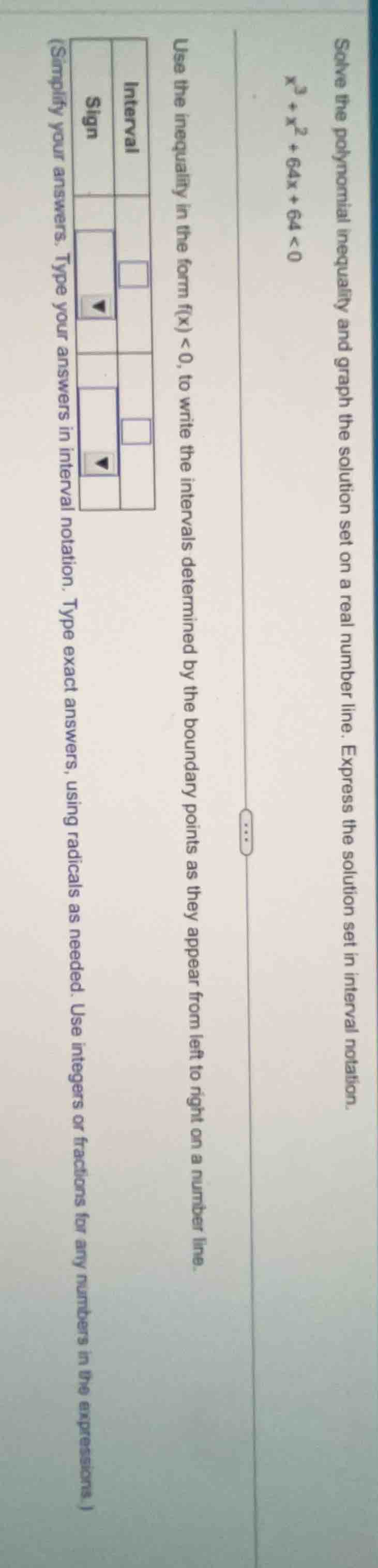
solve the polynomial inequality and graph the solution set on a real number line. express the solution set in interval notation.
(x^3 + x^2 + 64x + 64 < 0)
use the inequality in the form (f(x) < 0), to write the intervals determined by the boundary points as they appear from left to right on a number line.
(simplify your answers. type your answers in interval notation. type exact answers, using radicals as needed. use integers or fractions for any numbers in the expressions.)
Step1: Factor the polynomial
First, we try to factor the polynomial \( f(x)=x^{3}+x^{2}+64x + 64\). We can group the terms:
\(x^{3}+x^{2}+64x + 64=x^{2}(x + 1)+64(x + 1)=(x^{2}+64)(x + 1)\)
So the inequality becomes \((x^{2}+64)(x + 1)<0\)
Step2: Analyze the factors
- For the factor \(x^{2}+64\), since \(x^{2}\geq0\) for all real \(x\), then \(x^{2}+64\geq64>0\) for all real \(x\).
- For the factor \(x + 1\), we find the critical point by setting \(x+1 = 0\), which gives \(x=-1\).
Step3: Determine the sign of the product
Since \(x^{2}+64>0\) always, the sign of \((x^{2}+64)(x + 1)\) is the same as the sign of \(x + 1\). We want to find where \((x^{2}+64)(x + 1)<0\), which is equivalent to finding where \(x + 1<0\) (because \(x^{2}+64\) is always positive).
Solving \(x + 1<0\) gives \(x<-1\)

Snap & solve any problem in the app
Get step-by-step solutions on Sovi AI
Photo-based solutions with guided steps
Explore more problems and detailed explanations
\((-\infty,-1)\)