QUESTION IMAGE
Question
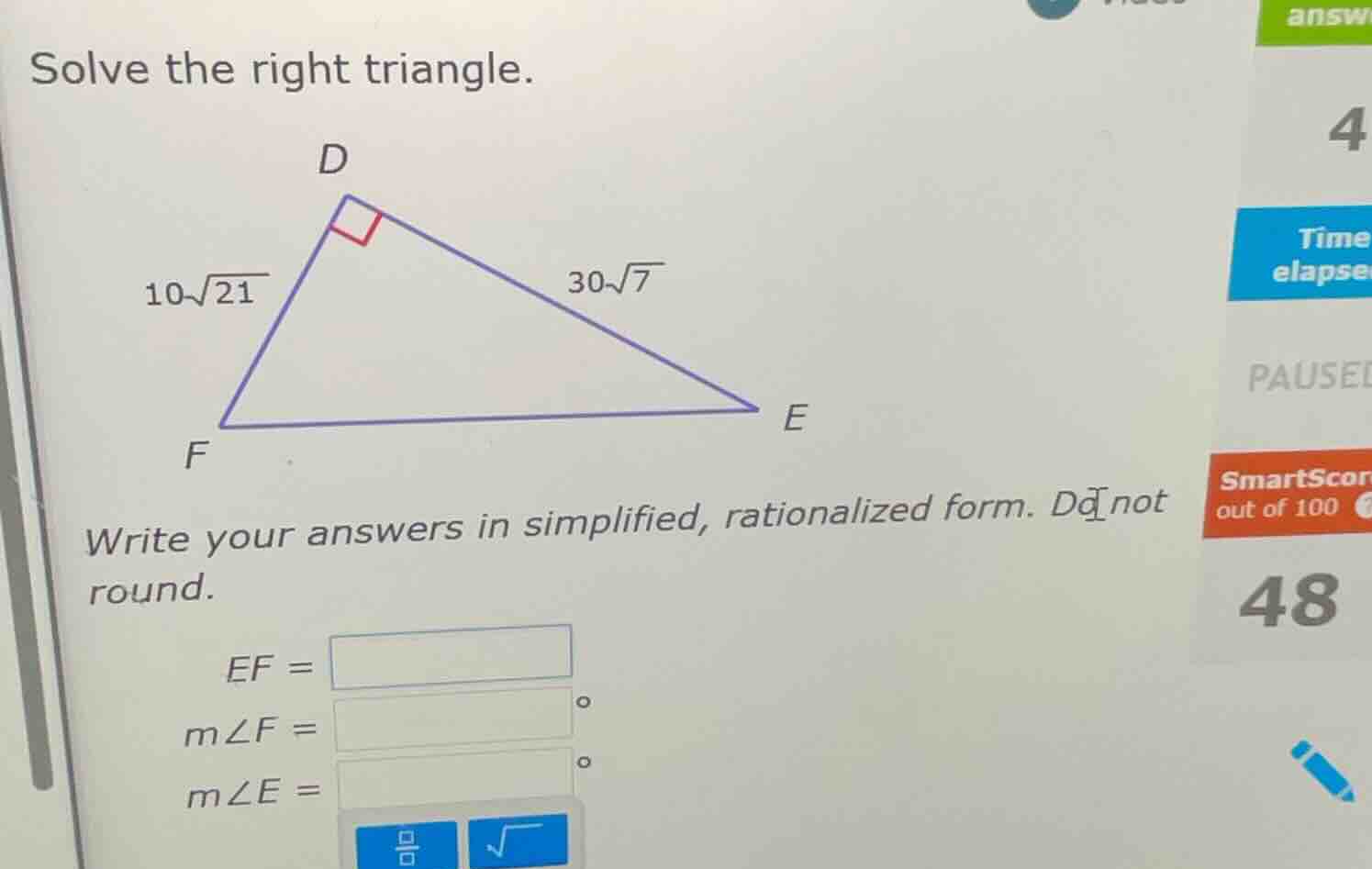
solve the right triangle.
triangle with right angle at d, df = 10√21, de = 30√7, vertices f, d, e
write your answers in simplified, rationalized form. do not round.
ef =
m∠f =
m∠e =
Step1: Find hypotenuse \( EF \)
In right triangle \( DEF \) (right-angled at \( D \)), use Pythagorean theorem: \( EF^2 = DF^2 + DE^2 \).
\( DF = 10\sqrt{21} \), \( DE = 30\sqrt{7} \).
\( DF^2 = (10\sqrt{21})^2 = 100 \times 21 = 2100 \)
\( DE^2 = (30\sqrt{7})^2 = 900 \times 7 = 6300 \)
\( EF^2 = 2100 + 6300 = 8400 \)
\( EF = \sqrt{8400} = \sqrt{400 \times 21} = 20\sqrt{21} \) (Wait, no—wait, \( \sqrt{8400} = \sqrt{100 \times 84} = 10\sqrt{84} = 10\sqrt{4 \times 21} = 20\sqrt{21} \)? Wait, no, \( 2100 + 6300 = 8400 \), \( \sqrt{8400} = \sqrt{100 \times 84} = 10\sqrt{84} = 10 \times 2\sqrt{21} = 20\sqrt{21} \)? Wait, no, let's recalculate: \( 10\sqrt{21} \) squared is \( 100 \times 21 = 2100 \), \( 30\sqrt{7} \) squared is \( 900 \times 7 = 6300 \). Sum is \( 2100 + 6300 = 8400 \). \( \sqrt{8400} = \sqrt{100 \times 84} = 10\sqrt{84} = 10 \times 2\sqrt{21} = 20\sqrt{21} \)? Wait, no, \( 84 = 4 \times 21 \), so \( \sqrt{84} = 2\sqrt{21} \), so \( 10 \times 2\sqrt{21} = 20\sqrt{21} \). Wait, but let's check ratios. Alternatively, maybe I made a mistake. Wait, \( 10\sqrt{21} \) and \( 30\sqrt{7} \): note that \( 30\sqrt{7} = 10\sqrt{7} \times 3 \), \( 10\sqrt{21} = 10\sqrt{7 \times 3} = 10\sqrt{7}\sqrt{3} \). So \( DF = 10\sqrt{7}\sqrt{3} \), \( DE = 30\sqrt{7} = 10\sqrt{7} \times 3 \). So let \( x = 10\sqrt{7} \), then \( DF = x\sqrt{3} \), \( DE = 3x \). Then hypotenuse \( EF = \sqrt{(x\sqrt{3})^2 + (3x)^2} = \sqrt{3x^2 + 9x^2} = \sqrt{12x^2} = 2x\sqrt{3} \). Substitute \( x = 10\sqrt{7} \): \( 2 \times 10\sqrt{7} \times \sqrt{3} = 20\sqrt{21} \). Correct.
Step2: Find \( \angle F \) (angle at \( F \))
Use trigonometric ratio: \( \tan F = \frac{DE}{DF} \) (opposite over adjacent to \( F \)).
\( \tan F = \frac{30\sqrt{7}}{10\sqrt{21}} = \frac{3\sqrt{7}}{\sqrt{21}} = \frac{3\sqrt{7}}{\sqrt{7 \times 3}} = \frac{3}{\sqrt{3}} = \sqrt{3} \)
\( \tan F = \sqrt{3} \implies m\angle F = 60^\circ \) (since \( \tan 60^\circ = \sqrt{3} \))
Step3: Find \( \angle E \) (angle at \( E \))
In right triangle, angles sum to \( 180^\circ \), so \( m\angle E = 90^\circ - 60^\circ = 30^\circ \) (or use \( \tan E = \frac{DF}{DE} \), \( \tan E = \frac{10\sqrt{21}}{30\sqrt{7}} = \frac{\sqrt{21}}{3\sqrt{7}} = \frac{\sqrt{3}}{3} = \frac{1}{\sqrt{3}} \), so \( m\angle E = 30^\circ \))
Step3 (alternate for \( \angle E \)):
\( \tan E = \frac{DF}{DE} = \frac{10\sqrt{21}}{30\sqrt{7}} = \frac{\sqrt{21}}{3\sqrt{7}} = \frac{\sqrt{7 \times 3}}{3\sqrt{7}} = \frac{\sqrt{3}}{3} \)
\( \tan E = \frac{1}{\sqrt{3}} \implies m\angle E = 30^\circ \)

Snap & solve any problem in the app
Get step-by-step solutions on Sovi AI
Photo-based solutions with guided steps
Explore more problems and detailed explanations
s:
\( EF = 20\sqrt{21} \)
\( m\angle F = 60^\circ \)
\( m\angle E = 30^\circ \)
(Wait, but earlier when calculating \( EF \), let's recheck Pythagorean theorem: \( (10\sqrt{21})^2 + (30\sqrt{7})^2 = 10021 + 9007 = 2100 + 6300 = 8400 \). \( \sqrt{8400} = \sqrt{100*84} = 10\sqrt{84} = 10*2\sqrt{21} = 20\sqrt{21} \). Correct.
For \( \angle F \): \( \sin F = \frac{DE}{EF} = \frac{30\sqrt{7}}{20\sqrt{21}} = \frac{3\sqrt{7}}{2\sqrt{21}} = \frac{3\sqrt{7}}{2\sqrt{7}\sqrt{3}} = \frac{3}{2\sqrt{3}} = \frac{\sqrt{3}}{2} \). \( \sin F = \frac{\sqrt{3}}{2} \implies m\angle F = 60^\circ \). Correct.
For \( \angle E \): \( \sin E = \frac{DF}{EF} = \frac{10\sqrt{21}}{20\sqrt{21}} = \frac{1}{2} \implies m\angle E = 30^\circ \). Correct.)