QUESTION IMAGE
Question
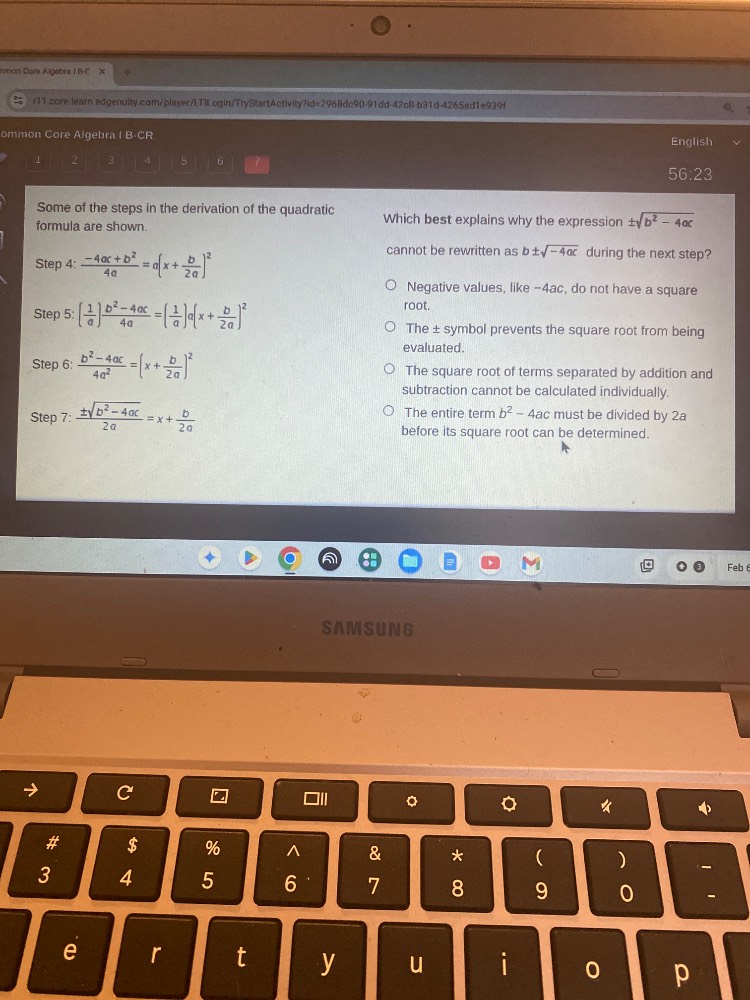
some of the steps in the derivation of the quadratic formula are shown. step 4: \\(\frac{-4ac + b^2}{4a}=\left(x + \frac{b}{2a}\
ight)^2\\) step 5: \\(\left(\frac{1}{a}\
ight)\frac{b^2 - 4ac}{4a}=\left(\frac{1}{a}\
ight)a\left(x + \frac{b}{2a}\
ight)^2\\) step 6: \\(\frac{b^2 - 4ac}{4a^2}=\left(x + \frac{b}{2a}\
ight)^2\\) step 7: \\(\frac{\pm\sqrt{b^2 - 4ac}}{2a}=x + \frac{b}{2a}\\) which best explains why the expression \\(\pm\sqrt{b^2 - 4ac}\\) cannot be rewritten as \\(b\pm\sqrt{-4ac}\\) during the next step? \\(\bigcirc\\) negative values, like \\(-4ac\\), do not have a square root. \\(\bigcirc\\) the \\(\pm\\) symbol prevents the square root from being evaluated. \\(\bigcirc\\) the square root of terms separated by addition and subtraction cannot be calculated individually. \\(\bigcirc\\) the entire term \\(b^2 - 4ac\\) must be divided by \\(2a\\) before its square root can be determined.
To determine why \(\pm\frac{\sqrt{b^{2}-4ac}}{2a}\) can't be rewritten as \(\frac{b\pm\sqrt{-4ac}}{2a}\) (or similar mis - split form), we analyze the square root property. The square root of a sum or difference (\(b^{2}-4ac\) is a single expression under the square root) cannot be split into the square root of each term separately. For example, \(\sqrt{x + y}
eq\sqrt{x}+\sqrt{y}\) in general, and the same logic applies to subtraction.
- Option 1: \(-4ac\) is part of \(b^{2}-4ac\), and we don't know if \(b^{2}-4ac\) is negative. Also, the issue is not about the sign of \(-4ac\) alone but about splitting the square root.
- Option 2: The \(\pm\) symbol does not prevent the square root from being evaluated. The square root can be evaluated first (as in the quadratic formula derivation, we take the square root of \(b^{2}-4ac\) as a whole).
- Option 4: The term \(b^{2}-4ac\) is under the square root, and we take the square root first and then divide by \(2a\), not the other way around.
So the correct reason is that the square root of terms separated by addition and subtraction cannot be calculated individually.

Snap & solve any problem in the app
Get step-by-step solutions on Sovi AI
Photo-based solutions with guided steps
Explore more problems and detailed explanations
The square root of terms separated by addition and subtraction cannot be calculated individually. (The option corresponding to this statement in the original question, e.g., if it's the third option, then: C. The square root of terms separated by addition and subtraction cannot be calculated individually)