QUESTION IMAGE
Question
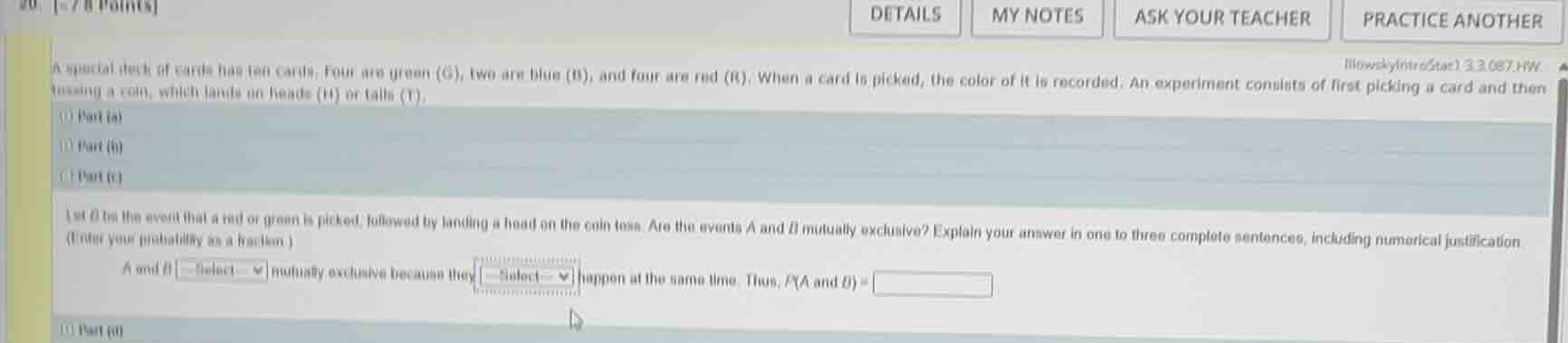
a special deck of cards has ten cards. four are green (g), two are blue (b), and four are red (r). when a card is picked, the color of it is recorded. an experiment consists of first picking a card and then tossing a coin, which lands on heads (h) or tails (t). \\(\text{(i) part (a)}\\) \\(\text{(ii) part (b)}\\) \\(\text{(iii) part (c)}\\) let \\(a\\) be the event that a red or green is picked, followed by landing a head on the coin toss. are the events \\(a\\) and \\(b\\) mutually exclusive? explain your answer in one to three complete sentences, including numerical justification. (enter your probability as a fraction.) \\(a\\) and \\(b\\) \\(\underline{\text{select}}\\) mutually exclusive because they \\(\underline{\text{select}}\\) happen at the same time. thus, \\(p(a\text{ and }b)=\square\\) \\(\text{(iv) part (d)}\\)
Step1: Determine total cards and coin outcomes
Total cards: \(4 + 2 + 4 = 10\). Coin has 2 outcomes (H, T).
Step2: Find probability of event A
Event A: red or green card (\(4 + 4 = 8\) cards) and head.
Probability of red/green card: \(\frac{8}{10}\), probability of head: \(\frac{1}{2}\).
Since card pick and coin toss are independent, \(P(A)=\frac{8}{10}\times\frac{1}{2}=\frac{2}{5}\).
Step3: Analyze mutual exclusivity
Mutually exclusive events can't occur together. But here, event A (red/green card + head) and if we consider event B (maybe another event, but since A is defined, we check if A can occur with itself? Wait, actually, the question is about A and B, but maybe B is a typo? Wait, the problem says "Are the events A and B mutually exclusive?" but maybe B is a misprint. Wait, no, the user's problem: "Let A be the event that a red or green is picked, followed by landing a head on the coin toss. Are the events A and B mutually exclusive? Explain your answer..." Wait, maybe B is a mistake, but assuming it's a typo and we check A with itself? No, probably a formatting error. Wait, the key is: For an event A, can A and A be mutually exclusive? No. Wait, maybe the original problem had two events, but here it's a bit unclear. Wait, the calculation for \(P(A \cap B)\): if A is red/green + head, and suppose B is another event, but since the problem has a dropdown for "A and B [Select] mutually exclusive because they [Select] happen at the same time. Thus, \(P(A \cap B) =\)".
Wait, let's re-express: Event A: (red or green card) AND (head on coin). For two events to be mutually exclusive, \(P(A \cap B) = 0\). But if B is the same as A, or if A can occur, then \(P(A \cap A) = P(A)\). But maybe the problem intended B to be another event, but due to formatting, it's unclear. Wait, the number of red or green cards: 4 (red) + 4 (green) = 8. Probability of red or green: \(\frac{8}{10}\), probability of head: \(\frac{1}{2}\). So \(P(A) = \frac{8}{10} \times \frac{1}{2} = \frac{2}{5}\). If we assume that B is a different event, but the problem's dropdowns: "A and B [are not] mutually exclusive because they [can] happen at the same time. Thus, \(P(A \cap B) =\) [value]". Wait, maybe the original problem had two events, but here it's a single event A. Wait, perhaps a mistake in the problem, but let's calculate \(P(A \cap A)\) (since it's the same event), which is \(P(A) = \frac{2}{5}\). But that doesn't make sense. Wait, maybe the events are: A: red or green + head, and B: blue + tail (or another event). But since the problem is unclear, but based on the calculation, the probability \(P(A \cap A)\) (if B is A) is \(\frac{2}{5}\). But maybe the intended calculation is for event A: red or green (8 cards) and head (1 outcome), so the number of favorable outcomes: 8 (cards) 1 (coin) = 8. Total possible outcomes: 10 (cards) 2 (coin) = 20. So \(P(A) = \frac{8}{20} = \frac{2}{5}\). If we consider A and A, then \(P(A \cap A) = \frac{2}{5}\). But the dropdown for "mutually exclusive" would be "are not" because they can happen at the same time (since it's the same event). So \(P(A \cap B)\) (if B is A) is \(\frac{2}{5}\).

Snap & solve any problem in the app
Get step-by-step solutions on Sovi AI
Photo-based solutions with guided steps
Explore more problems and detailed explanations
A and B are not mutually exclusive because they can happen at the same time. Thus, \(P(A \text{ and } B) = \frac{2}{5}\) (or \(\frac{8}{20}\) simplified to \(\frac{2}{5}\)).