QUESTION IMAGE
Question
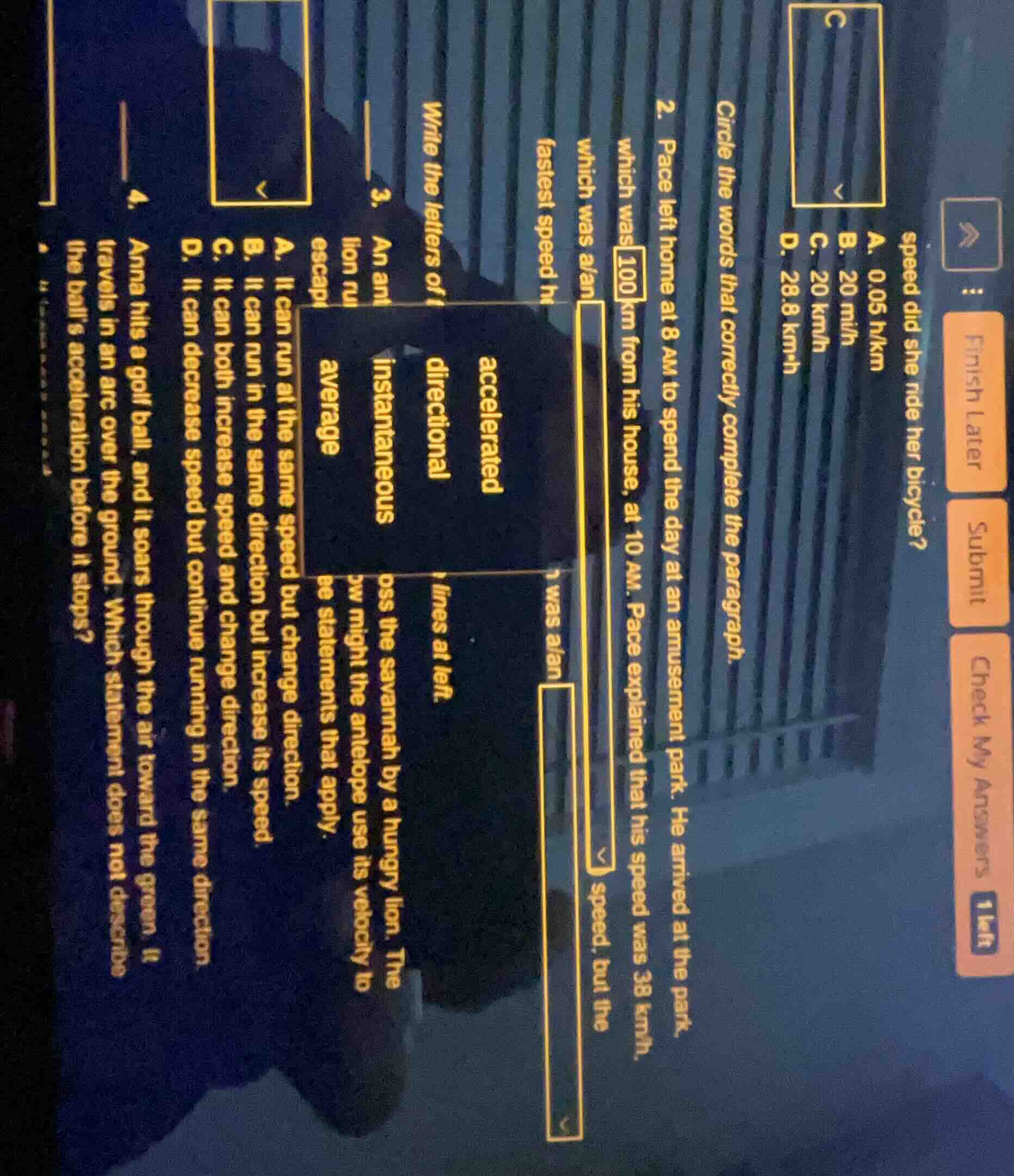
speed did she ride her bicycle?
a. 0.05 h/km
b. 20 mi/h
c. 20 km/h
d. 28.8 km·h
circle the words that correctly complete the paragraph.
- pace left home at 8 am to spend the day at an amusement park. he arrived at the park, which was \boxed{100} km from his house, at 10 am. pace explained that his speed was 38 km/h, which was a/an \
ule{1cm}{0.15mm} speed, but the fastest speed he \
ule{1cm}{0.15mm} was a/an \
ule{1cm}{0.15mm}
write the letters of
- an ant lion run escapi
a. it can run at the same speed but change direction.
b. it can run in the same direction but increase its speed.
c. it can both increase speed and change direction.
d. it can decrease speed but continue running in the same direction.
- anna hits a golf ball, and it soars through the air toward the green. it travels in an arc over the ground. which statement does not describe the ball’s acceleration before it stops?
Problem 2 (Pace's travel speed)
Step1: Determine time taken
Pace left home at 8 AM and arrived at 10 AM, so time taken $t = 10 - 8 = 2$ hours.
Step2: Calculate average speed
Distance $d = 100$ km, average speed $v=\frac{d}{t}=\frac{100}{2}=50$ km/h? Wait, no, maybe the question is about the first part (speed she rode bicycle). Wait, the first question: "speed did she ride her bicycle?" with options A. 0.05 h/km, B. 20 m/h, C. 20 km/h, D. 28.8 km·h⁻¹. Wait, maybe unit conversion. Let's assume typical bicycle speed. 20 km/h is reasonable. Wait, maybe the first question: let's check units. Option A: 0.05 h/km is time per distance, not speed. Option B: 20 m/h is too slow. Option D: 28.8 km/h is 8 m/s, a bit fast for bicycle. So 20 km/h (option C) is reasonable. Wait, maybe the first question's solution:
Step1: Analyze units
Speed units: km/h, m/s, etc. Option A is h/km (time per distance, inverse of speed). Option B: 20 m/h is 0.02 km/h, too slow. Option D: 28.8 km/h = 8 m/s (since 1 km/h = 1000m/3600s = 5/18 m/s, so 28.8*(5/18)=8 m/s), which is fast for bicycle. Option C: 20 km/h is 20,000 m/3600s ≈5.56 m/s, reasonable for bicycle.
- "accelerated": When escaping, antelope changes speed (increases) and direction, so velocity (speed + direction) changes, meaning it's accelerated.
- "directional": Velocity is directional, so when antelope changes direction, velocity is directional and changes.
- "instantaneous": At any instant, the speed is instantaneous speed.
- "average": Over time, average speed is total distance over total time.
For the statements:
- A: "It can run at the same speed but change direction." Speed is scalar, direction change means velocity change (since velocity is vector), so speed (scalar) can be same, direction (vector part) changes. So A is possible (speed same, direction change: velocity changes).
- B: "It can run in the same direction but increase its speed." Speed increases, direction same: velocity (speed + direction) changes (speed increases, direction same: velocity vector magnitude increases, direction same). So B is possible.
- C: "It can both increase speed and change direction." Both speed (magnitude) and direction change: velocity changes. So C is possible.
- D: "It can decrease speed but continue running in the same direction." Speed decreases, direction same: velocity magnitude decreases, direction same: velocity changes. Wait, but the question is "which statements that apply" for antelope escaping lion. Wait, maybe the words to circle: "accelerated", "directional", "instantaneous", "average". And for the statements, A, B, C, D? Wait, maybe the antelope's velocity: when escaping, it can change speed (increase/decrease) and direction. So statements A (same speed, change direction: velocity changes), B (same direction, increase speed: velocity changes), C (both increase speed and change direction: velocity changes), D (decrease speed, same direction: velocity changes). So all A, B, C, D? But maybe the question is to write letters of words (accelerated, directional, instantaneous, average) and statements.
Problem 4 (Anna's golf ball)
When a golf ball is hit, it travels in an arc (projectile motion). Acceleration: gravity acts downward, so acceleration is constant (gravity) but direction is downward. The ball's speed: at the top of the arc, speed is minimum (horizontal component), then increases as it falls. Direction: changes (arc). So the statement that does not describe the ball's acceleration before it stops: Wait, acceleration is due to gravity, constant (magnitude 9.8 m/s², direction downward). So if a statement says acceleration changes, that's wrong. But the question: "Which statement does not describe the ball’s acceleration before it stops?" Need to see options, but the text: "Anna hits a golf ball, and it soars through the air toward the green. It travels in an arc over the ground. Which statement does not describe the ball’s acceleration before it stops?" Possible statements: If a statement says acceleration is zero, or changes direction, or changes magnitude, that's wrong. Since gravity provides constant acceleration (magnitude and direction), so a statement like "The ball’s acceleration changes direction as it moves" would be wrong, or "The ball’s acceleration increases as it moves" would be wrong. But without options, hard to say, but the key is acceleration due to gravity is constant (near Earth's surface) in magnitude and direction (downward) during flight (before hitting the ground, then impact acceleration).
But since the user's image has multiple questions, let's focus on the first (speed she rode bicycle) answer: C. 20 km/h, and for the Pace's travel: average speed 50 km/h, but the question about the words: "100 km from his house, at 10 AM. Pace explained that his speed was 38 km/h, which was a/an [instantaneous] speed, but the fastest speed he [accelerated]? Wait, maybe "instantaneous" (speed at a moment) and "average" (total distance over time).
Due to image clarity issues, but for the first multiple-choice (speed she rode bicycle), the answer is C. 20 km/h.

Snap & solve any problem in the app
Get step-by-step solutions on Sovi AI
Photo-based solutions with guided steps
Explore more problems and detailed explanations
C. 20 km/h