QUESTION IMAGE
Question
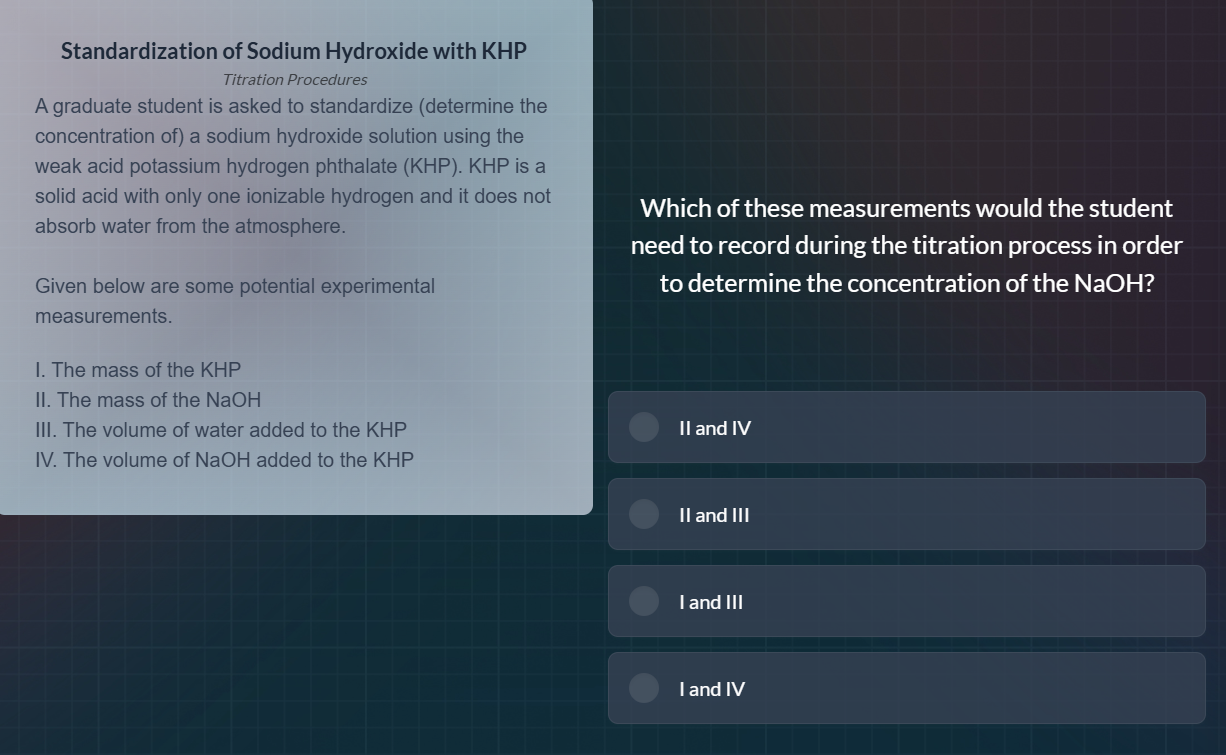
standardization of sodium hydroxide with khp
titration procedures
a graduate student is asked to standardize (determine the
concentration of) a sodium hydroxide solution using the
weak acid potassium hydrogen phthalate (khp). khp is a
solid acid with only one ionizable hydrogen and it does not
absorb water from the atmosphere.
given below are some potential experimental
measurements.
i. the mass of the khp
ii. the mass of the naoh
iii. the volume of water added to the khp
iv. the volume of naoh added to the khp
which of these measurements would the student
need to record during the titration process in order
to determine the concentration of the naoh?
ii and iv
ii and iii
i and iii
i and iv
To determine the concentration of NaOH, we use the reaction between KHP (a monoprotic acid) and NaOH (a base). The stoichiometry is 1:1. We need the moles of KHP (calculated from its mass, as moles = mass/molar mass) and the volume of NaOH used (to find moles of NaOH, since moles = concentration × volume, and we can solve for concentration). The mass of NaOH is not needed (we use its volume), and the volume of water added to KHP doesn't affect the moles of KHP or the reaction with NaOH. So we need I (mass of KHP) and IV (volume of NaOH added).

Snap & solve any problem in the app
Get step-by-step solutions on Sovi AI
Photo-based solutions with guided steps
Explore more problems and detailed explanations
I and IV