QUESTION IMAGE
Question
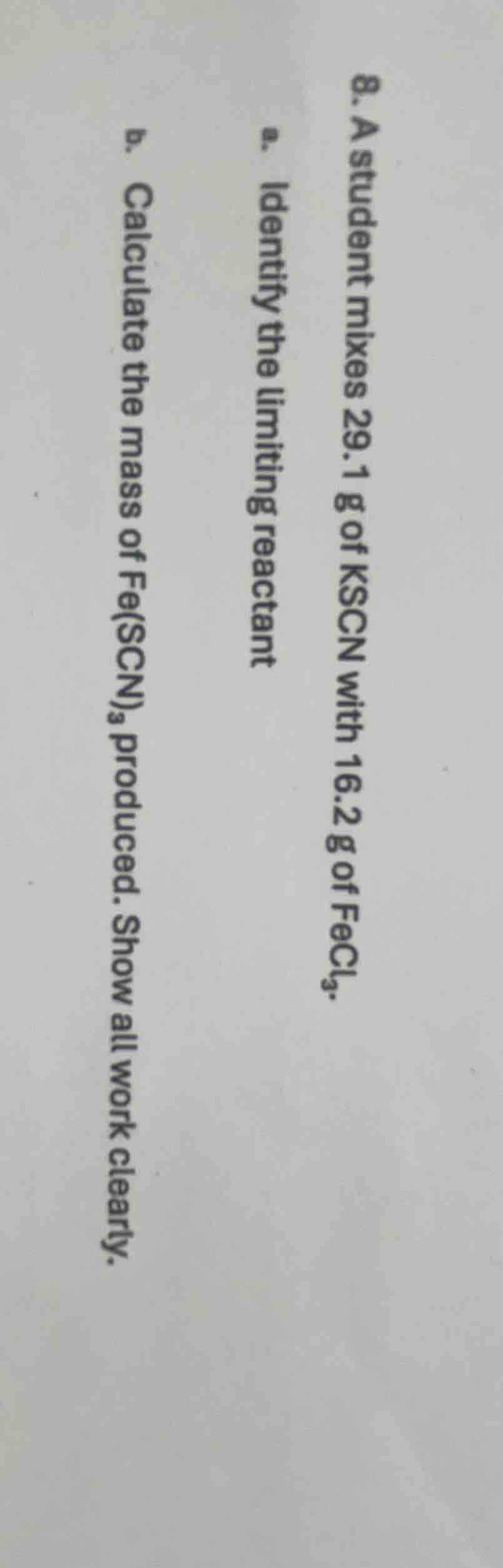
- a student mixes 29.1 g of kscn with 16.2 g of fecl₃.
a. identify the limiting reactant
b. calculate the mass of fe(scn)₃ produced. show all work clearly.
Part a: Identify the limiting reactant
First, we need to write the balanced chemical equation for the reaction between \( \text{KSCN} \) and \( \text{FeCl}_3 \). The reaction is:
\[ \text{FeCl}_3 + 3\text{KSCN}
ightarrow \text{Fe(SCN)}_3 + 3\text{KCl} \]
Step 1: Calculate moles of \( \text{FeCl}_3 \)
Molar mass of \( \text{FeCl}_3 \) = \( 55.85 + 3(35.45) = 55.85 + 106.35 = 162.2 \, \text{g/mol} \)
Moles of \( \text{FeCl}_3 = \frac{\text{mass}}{\text{molar mass}} = \frac{16.2 \, \text{g}}{162.2 \, \text{g/mol}} \approx 0.100 \, \text{mol} \)
Step 2: Calculate moles of \( \text{KSCN} \)
Molar mass of \( \text{KSCN} \) = \( 39.10 + 32.07 + 12.01 + 14.01 = 97.19 \, \text{g/mol} \)
Moles of \( \text{KSCN} = \frac{29.1 \, \text{g}}{97.19 \, \text{g/mol}} \approx 0.299 \, \text{mol} \)
Step 3: Determine the mole ratio required by the reaction
From the balanced equation, 1 mole of \( \text{FeCl}_3 \) reacts with 3 moles of \( \text{KSCN} \).
The mole ratio of \( \text{FeCl}_3 \) to \( \text{KSCN} \) in the reaction is \( 1:3 \).
Step 4: Compare the actual mole ratio with the required ratio
Actual mole ratio of \( \text{FeCl}_3 \) to \( \text{KSCN} = \frac{0.100 \, \text{mol}}{0.299 \, \text{mol}} \approx 0.334 \)
Required mole ratio (from the balanced equation) is \( \frac{1}{3} \approx 0.333 \)
Now, let's check the moles of reactants required for complete reaction:
- If all \( \text{FeCl}_3 \) (0.100 mol) reacts, moles of \( \text{KSCN} \) required = \( 3 \times 0.100 = 0.300 \, \text{mol} \)
- We have 0.299 mol of \( \text{KSCN} \), which is slightly less than 0.300 mol.
- If all \( \text{KSCN} \) (0.299 mol) reacts, moles of \( \text{FeCl}_3 \) required = \( \frac{0.299 \, \text{mol}}{3} \approx 0.0997 \, \text{mol} \)
- We have 0.100 mol of \( \text{FeCl}_3 \), which is slightly more than 0.0997 mol.
Since we don't have enough \( \text{KSCN} \) to react with all the \( \text{FeCl}_3 \) (we need 0.300 mol of \( \text{KSCN} \) but only have 0.299 mol), \( \text{KSCN} \) is the limiting reactant? Wait, no—wait, let's recheck.
Wait, when we calculate the moles of \( \text{FeCl}_3 \) is 0.100 mol, and moles of \( \text{KSCN} \) is 0.299 mol.
The stoichiometric ratio is 1 mol \( \text{FeCl}_3 \) : 3 mol \( \text{KSCN} \).
So, for 0.100 mol \( \text{FeCl}_3 \), we need 3 * 0.100 = 0.300 mol \( \text{KSCN} \). But we have only 0.299 mol \( \text{KSCN} \), which is less than 0.300 mol. Therefore, \( \text{KSCN} \) is the limiting reactant? Wait, no—wait, maybe I made a mistake. Wait, let's check the other way: how much \( \text{FeCl}_3 \) is needed for 0.299 mol \( \text{KSCN} \).
Moles of \( \text{FeCl}_3 \) needed = \( \frac{0.299 \, \text{mol} \, \text{KSCN}}{3} \approx 0.0997 \, \text{mol} \). We have 0.100 mol \( \text{FeCl}_3 \), which is more than 0.0997 mol. So \( \text{KSCN} \) is the limiting reactant because it will be completely consumed first, and there will be some \( \text{FeCl}_3 \) left over.
Wait, but let's confirm:
Moles of \( \text{FeCl}_3 \) = 0.100 mol
Moles of \( \text{KSCN} \) = 0.299 mol
From the balanced equation, 1 mol \( \text{FeCl}_3 \) reacts with 3 mol \( \text{KSCN} \).
So, the mole ratio of \( \text{FeCl}_3 \) to \( \text{KSCN} \) in the reaction is 1:3.
The actual mole ratio is \( \frac{0.100}{0.299} \approx 0.334 \), which is slightly more than \( \frac{1}{3} \approx 0.333 \). This means we have a bit more \( \text{FeCl}_3 \) than needed for the \( \text{KSCN} \) present. Wait, no—if the actual ratio is higher than the stoichiometric ratio, that means the numerator…

Snap & solve any problem in the app
Get step-by-step solutions on Sovi AI
Photo-based solutions with guided steps
Explore more problems and detailed explanations
Part a: Identify the limiting reactant
First, we need to write the balanced chemical equation for the reaction between \( \text{KSCN} \) and \( \text{FeCl}_3 \). The reaction is:
\[ \text{FeCl}_3 + 3\text{KSCN}
ightarrow \text{Fe(SCN)}_3 + 3\text{KCl} \]
Step 1: Calculate moles of \( \text{FeCl}_3 \)
Molar mass of \( \text{FeCl}_3 \) = \( 55.85 + 3(35.45) = 55.85 + 106.35 = 162.2 \, \text{g/mol} \)
Moles of \( \text{FeCl}_3 = \frac{\text{mass}}{\text{molar mass}} = \frac{16.2 \, \text{g}}{162.2 \, \text{g/mol}} \approx 0.100 \, \text{mol} \)
Step 2: Calculate moles of \( \text{KSCN} \)
Molar mass of \( \text{KSCN} \) = \( 39.10 + 32.07 + 12.01 + 14.01 = 97.19 \, \text{g/mol} \)
Moles of \( \text{KSCN} = \frac{29.1 \, \text{g}}{97.19 \, \text{g/mol}} \approx 0.299 \, \text{mol} \)
Step 3: Determine the mole ratio required by the reaction
From the balanced equation, 1 mole of \( \text{FeCl}_3 \) reacts with 3 moles of \( \text{KSCN} \).
The mole ratio of \( \text{FeCl}_3 \) to \( \text{KSCN} \) in the reaction is \( 1:3 \).
Step 4: Compare the actual mole ratio with the required ratio
Actual mole ratio of \( \text{FeCl}_3 \) to \( \text{KSCN} = \frac{0.100 \, \text{mol}}{0.299 \, \text{mol}} \approx 0.334 \)
Required mole ratio (from the balanced equation) is \( \frac{1}{3} \approx 0.333 \)
Now, let's check the moles of reactants required for complete reaction:
- If all \( \text{FeCl}_3 \) (0.100 mol) reacts, moles of \( \text{KSCN} \) required = \( 3 \times 0.100 = 0.300 \, \text{mol} \)
- We have 0.299 mol of \( \text{KSCN} \), which is slightly less than 0.300 mol.
- If all \( \text{KSCN} \) (0.299 mol) reacts, moles of \( \text{FeCl}_3 \) required = \( \frac{0.299 \, \text{mol}}{3} \approx 0.0997 \, \text{mol} \)
- We have 0.100 mol of \( \text{FeCl}_3 \), which is slightly more than 0.0997 mol.
Since we don't have enough \( \text{KSCN} \) to react with all the \( \text{FeCl}_3 \) (we need 0.300 mol of \( \text{KSCN} \) but only have 0.299 mol), \( \text{KSCN} \) is the limiting reactant? Wait, no—wait, let's recheck.
Wait, when we calculate the moles of \( \text{FeCl}_3 \) is 0.100 mol, and moles of \( \text{KSCN} \) is 0.299 mol.
The stoichiometric ratio is 1 mol \( \text{FeCl}_3 \) : 3 mol \( \text{KSCN} \).
So, for 0.100 mol \( \text{FeCl}_3 \), we need 3 * 0.100 = 0.300 mol \( \text{KSCN} \). But we have only 0.299 mol \( \text{KSCN} \), which is less than 0.300 mol. Therefore, \( \text{KSCN} \) is the limiting reactant? Wait, no—wait, maybe I made a mistake. Wait, let's check the other way: how much \( \text{FeCl}_3 \) is needed for 0.299 mol \( \text{KSCN} \).
Moles of \( \text{FeCl}_3 \) needed = \( \frac{0.299 \, \text{mol} \, \text{KSCN}}{3} \approx 0.0997 \, \text{mol} \). We have 0.100 mol \( \text{FeCl}_3 \), which is more than 0.0997 mol. So \( \text{KSCN} \) is the limiting reactant because it will be completely consumed first, and there will be some \( \text{FeCl}_3 \) left over.
Wait, but let's confirm:
Moles of \( \text{FeCl}_3 \) = 0.100 mol
Moles of \( \text{KSCN} \) = 0.299 mol
From the balanced equation, 1 mol \( \text{FeCl}_3 \) reacts with 3 mol \( \text{KSCN} \).
So, the mole ratio of \( \text{FeCl}_3 \) to \( \text{KSCN} \) in the reaction is 1:3.
The actual mole ratio is \( \frac{0.100}{0.299} \approx 0.334 \), which is slightly more than \( \frac{1}{3} \approx 0.333 \). This means we have a bit more \( \text{FeCl}_3 \) than needed for the \( \text{KSCN} \) present. Wait, no—if the actual ratio is higher than the stoichiometric ratio, that means the numerator ( \( \text{FeCl}_3 \)) is in excess, and the denominator ( \( \text{KSCN} \)) is the limiting reactant. Wait, maybe I confused the ratio.
Let me use the method of calculating the amount of product each reactant can produce.
Step 5: Calculate moles of \( \text{Fe(SCN)}_3 \) from each reactant
From \( \text{FeCl}_3 \):
1 mol \( \text{FeCl}_3 \) produces 1 mol \( \text{Fe(SCN)}_3 \)
Moles of \( \text{Fe(SCN)}_3 \) from \( \text{FeCl}_3 = 0.100 \, \text{mol} \)
From \( \text{KSCN} \):
3 mol \( \text{KSCN} \) produces 1 mol \( \text{Fe(SCN)}_3 \)
Moles of \( \text{Fe(SCN)}_3 \) from \( \text{KSCN} = \frac{0.299 \, \text{mol}}{3} \approx 0.0997 \, \text{mol} \)
Since \( \text{KSCN} \) produces less \( \text{Fe(SCN)}_3 \), \( \text{KSCN} \) is the limiting reactant. Wait, but earlier when we calculated moles of \( \text{FeCl}_3 \) needed for \( \text{KSCN} \), it was ~0.0997 mol, and we have 0.100 mol, so \( \text{FeCl}_3 \) is in excess, and \( \text{KSCN} \) is limiting. Wait, but let's check the moles again.
Wait, mass of \( \text{FeCl}_3 \) is 16.2 g, molar mass 162.2 g/mol, so moles = 16.2 / 162.2 ≈ 0.100 mol (correct).
Mass of \( \text{KSCN} \) is 29.1 g, molar mass 97.19 g/mol, so moles = 29.1 / 97.19 ≈ 0.299 mol (correct).
From the balanced equation, 1 mol \( \text{FeCl}_3 \) reacts with 3 mol \( \text{KSCN} \).
So, the mole ratio of \( \text{FeCl}_3 \) to \( \text{KSCN} \) required is 1:3.
Actual mole ratio: 0.100 : 0.299 ≈ 1 : 2.99, which is less than 1:3 (since 2.99 < 3). Wait, that means we have less \( \text{KSCN} \) than needed for the \( \text{FeCl}_3 \) present. Therefore, \( \text{KSCN} \) is the limiting reactant.
Yes, because the actual ratio of \( \text{KSCN} \) to \( \text{FeCl}_3 \) is 2.99:1, which is less than the required 3:1. So \( \text{KSCN} \) is limiting.
Part b: Calculate the mass of \( \text{Fe(SCN)}_3 \) produced
Since \( \text{KSCN} \) is the limiting reactant, we use its moles to calculate the moles of \( \text{Fe(SCN)}_3 \).
Step 1: Moles of \( \text{Fe(SCN)}_3 \) from \( \text{KSCN} \)
From the balanced equation, 3 mol \( \text{KSCN} \) produces 1 mol \( \text{Fe(SCN)}_3 \).
Moles of \( \text{Fe(SCN)}_3 = \frac{0.299 \, \text{mol} \, \text{KSCN}}{3} \approx 0.0997 \, \text{mol} \)
Step 2: Molar mass of \( \text{Fe(SCN)}_3 \)
Molar mass of \( \text{Fe(SCN)}_3 \) = \( 55.85 + 3(32.07 + 12.01 + 14.01) \)
= \( 55.85 + 3(58.09) \)
= \( 55.85 + 174.27 \)
= \( 229.12 \, \text{g/mol} \)
Step 3: Mass of \( \text{Fe(SCN)}_3 \)
Mass = moles × molar mass = \( 0.0997 \, \text{mol} × 229.12 \, \text{g/mol} \approx 22.8 \, \text{g} \)
Final Answers
Part a:
The limiting reactant is \( \text{KSCN} \).
Part b:
The mass of \( \text{Fe(SCN)}_3 \) produced is approximately \( \boldsymbol{22.8 \, \text{g}} \) (or more precisely, ~22.8 g).