QUESTION IMAGE
Question
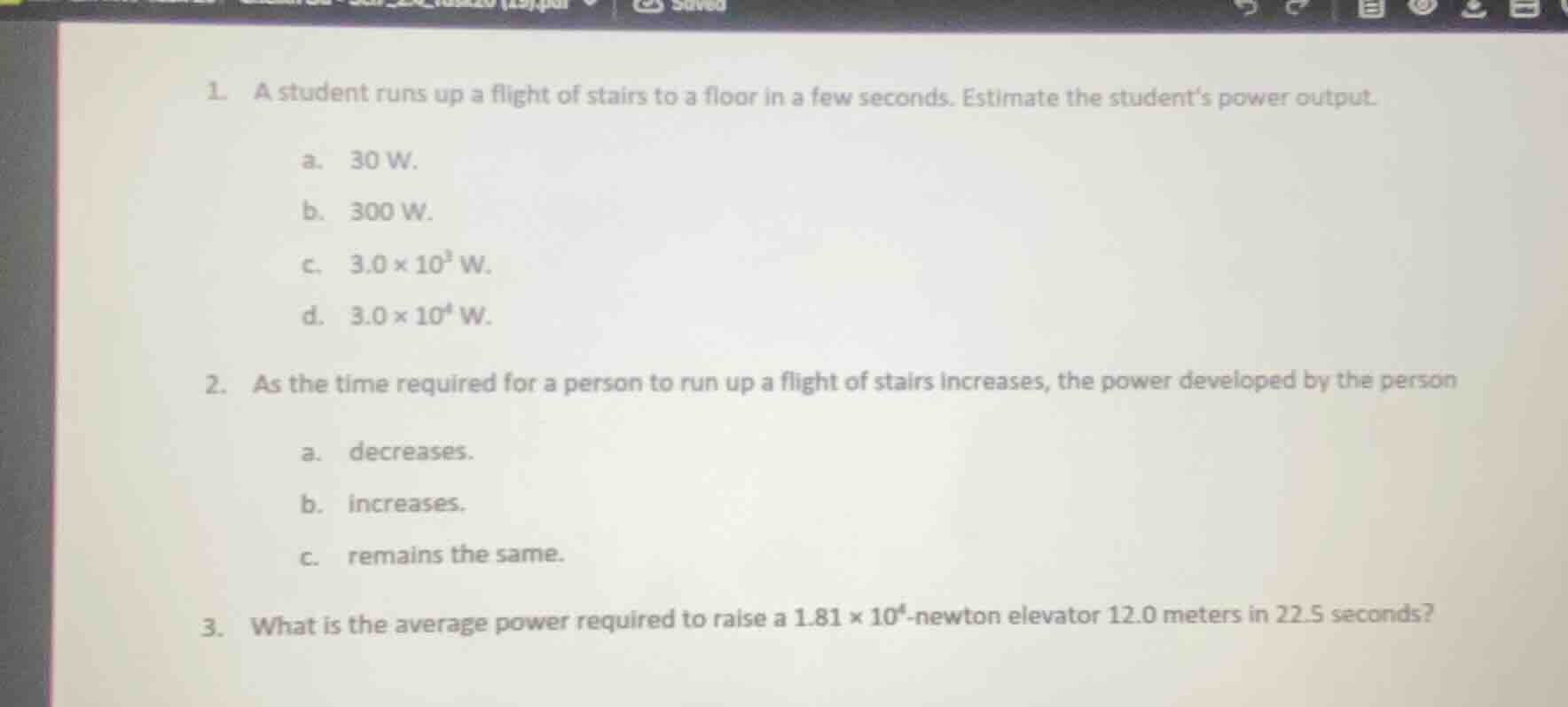
- a student runs up a flight of stairs to a floor in a few seconds. estimate the student’s power output.
a. 30 w.
b. 300 w.
c. 3.0×10³ w.
d. 3.0×10⁴ w.
- as the time required for a person to run up a flight of stairs increases, the power developed by the person
a. decreases.
b. increases.
c. remains the same.
- what is the average power required to raise a 1.81×10⁴-newton elevator 12.0 meters in 22.5 seconds?
Question 1
To estimate the student's power output, we use the formula for power \( P=\frac{W}{t} \), where \( W = mgh \) (work done against gravity). A typical student's mass \( m \approx 60\space kg \), height of stairs \( h \approx 5\space m \), time \( t \approx 10\space s \). Then \( W = 60\times9.8\times5= 2940\space J \), and \( P=\frac{2940}{10} \approx 294\space W \), which is close to 300 W. Options a is too low, c and d are extremely high (like power of a large machine), so b is correct.
Power formula is \( P=\frac{W}{t} \) (work \( W \) is constant as the person does work against gravity to climb stairs). If time \( t \) increases and \( W \) is constant, from \( P=\frac{W}{t} \), power \( P \) is inversely proportional to \( t \). So as \( t \) increases, \( P \) decreases.
Step1: Calculate work done
Work \( W \) done to raise the elevator is \( W = F\times d \) (since force \( F \) is weight and displacement \( d \) is height). Given \( F = 1.81\times 10^{4}\space N \), \( d=12.0\space m \). So \( W=(1.81\times 10^{4})\times12.0 = 2.172\times 10^{5}\space J \)
Step2: Calculate power
Power \( P=\frac{W}{t} \), time \( t = 22.5\space s \). So \( P=\frac{2.172\times 10^{5}}{22.5}\approx 9653.33\space W \) or we can write it as \( P=\frac{F\times d}{t}=\frac{1.81\times 10^{4}\times12.0}{22.5} \)
First, calculate numerator: \( 1.81\times 10^{4}\times12.0 = 1.81\times12\times 10^{4}=21.72\times 10^{4} = 2.172\times 10^{5} \)
Then divide by \( t = 22.5 \): \( \frac{2.172\times 10^{5}}{22.5}=\frac{217200}{22.5}=9653.33\space W \approx 9.65\times 10^{3}\space W \) (or we can keep more precise calculation)

Snap & solve any problem in the app
Get step-by-step solutions on Sovi AI
Photo-based solutions with guided steps
Explore more problems and detailed explanations
b. 300 W