QUESTION IMAGE
Question
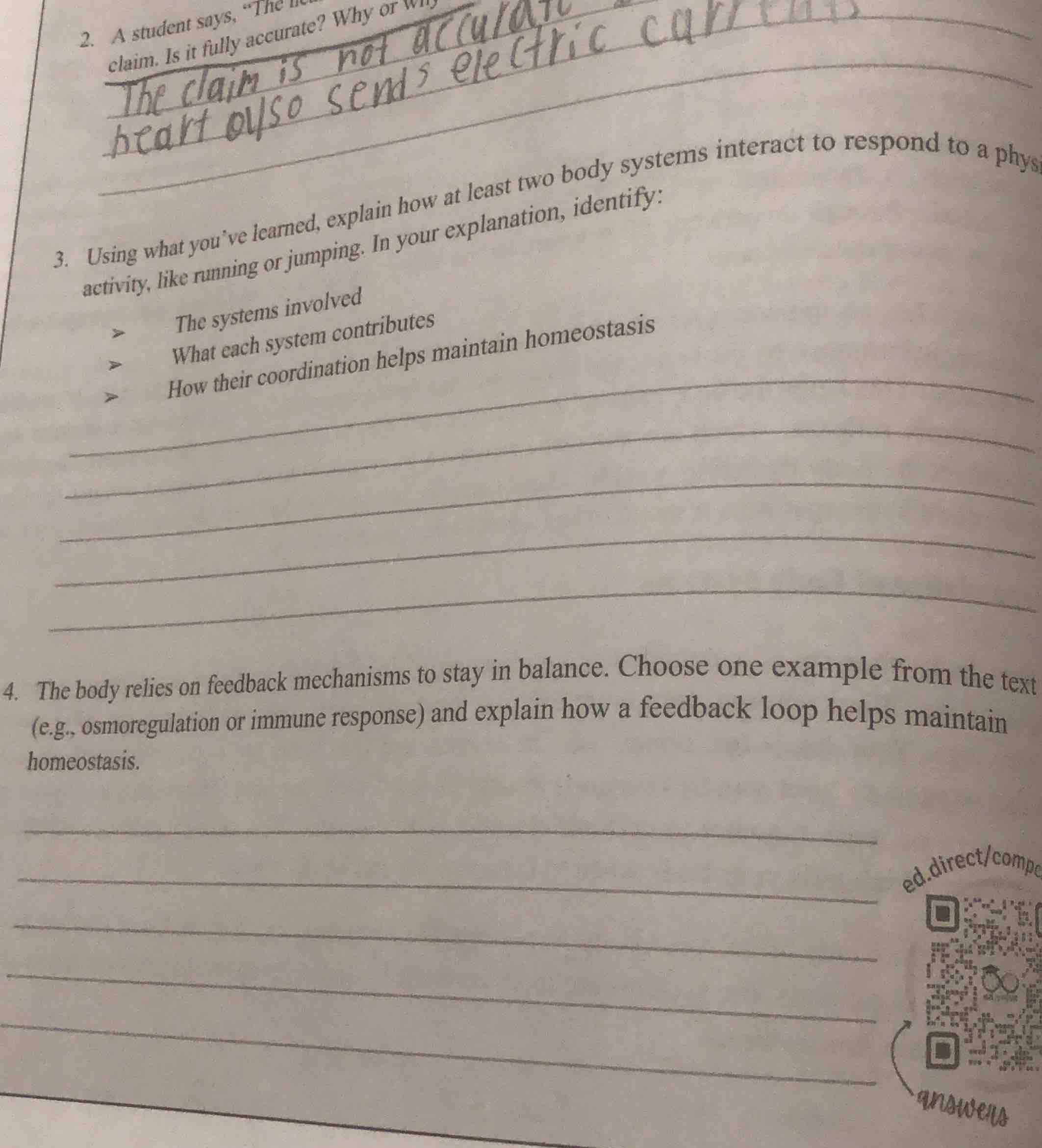
- a student says, \the ... claim. is it fully accurate? why or why ... the claim is not accurate ... heart also sends electric ...
- using what youve learned, explain how at least two body systems interact to respond to a physical activity, like running or jumping. in your explanation, identify:
- the systems involved
- what each system contributes
- how their coordination helps maintain homeostasis
- the body relies on feedback mechanisms to stay in balance. choose one example from the text (e.g., osmoregulation or immune response) and explain how a feedback loop helps maintain homeostasis.
Response
Question 3 (Explanation for body systems interaction during running):
Brief Explanations
- Systems Involved: Muscular System, Respiratory System, Circulatory System (we'll focus on Muscular and Respiratory for simplicity).
- Contributions:
- Muscular System: Muscles contract to enable running, which requires energy (ATP) and produces carbon dioxide (CO₂) as a waste product.
- Respiratory System: Increases breathing rate to take in more oxygen (O₂) needed for cellular respiration in muscles and to expel the excess CO₂ produced by muscles.
- Coordination for Homeostasis: As muscles work harder during running, they need more O₂ and produce more CO₂. The respiratory system responds by increasing ventilation (breathing in more O₂ and out more CO₂). This ensures that the muscle cells have enough O₂ for energy production and that CO₂ levels in the blood don't rise too much, maintaining pH balance and overall internal stability (homeostasis). The circulatory system also plays a role by transporting O₂ to muscles and CO₂ away, but the interaction between Muscular and Respiratory is key here for gas exchange and energy supply.
Brief Explanations
- Example: Osmoregulation (regulation of water and solute concentrations, e.g., in blood).
- Feedback Loop Steps:
- Stimulus: Dehydration (e.g., after sweating a lot) leads to increased blood solute concentration (osmolarity) and decreased blood volume.
- Receptor: Osmoreceptors in the hypothalamus detect the high osmolarity.
- Control Center: Hypothalamus signals the pituitary gland to release antidiuretic hormone (ADH).
- Effector: Kidneys (specifically, the collecting ducts of nephrons). ADH makes the collecting ducts more permeable to water, so more water is reabsorbed from the urine back into the blood.
- Response: Blood volume increases, and blood osmolarity decreases (returns to normal).
- Feedback: As blood osmolarity returns to the set point (homeostatic range), the osmoreceptors stop signaling as strongly, and ADH release is reduced. This is a negative feedback loop because the response (water reabsorption) counteracts the initial stimulus (high osmolarity).

Snap & solve any problem in the app
Get step-by-step solutions on Sovi AI
Photo-based solutions with guided steps
Explore more problems and detailed explanations
- Systems Involved: Muscular System and Respiratory System.
- Contributions:
- Muscular System: Contracts to generate movement (running) and produces CO₂ as a metabolic waste.
- Respiratory System: Increases breathing rate to deliver more O₂ to muscles (for ATP production) and remove excess CO₂.
- Homeostasis Maintenance: The increased O₂ supply from the respiratory system supports muscle energy needs (preventing fatigue), while removing CO₂ prevents blood acidification (from CO₂ - to - carbonic acid conversion). This coordination keeps internal conditions (e.g., O₂/CO₂ levels, pH) stable during physical exertion.