QUESTION IMAGE
Question
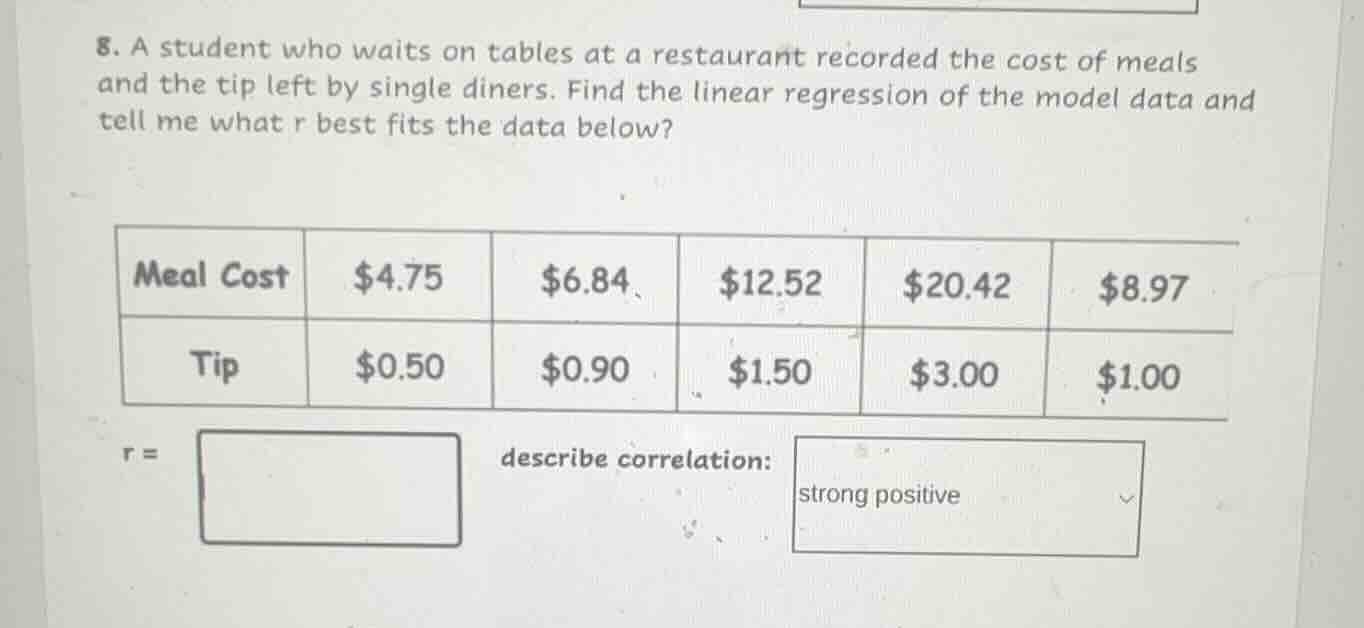
- a student who waits on tables at a restaurant recorded the cost of meals and the tip left by single diners. find the linear regression of the model data and tell me what r best fits the data below?
meal cost $4.75 $6.84 $12.52 $20.42 $8.97
tip $0.50 $0.90 $1.50 $3.00 $1.00
r =
describe correlation:
strong positive
Step1: Define Variables
Let \( x \) be the meal cost (independent variable) and \( y \) be the tip (dependent variable). The data points are:
\( (x_1, y_1) = (4.75, 0.50) \), \( (x_2, y_2) = (6.84, 0.90) \), \( (x_3, y_3) = (12.52, 1.50) \), \( (x_4, y_4) = (20.42, 3.00) \), \( (x_5, y_5) = (8.97, 1.00) \)
Step2: Calculate Mean of \( x \) and \( y \)
Mean of \( x \): \( \bar{x} = \frac{4.75 + 6.84 + 12.52 + 20.42 + 8.97}{5} = \frac{53.5}{5} = 10.7 \)
Mean of \( y \): \( \bar{y} = \frac{0.50 + 0.90 + 1.50 + 3.00 + 1.00}{5} = \frac{6.9}{5} = 1.38 \)
Step3: Calculate Deviations and Products
For each data point, calculate \( (x_i - \bar{x}) \), \( (y_i - \bar{y}) \), \( (x_i - \bar{x})(y_i - \bar{y}) \), and \( (x_i - \bar{x})^2 \), \( (y_i - \bar{y})^2 \)
- For \( (4.75, 0.50) \):
\( (4.75 - 10.7) = -5.95 \), \( (0.50 - 1.38) = -0.88 \)
\( (x_i - \bar{x})(y_i - \bar{y}) = (-5.95)(-0.88) = 5.236 \)
\( (x_i - \bar{x})^2 = (-5.95)^2 = 35.4025 \)
\( (y_i - \bar{y})^2 = (-0.88)^2 = 0.7744 \)
- For \( (6.84, 0.90) \):
\( (6.84 - 10.7) = -3.86 \), \( (0.90 - 1.38) = -0.48 \)
\( (x_i - \bar{x})(y_i - \bar{y}) = (-3.86)(-0.48) = 1.8528 \)
\( (x_i - \bar{x})^2 = (-3.86)^2 = 14.8996 \)
\( (y_i - \bar{y})^2 = (-0.48)^2 = 0.2304 \)
- For \( (12.52, 1.50) \):
\( (12.52 - 10.7) = 1.82 \), \( (1.50 - 1.38) = 0.12 \)
\( (x_i - \bar{x})(y_i - \bar{y}) = (1.82)(0.12) = 0.2184 \)
\( (x_i - \bar{x})^2 = (1.82)^2 = 3.3124 \)
\( (y_i - \bar{y})^2 = (0.12)^2 = 0.0144 \)
- For \( (20.42, 3.00) \):
\( (20.42 - 10.7) = 9.72 \), \( (3.00 - 1.38) = 1.62 \)
\( (x_i - \bar{x})(y_i - \bar{y}) = (9.72)(1.62) = 15.7464 \)
\( (x_i - \bar{x})^2 = (9.72)^2 = 94.4784 \)
\( (y_i - \bar{y})^2 = (1.62)^2 = 2.6244 \)
- For \( (8.97, 1.00) \):
\( (8.97 - 10.7) = -1.73 \), \( (1.00 - 1.38) = -0.38 \)
\( (x_i - \bar{x})(y_i - \bar{y}) = (-1.73)(-0.38) = 0.6574 \)
\( (x_i - \bar{x})^2 = (-1.73)^2 = 2.9929 \)
\( (y_i - \bar{y})^2 = (-0.38)^2 = 0.1444 \)
Step4: Calculate Sums
Sum of \( (x_i - \bar{x})(y_i - \bar{y}) \): \( \sum (x_i - \bar{x})(y_i - \bar{y}) = 5.236 + 1.8528 + 0.2184 + 15.7464 + 0.6574 = 23.711 \)
Sum of \( (x_i - \bar{x})^2 \): \( \sum (x_i - \bar{x})^2 = 35.4025 + 14.8996 + 3.3124 + 94.4784 + 2.9929 = 151.0858 \)
Sum of \( (y_i - \bar{y})^2 \): \( \sum (y_i - \bar{y})^2 = 0.7744 + 0.2304 + 0.0144 + 2.6244 + 0.1444 = 3.788 \)
Step5: Calculate Correlation Coefficient \( r \)
The formula for \( r \) is:
\( r = \frac{\sum (x_i - \bar{x})(y_i - \bar{y})}{\sqrt{\sum (x_i - \bar{x})^2 \sum (y_i - \bar{y})^2}} \)
Substitute the values:
\( r = \frac{23.711}{\sqrt{151.0858 \times 3.788}} \)
First, calculate the denominator: \( \sqrt{151.0858 \times 3.788} \approx \sqrt{572.31} \approx 23.92 \)
Then, \( r \approx \frac{23.711}{23.92} \approx 0.991 \)

Snap & solve any problem in the app
Get step-by-step solutions on Sovi AI
Photo-based solutions with guided steps
Explore more problems and detailed explanations
The correlation coefficient \( r \approx 0.991 \), which indicates a strong positive correlation (consistent with the given dropdown option).