QUESTION IMAGE
Question
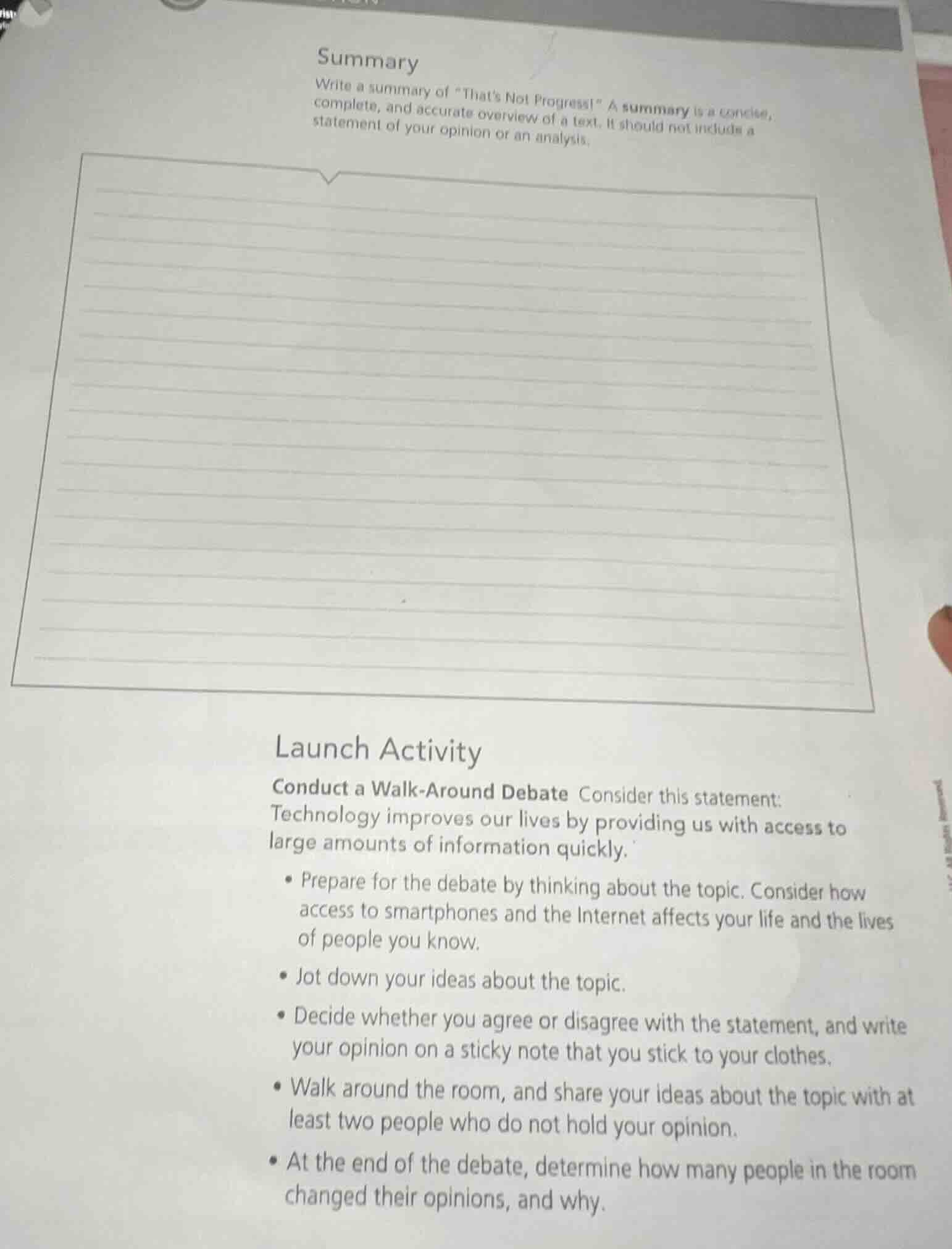
summary
write a summary of \thats not progress!\ a summary is a concise, complete, and accurate overview of a text. it should not include a statement of your opinion or an analysis.
launch activity
conduct a walk - around debate consider this statement:
technology improves our lives by providing us with access to large amounts of information quickly.
- prepare for the debate by thinking about the topic. consider how access to smartphones and the internet affects your life and the lives of people you know.
- jot down your ideas about the topic.
- decide whether you agree or disagree with the statement, and write your opinion on a sticky note that you stick to your clothes.
- walk around the room, and share your ideas about the topic with at least two people who do not hold your opinion.
- at the end of the debate, determine how many people in the room changed their opinions, and why.
To answer this, we assume the text "That’s Not Progress!" discusses the impact of technology (maybe critiquing the idea that tech’s info access is unqualified progress). A summary should capture the main points concisely, without opinion/analysis.
Step 1: Identify the text’s core topic
The text likely explores whether technology’s ability to provide rapid information access qualifies as “progress.” It may present arguments (e.g., drawbacks like misinformation, distraction, or unequal access, or counterpoints to the “technology improves lives” claim).
Step 2: Extract key elements
- Thesis/central claim: The text argues that technology’s info access is not true progress (or qualifies its benefits).
- Supporting points: May include examples of how rapid info access has negative consequences (e.g., misinformation, reduced critical thinking, social isolation) or fails to address deeper issues (equity, quality of information).
- Structure: The summary should mirror the text’s main argument and key evidence, keeping it concise.
For example, a summary could be: “‘That’s Not Progress!’ argues that while technology provides quick access to large amounts of information, this does not equate to true progress. It highlights issues like the spread of misinformation, the decline of critical thinking, and unequal access to reliable information, suggesting these drawbacks undermine the idea that rapid info access improves lives unconditionally.”
(Note: Since the original text of “That’s Not Progress!” is not provided, this is a template based on common themes. If the actual text has different details, adjust to reflect its specific arguments, evidence, and conclusion.)

Snap & solve any problem in the app
Get step-by-step solutions on Sovi AI
Photo-based solutions with guided steps
Explore more problems and detailed explanations
To answer this, we assume the text "That’s Not Progress!" discusses the impact of technology (maybe critiquing the idea that tech’s info access is unqualified progress). A summary should capture the main points concisely, without opinion/analysis.
Step 1: Identify the text’s core topic
The text likely explores whether technology’s ability to provide rapid information access qualifies as “progress.” It may present arguments (e.g., drawbacks like misinformation, distraction, or unequal access, or counterpoints to the “technology improves lives” claim).
Step 2: Extract key elements
- Thesis/central claim: The text argues that technology’s info access is not true progress (or qualifies its benefits).
- Supporting points: May include examples of how rapid info access has negative consequences (e.g., misinformation, reduced critical thinking, social isolation) or fails to address deeper issues (equity, quality of information).
- Structure: The summary should mirror the text’s main argument and key evidence, keeping it concise.
For example, a summary could be: “‘That’s Not Progress!’ argues that while technology provides quick access to large amounts of information, this does not equate to true progress. It highlights issues like the spread of misinformation, the decline of critical thinking, and unequal access to reliable information, suggesting these drawbacks undermine the idea that rapid info access improves lives unconditionally.”
(Note: Since the original text of “That’s Not Progress!” is not provided, this is a template based on common themes. If the actual text has different details, adjust to reflect its specific arguments, evidence, and conclusion.)