QUESTION IMAGE
Question
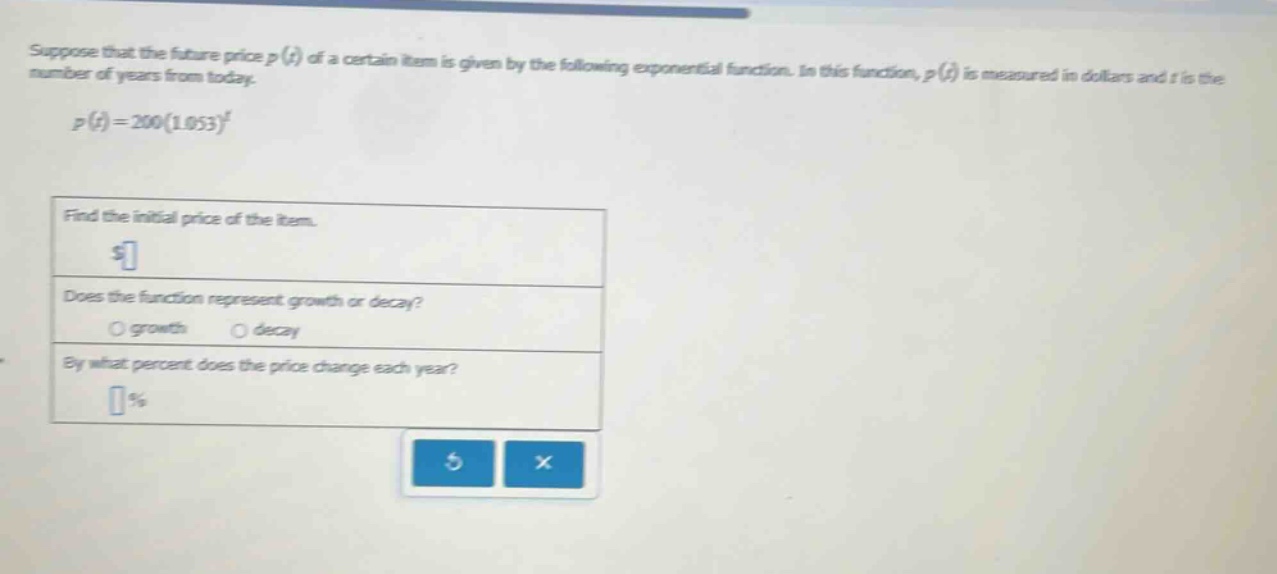
suppose that the future price p(t) of a certain item is given by the following exponential function. in this function, p(t) is measured in dollars and t is the number of years from today.\\( p(t) = 200(1.053)^t \\)\
find the initial price of the item.\
\\$\square\
does the function represent growth or decay?\
\\( \circ \\) growth \\( \circ \\) decay\
by what percent does the price change each year?\
\\( \square \\% \\)
Part 1: Initial Price
Step1: Recall exponential function form
The general form of an exponential function is \( p(t) = a(b)^t \), where \( a \) is the initial value (when \( t = 0 \)).
Step2: Substitute \( t = 0 \) into \( p(t) \)
For \( p(t) = 200(1.053)^t \), when \( t = 0 \), we have \( p(0) = 200(1.053)^0 \). Since any non - zero number to the power of 0 is 1, \( (1.053)^0=1 \). So \( p(0)=200\times1 = 200 \).
Step1: Recall growth/decay criteria
For an exponential function \( y = a(b)^t \), if \( b>1 \), the function represents growth; if \( 0 < b<1 \), it represents decay.
Step2: Analyze the base \( b \)
In the function \( p(t)=200(1.053)^t \), the base \( b = 1.053 \). Since \( 1.053>1 \), the function represents growth.
Step1: Recall exponential growth formula
The exponential growth formula is \( y=a(1 + r)^t \), where \( r \) is the growth rate (expressed as a decimal). In our function \( p(t)=200(1.053)^t=200(1 + 0.053)^t \).
Step2: Convert decimal to percentage
To find the percentage change, we convert the decimal growth rate \( r = 0.053 \) to a percentage by multiplying by 100. So \( 0.053\times100=5.3 \).

Snap & solve any problem in the app
Get step-by-step solutions on Sovi AI
Photo-based solutions with guided steps
Explore more problems and detailed explanations
200