QUESTION IMAGE
Question
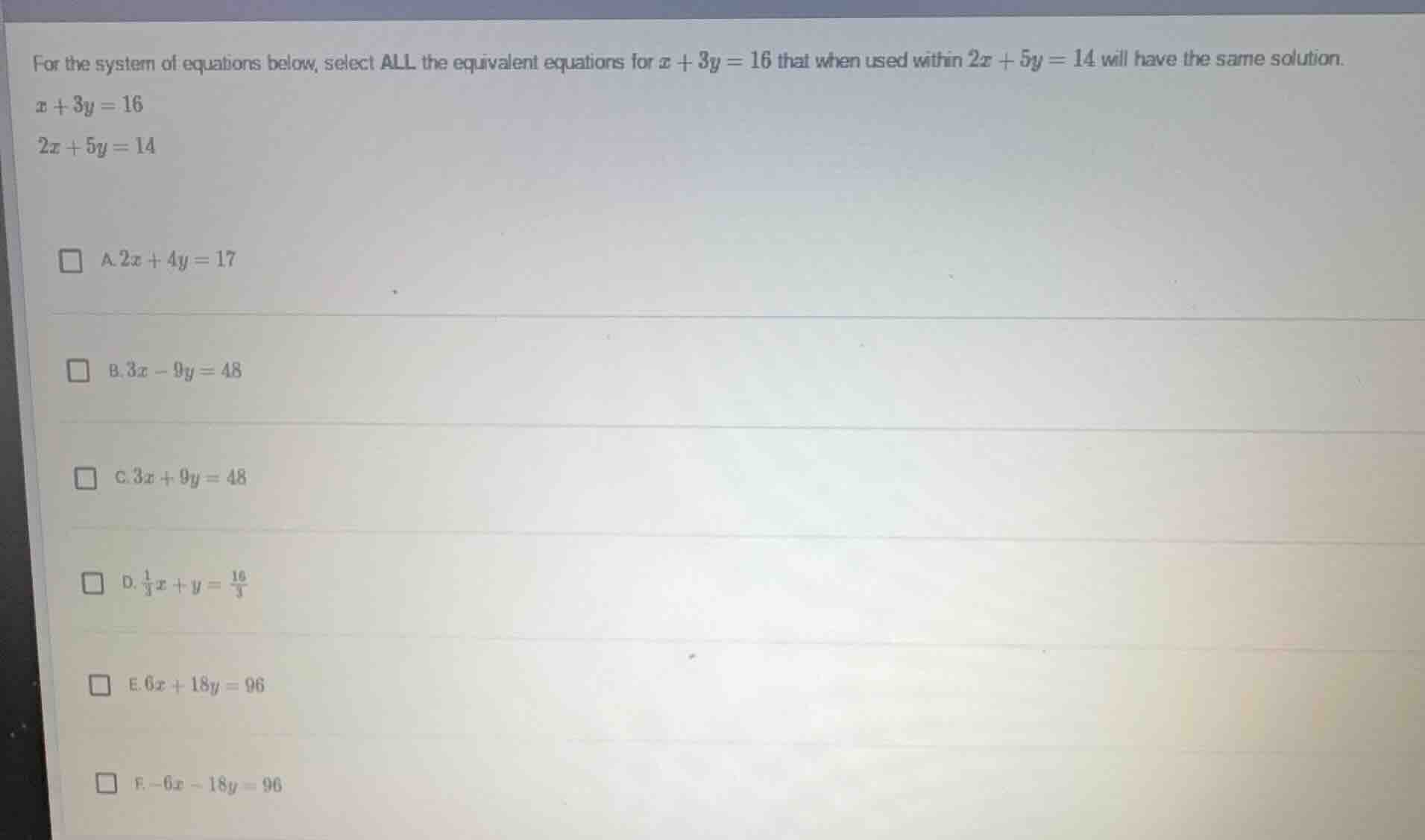
for the system of equations below, select all the equivalent equations for ( x + 3y = 16 ) that when used within ( 2x + 5y = 14 ) will have the same solution. ( x + 3y = 16 ) ( 2x + 5y = 14 ) a. ( 2x + 4y = 17 ) b. ( 3x - 9y = 48 ) c. ( 3x + 9y = 48 ) d. ( \frac{1}{3}x + y = \frac{16}{3} ) e. ( 6x + 18y = 96 ) f. ( -6x - 18y = 96 )
Step1: Recall Equivalent Equation Rule
An equivalent equation to \(x + 3y=16\) is obtained by multiplying/dividing the entire equation by a non - zero constant or performing valid algebraic manipulations (like adding/subtracting the same expression to both sides, but in the case of linear equations, scalar multiplication is the main way to get equivalent equations for the purpose of this problem). If we have an equation \(ax + by=c\), multiplying both sides by a non - zero constant \(k\) gives \(kax + kby = kc\), and this new equation is equivalent (has the same solution set) to the original equation.
Step2: Analyze Option A
The original equation is \(x + 3y = 16\). For option A: \(2x+4y = 17\). The left - hand side of the original equation is \(x + 3y\), and if we try to get \(2x+4y\) from \(x + 3y\), we would need to do operations that don't follow the scalar multiplication rule. Let's check the solution of the original system \(
\). From the first equation \(x=16 - 3y\). Substitute into the second equation: \(2(16 - 3y)+5y = 14\), \(32-6y + 5y=14\), \(32 - y=14\), \(y = 18\), \(x=16-3\times18=16 - 54=- 38\). Now substitute \(x=-38\) and \(y = 18\) into \(2x + 4y\): \(2\times(-38)+4\times18=-76 + 72=-4
eq17\). So option A is not equivalent.
Step3: Analyze Option B
The original equation is \(x + 3y = 16\). For option B: \(3x-9y = 48\). If we multiply the original equation \(x + 3y=16\) by 3, we get \(3x+9y = 48\), not \(3x - 9y=48\). Let's substitute \(x=-38\) and \(y = 18\) into \(3x-9y\): \(3\times(-38)-9\times18=-114-162=-276
eq48\). So option B is not equivalent.
Step4: Analyze Option C
Multiply the equation \(x + 3y = 16\) by 3. According to the rule of equivalent equations (multiplying both sides by 3), we have \(3\times(x + 3y)=3\times16\), which simplifies to \(3x+9y = 48\). So option C is equivalent.
Step5: Analyze Option D
Multiply the equation \(x + 3y = 16\) by \(\frac{1}{3}\). We get \(\frac{1}{3}\times(x + 3y)=\frac{1}{3}\times16\), which simplifies to \(\frac{1}{3}x + y=\frac{16}{3}\). So option D is equivalent.
Step6: Analyze Option E
Multiply the equation \(x + 3y = 16\) by 6. We have \(6\times(x + 3y)=6\times16\), which simplifies to \(6x+18y = 96\). So option E is equivalent.
Step7: Analyze Option F
Multiply the equation \(x + 3y = 16\) by \(- 6\). We get \(-6\times(x + 3y)=-6\times16\), which is \(-6x-18y=-96\), not \(-6x - 18y = 96\). Let's substitute \(x=-38\) and \(y = 18\) into \(-6x-18y\): \(-6\times(-38)-18\times18 = 228-324=-96
eq96\). So option F is not equivalent.

Snap & solve any problem in the app
Get step-by-step solutions on Sovi AI
Photo-based solutions with guided steps
Explore more problems and detailed explanations
C. \(3x + 9y = 48\), D. \(\frac{1}{3}x + y=\frac{16}{3}\), E. \(6x + 18y = 96\)