QUESTION IMAGE
Question
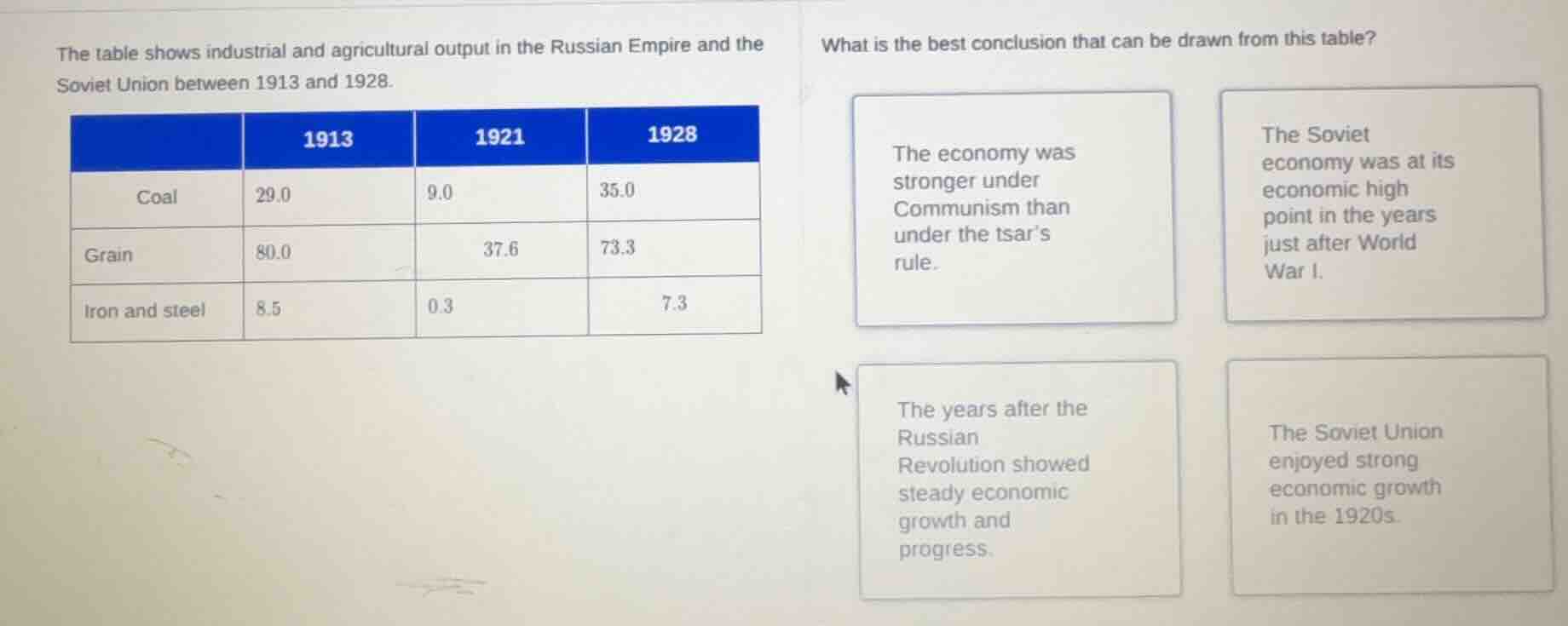
the table shows industrial and agricultural output in the russian empire and the soviet union between 1913 and 1928.
| 1913 | 1921 | 1928 | |
|---|---|---|---|
| grain | 80.0 | 37.6 | 73.3 |
| iron and steel | 8.5 | 0.3 | 7.3 |
what is the best conclusion that can be drawn from this table?
- the economy was stronger under communism than under the tsars rule.
- the soviet economy was at its economic high point in the years just after world war i.
- the years after the russian revolution showed steady economic growth and progress.
- the soviet union enjoyed strong economic growth in the 1920s.
Brief Explanations
- Evaluate "The economy was stronger under Communism than under the tsar’s rule": 1928 grain (73.3) and iron/steel (7.3) are still below 1913 levels (80.0 and 8.5 respectively), so this is false.
- Evaluate "The Soviet economy was at its economic high point in the years just after World War I": 1921 (post-WWI/Revolution) has the lowest output across all categories, so this is false.
- Evaluate "The years after the Russian Revolution showed steady economic growth and progress": Output dropped sharply in 1921 before rising, so growth was not steady, this is false.
- Evaluate "The Soviet Union enjoyed strong economic growth in the 1920s": From 1921 to 1928, coal rose from 9.0 to 35.0, grain from 37.6 to 73.3, and iron/steel from 0.3 to 7.3, showing strong growth in this decade, so this is true.

Snap & solve any problem in the app
Get step-by-step solutions on Sovi AI
Photo-based solutions with guided steps
Explore more problems and detailed explanations
The Soviet Union enjoyed strong economic growth in the 1920s.