QUESTION IMAGE
Question
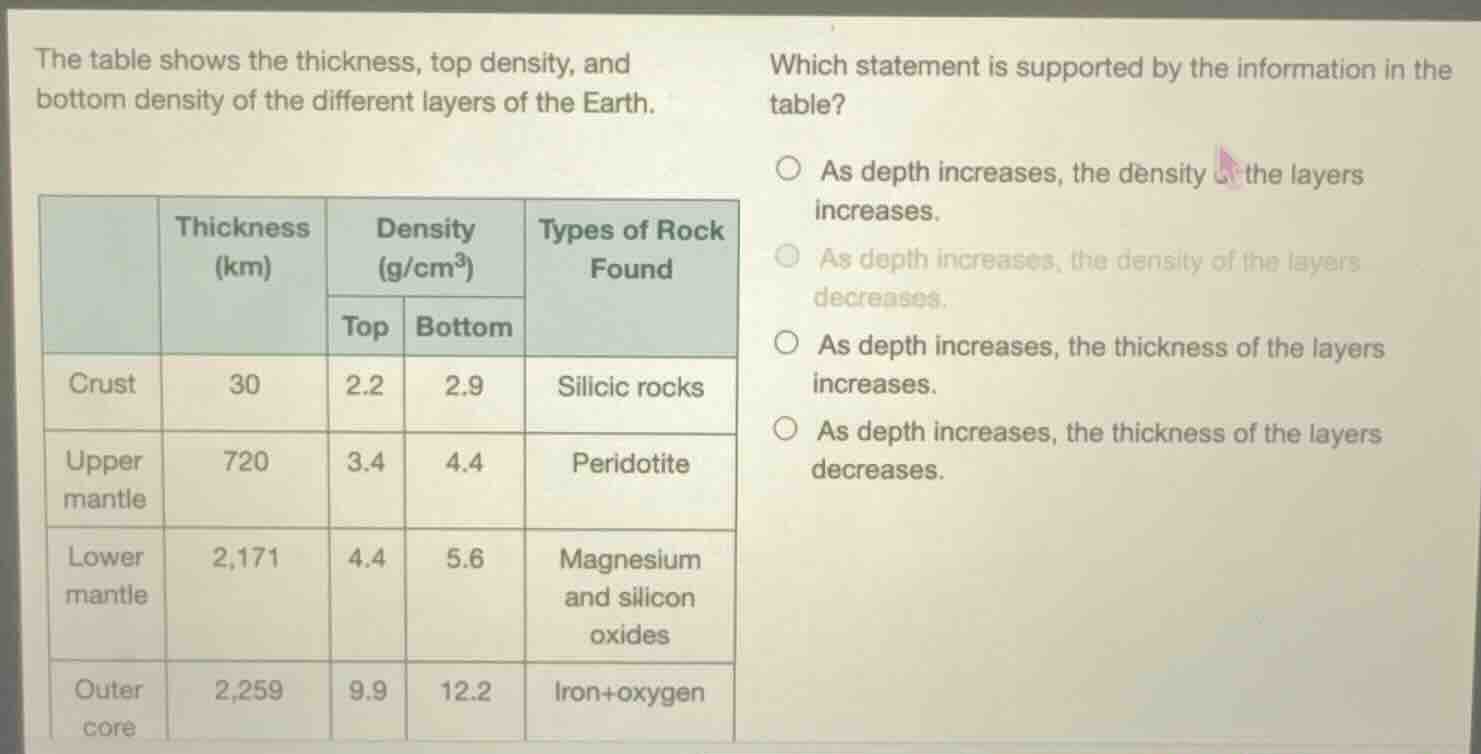
the table shows the thickness, top density, and bottom density of the different layers of the earth.
which statement is supported by the information in the table?
○ as depth increases, the density of the layers increases.
○ as depth increases, the density of the layers decreases.
○ as depth increases, the thickness of the layers increases.
○ as depth increases, the thickness of the layers decreases.
| thickness (km) | density (g/cm³) | types of rock found | ||
|---|---|---|---|---|
| crust | 30 | 2.2 | 2.9 | silicic rocks |
| upper mantle | 720 | 3.4 | 4.4 | peridotite |
| lower mantle | 2,171 | 4.4 | 5.6 | magnesium and silicon oxides |
| outer core | 2,259 | 9.9 | 12.2 | iron+oxygen |
- Analyze density trend with depth:
- Crust (shallowest): top density = 2.2 $\text{g/cm}^3$, bottom = 2.9 $\text{g/cm}^3$
- Upper mantle: top density = 3.4 $\text{g/cm}^3$, bottom = 4.4 $\text{g/cm}^3$
- Lower mantle: top density = 4.4 $\text{g/cm}^3$, bottom = 5.6 $\text{g/cm}^3$
- Outer core (deepest): top density = 9.9 $\text{g/cm}^3$, bottom = 12.2 $\text{g/cm}^3$
Each subsequent deeper layer has a higher top and bottom density than the layer above, so density increases with depth.
- Analyze thickness trend with depth:
- Crust thickness = 30 km
- Upper mantle thickness = 720 km
- Lower mantle thickness = 2,171 km
- Outer core thickness = 2,259 km
Thickness increases with depth, so the statements about decreasing thickness are incorrect.

Snap & solve any problem in the app
Get step-by-step solutions on Sovi AI
Photo-based solutions with guided steps
Explore more problems and detailed explanations
As depth increases, the density of the layers increases.