QUESTION IMAGE
Question
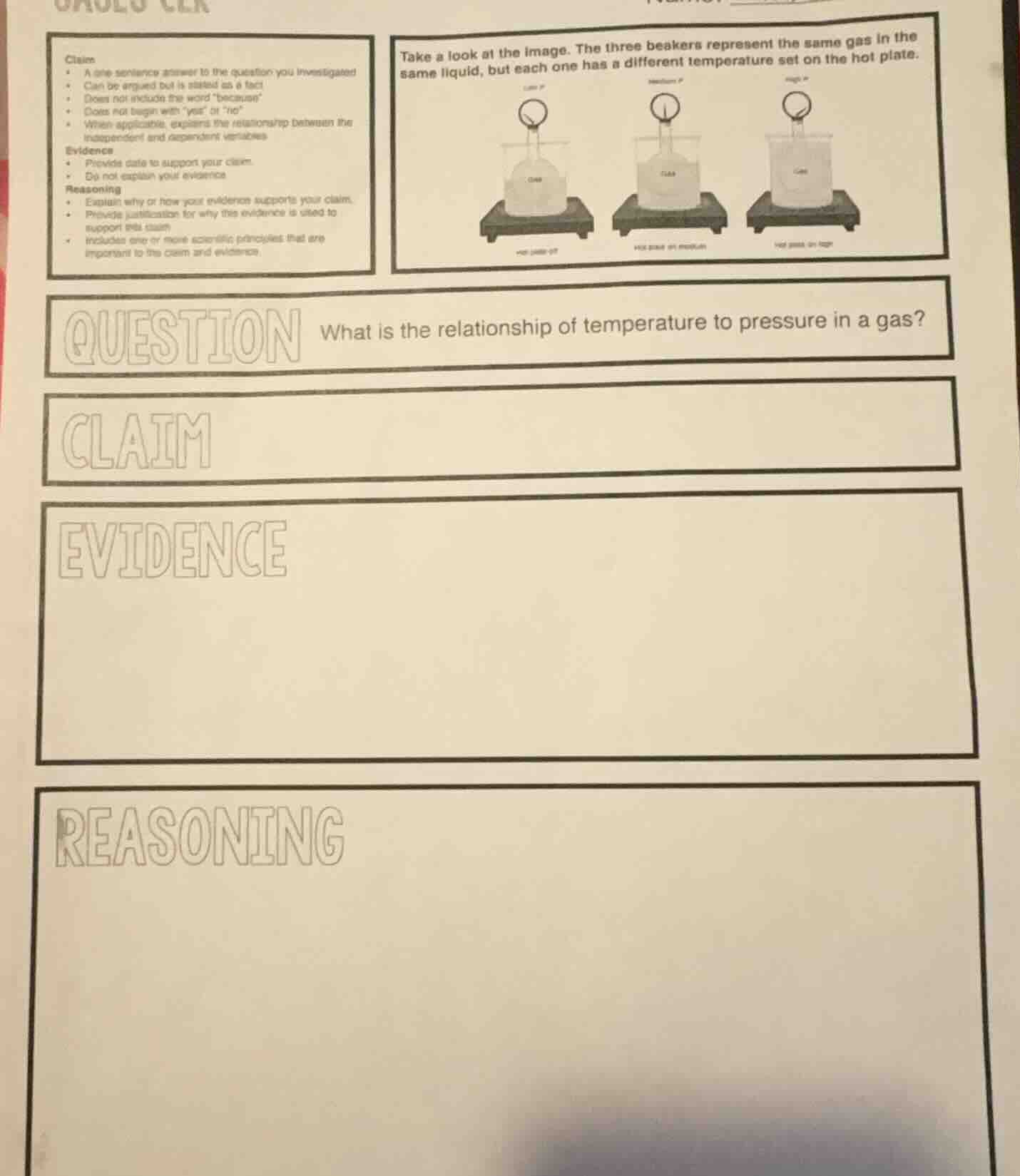
take a look at the image. the three beakers represent the same gas in the same liquid, but each one has a different temperature set on the hot plate.
question
what is the relationship of temperature to pressure in a gas?
claim
evidence
reasoning
CLAIM
As the temperature of a gas increases, its pressure increases (when volume is constant).
EVIDENCE
The pressure gauge shows low pressure at low temperature (hot plate off), medium pressure at medium temperature (hot plate on medium), and high pressure at high temperature (hot plate on high) for the same gas in the same - sized container.
REASONING
According to the kinetic molecular theory, gas particles are in constant motion. When the temperature of the gas (the independent variable) increases, the average kinetic energy of the gas particles increases. This means the particles move faster and collide with the walls of the container (which has a constant volume here) more frequently and with greater force. The pressure of a gas (the dependent variable) is defined as the force per unit area exerted by the gas particles on the container walls. So, more frequent and forceful collisions lead to an increase in pressure, which supports the claim that temperature and pressure of a gas are directly related (at constant volume).

Snap & solve any problem in the app
Get step-by-step solutions on Sovi AI
Photo-based solutions with guided steps
Explore more problems and detailed explanations
CLAIM
As the temperature of a gas increases, its pressure increases (when volume is constant).
EVIDENCE
The pressure gauge shows low pressure at low temperature (hot plate off), medium pressure at medium temperature (hot plate on medium), and high pressure at high temperature (hot plate on high) for the same gas in the same - sized container.
REASONING
According to the kinetic molecular theory, gas particles are in constant motion. When the temperature of the gas (the independent variable) increases, the average kinetic energy of the gas particles increases. This means the particles move faster and collide with the walls of the container (which has a constant volume here) more frequently and with greater force. The pressure of a gas (the dependent variable) is defined as the force per unit area exerted by the gas particles on the container walls. So, more frequent and forceful collisions lead to an increase in pressure, which supports the claim that temperature and pressure of a gas are directly related (at constant volume).