QUESTION IMAGE
Question
task 2
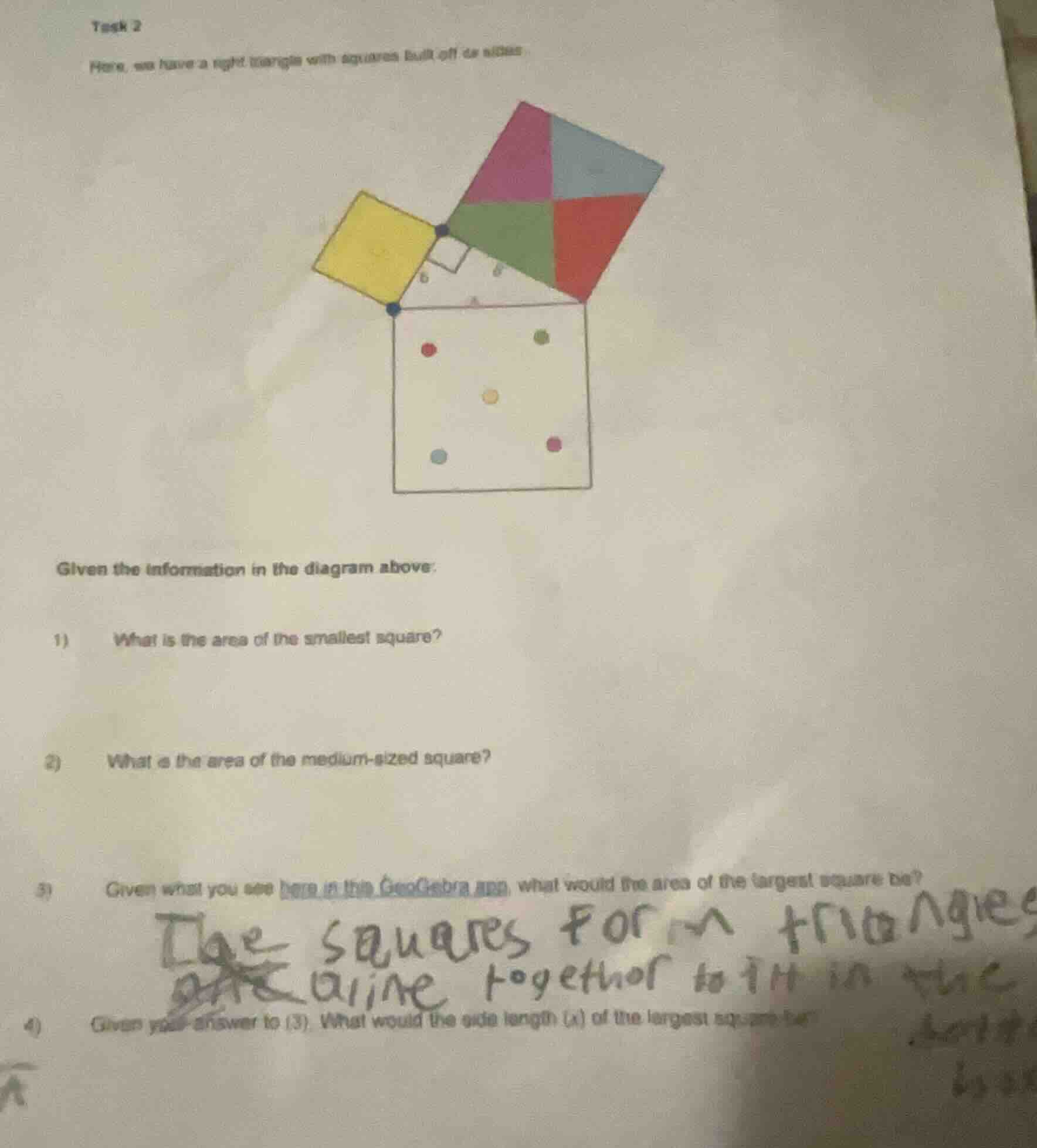
here, we have a right triangle with squares built off its sides.
given the information in the diagram above:
- what is the area of the smallest square?
- what is the area of the medium - sized square?
- given what you see here in the geogebra app, what would the area of the largest square be?
- given your answer to (3), what would the side length (x) of the largest square be?
Sub - question 1: Area of the smallest square
Step 1: Identify side length
From the diagram, the side length of the smallest square is 6 (assuming the label 6 is for its side).
Step 2: Calculate area
The area of a square is given by \( A = s^2 \), where \( s \) is the side length. So for \( s = 6 \), \( A=6^2 = 36 \).
Step 1: Identify side length
From the diagram, the side length of the medium - sized square is also 6 (assuming the other 6 label is for its side).
Step 2: Calculate area
Using the formula for the area of a square \( A = s^2 \), with \( s = 6 \), we get \( A = 6^2=36 \)? Wait, no, maybe I misread. Wait, if the right triangle has legs of length 6 and 8? Wait, maybe the medium - sized square has side length 8? Wait, the diagram shows a right triangle with legs 6 and 8? Wait, maybe the smallest square has side 6, medium has side 8. Let's re - evaluate. If the right triangle has legs \( a = 6 \) and \( b = 8 \), then the area of the square on the leg of length 6 is \( 6^2 = 36 \), and on the leg of length 8 is \( 8^2=64 \). Maybe the smallest square has side 6, area \( 6\times6 = 36 \), medium has side 8, area \( 8\times8 = 64 \). Let's correct.
Step 1: Assume side length
If the medium - sized square has side length 8 (from the right triangle leg), then area \( A=s^2\), \( s = 8 \), so \( A = 8^2=64 \).
Step 1: Apply Pythagorean theorem
For a right triangle, the Pythagorean theorem states that \( c^2=a^2 + b^2 \), where \( c \) is the hypotenuse and \( a,b \) are the legs. The area of the square on the hypotenuse (the largest square) is equal to \( c^2 \), and the areas of the squares on the legs are \( a^2 \) and \( b^2 \). From sub - questions 1 and 2, if \( a^2 = 36 \) and \( b^2=64 \), then \( c^2=a^2 + b^2=36 + 64 = 100 \).

Snap & solve any problem in the app
Get step-by-step solutions on Sovi AI
Photo-based solutions with guided steps
Explore more problems and detailed explanations
36