QUESTION IMAGE
Question
theory. it is thought that the earth is about ____ years old and is one of the results of a cosmic ____.
- dust particles collided together to form rocks that became ____ and __ until we had the ____ that we have today.
- early earth was probably ____ due to the __ heat, __ began to settle due to their ____.
- the denser material would ____ to the __ of the planet and the __ material moved towards the ____.
what is the internal structure of earth?
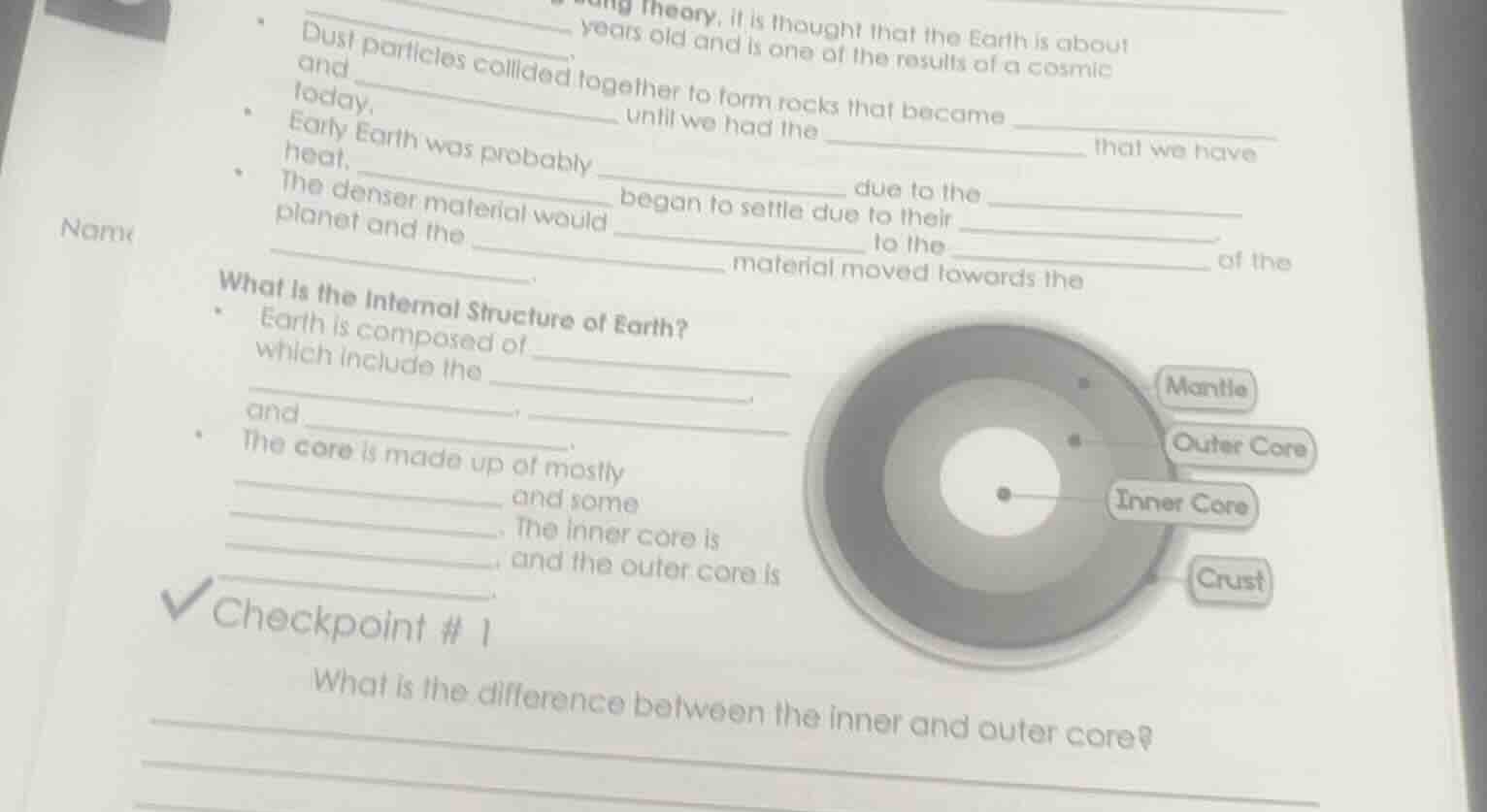
- earth is composed of ____ __, which include the __, __ and ____.
- the core is made up of mostly ____ and some __. the inner core is __, and the outer core is ____.
checkpoint # 1
what is the difference between the inner and outer core?
______
______
These fill-in-the-blank and short-answer questions cover Earth's formation and internal structure, based on basic Earth science principles.
- For the age of Earth: The widely accepted scientific age is derived from radiometric dating.
- For planetary formation: Dust particles collided to form planetesimals, then protoplanets, leading to the modern Earth.
- Early Earth's heat came from accretion and radioactive decay, causing differentiation by density.
- Earth's internal structure has distinct layers, with the core composed of iron and nickel, differing in state of matter.
- The core layers differ primarily in their physical state (solid vs. liquid) due to pressure differences.

Snap & solve any problem in the app
Get step-by-step solutions on Sovi AI
Photo-based solutions with guided steps
Explore more problems and detailed explanations
- First section (Earth formation):
- 4.5 billion
- planetesimals; protoplanets; Earth; planet
- molten; heat from accretion and radioactive decay; materials; density; center; sink; less dense; core
- Internal Structure of Earth:
- distinct concentric layers; crust, mantle, core
- iron; nickel; solid; liquid
- Checkpoint #1:
The inner core is a solid sphere composed mainly of iron and nickel, kept solid by the extreme pressure of the overlying layers. The outer core is a liquid layer of iron and nickel, and its churning motion generates Earth's magnetic field.