QUESTION IMAGE
Question
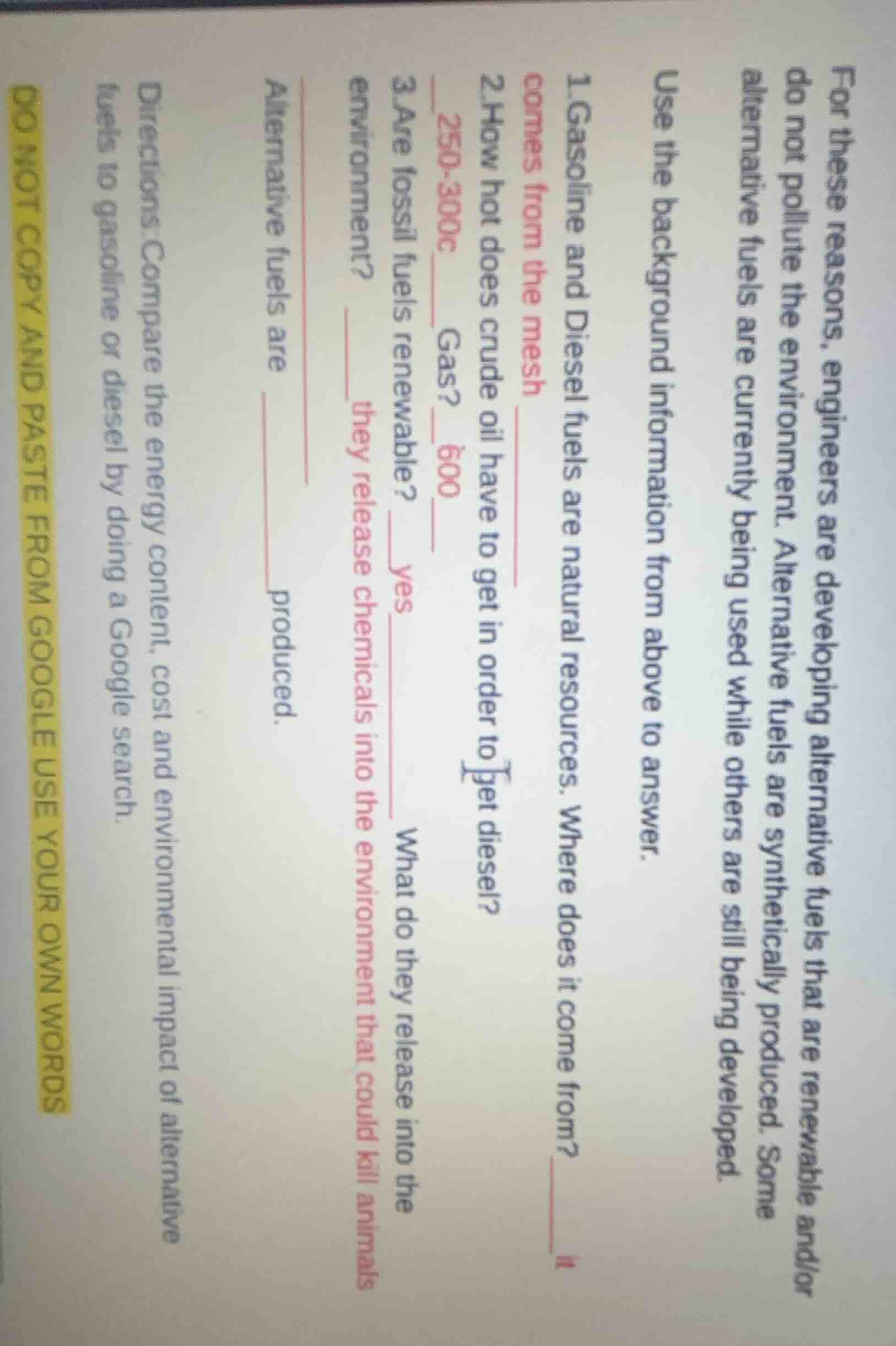
for these reasons, engineers are developing alternative fuels that are renewable and/or do not pollute the environment. alternative fuels are synthetically produced. some alternative fuels are currently being used while others are still being developed.
use the background information from above to answer.
1.gasoline and diesel fuels are natural resources. where does it come from? ____ it comes from the mesh ____
2.how hot does crude oil have to get in order to get diesel?
250-300cgas?600____
3.are fossil fuels renewable? __yes_____ what do they release into the environment? ____they release chemicals into the environment that could kill animals
alternative fuels are ______________produced.
directions:compare the energy content, cost and environmental impact of alternative fuels to gasoline or diesel by doing a google search.
do not copy and paste from google use your own words
- Gasoline and diesel are fossil fuels formed from ancient organic matter trapped in underground rock formations (oil reservoirs).
- Crude oil is heated in fractional distillation; different fuels vaporize at specific temperatures.
- Fossil fuels form over millions of years and cannot be replenished in a human timescale; their combustion releases greenhouse gases and toxic pollutants.
- Alternative fuels are made from renewable or synthetic sources to reduce pollution.
- Comparison based on standard energy, cost, and environmental data:
- Energy content: Measured in MJ/L; gasoline/diesel have higher values than most alternatives.
- Cost: Fossil fuels have lower upfront costs but hidden environmental costs; alternatives have higher production costs but stable long-term pricing.
- Environmental impact: Fossil fuels emit high CO₂ and pollutants; alternatives have near-zero or low emissions.

Snap & solve any problem in the app
Get step-by-step solutions on Sovi AI
Photo-based solutions with guided steps
Explore more problems and detailed explanations
- It comes from underground oil reservoirs (ancient organic matter buried in rock formations).
- 250-300°C (Gasoline), 600°C (Diesel)
- No; they release greenhouse gases (like CO₂) and toxic pollutants (like sulfur oxides, nitrogen oxides, and particulate matter) into the environment.
- Alternative fuels are renewably or synthetically produced.
5.
- Energy Content: Gasoline (~34.8 MJ/L) and diesel (~38.6 MJ/L) have higher energy density than most alternatives (e.g., ethanol: ~21.2 MJ/L, biodiesel: ~33 MJ/L, hydrogen: ~120 MJ/kg but low volumetric density).
- Cost: Gasoline and diesel have lower upfront per-unit costs, but alternative fuels (e.g., electric, hydrogen) have higher production/infrastructure costs but lower long-term operational costs.
- Environmental Impact: Gasoline and diesel release high levels of greenhouse gases (CO₂) and air pollutants (NOₓ, SOₓ, particulates) that contribute to climate change and poor air quality. Most alternative fuels (e.g., biodiesel, hydrogen, electric) have significantly lower or zero tailpipe emissions, reducing environmental harm.