QUESTION IMAGE
Question
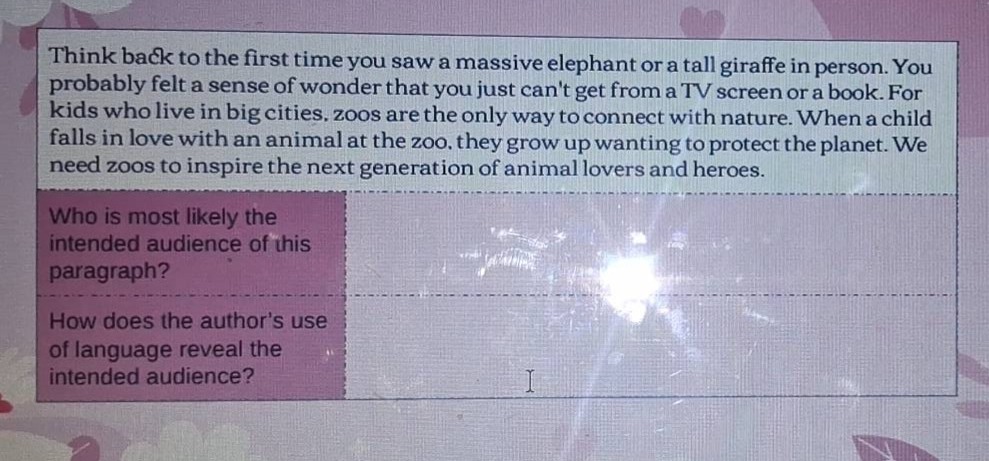
think back to the first time you saw a massive elephant or a tall giraffe in person. you probably felt a sense of wonder that you just cant get from a tv screen or a book. for kids who live in big cities, zoos are the only way to connect with nature. when a child falls in love with an animal at the zoo, they grow up wanting to protect the planet. we need zoos to inspire the next generation of animal lovers and heroes.
who is most likely the
intended audience of this
paragraph?
how does the author’s use
of language reveal the
intended audience?
First Sub - Question: Who is most likely the intended audience of this paragraph?
The paragraph talks about kids in big cities connecting with nature via zoos and inspiring the next generation of animal lovers. The language is simple and focuses on children's experiences (like seeing animals in zoos, growing up to protect the planet), so the intended audience is likely parents (to encourage them to take kids to zoos) or educators, but more directly, it's aimed at people who care about children's connection to nature, with a focus on a general audience that includes those responsible for children (like parents) or the public to advocate for zoos' role in inspiring kids. However, the most probable is parents or people involved in children's upbringing, or the general public to raise awareness about zoos' role for kids. But more precisely, the intended audience could be parents (to show them the value of zoos for their kids) or educators, or the general public interested in environmental education for children.
The author uses simple, relatable language (e.g., “kids who live in big cities”, “when a child falls in love with an animal at the zoo”) that is easy for a general audience (including parents) to understand. The focus on children’s experiences (seeing animals in person, growing up to protect the planet) and the emotional appeal (sense of wonder, inspiring the next generation) suggests the audience is people who care about children’s development and environmental awareness, like parents. The tone is persuasive and nurturing, using imagery of kids’ wonder and future - oriented goals (protecting the planet) to connect with an audience interested in children’s well - being and environmental stewardship.

Snap & solve any problem in the app
Get step-by-step solutions on Sovi AI
Photo-based solutions with guided steps
Explore more problems and detailed explanations
The intended audience is likely parents (or people responsible for children's upbringing) and the general public, especially those who care about children's connection to nature and environmental education, as the paragraph emphasizes how zoos inspire kids to become animal lovers and planet protectors.