QUESTION IMAGE
Question
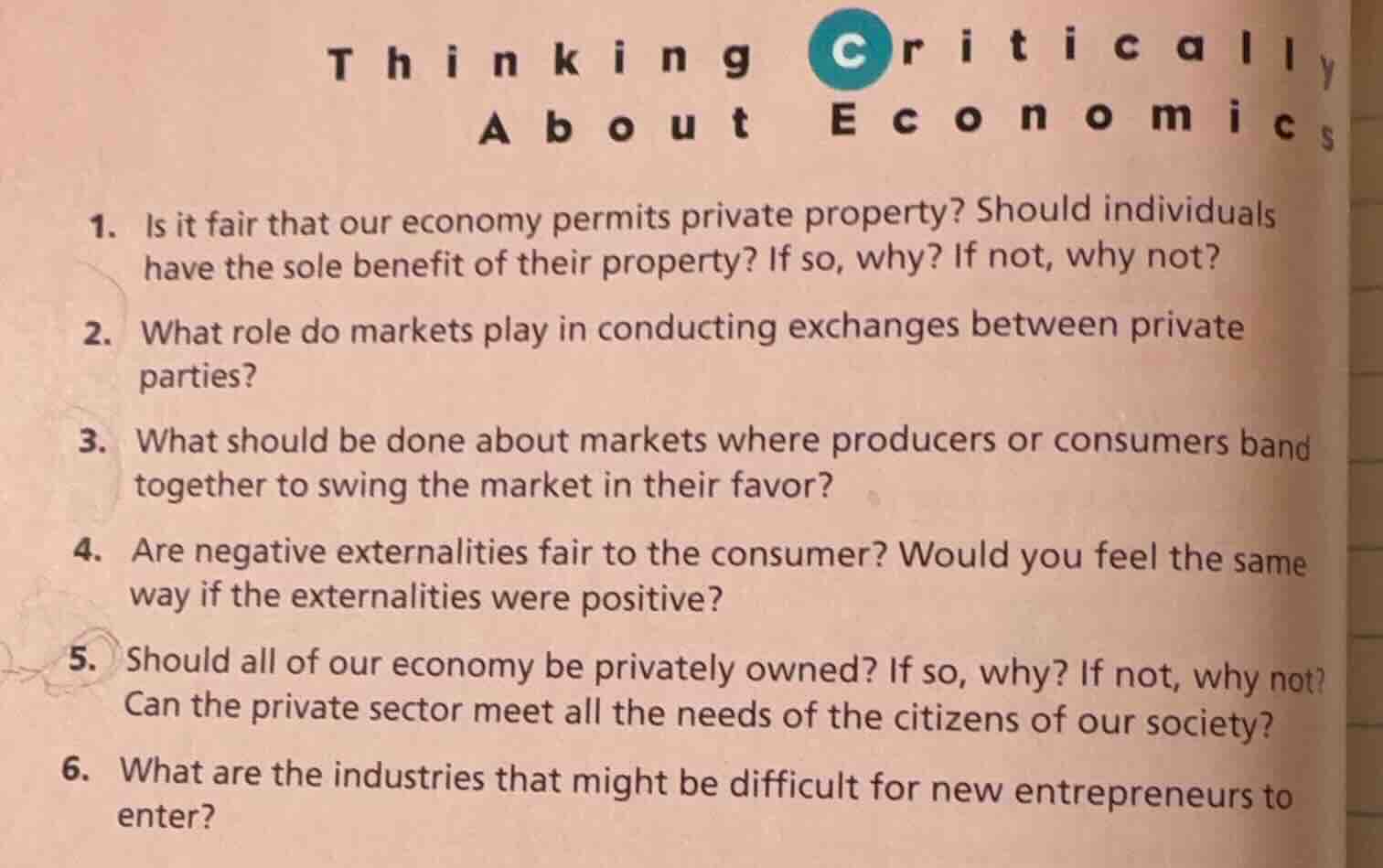
thinking critically about economics
- is it fair that our economy permits private property? should individuals have the sole benefit of their property? if so, why? if not, why not?
- what role do markets play in conducting exchanges between private parties?
- what should be done about markets where producers or consumers band together to swing the market in their favor?
- are negative externalities fair to the consumer? would you feel the same way if the externalities were positive?
- should all of our economy be privately owned? if so, why? if not, why not? can the private sector meet all the needs of the citizens of our society?
- what are the industries that might be difficult for new entrepreneurs to enter?
Brief Explanations
- For private property fairness: Views depend on ethical frameworks. Liberal perspectives argue it rewards effort and incentivizes investment, justifying sole benefit. Egalitarian perspectives note unequal initial access creates unfair advantages, so sole benefit is not fair, and property rights should be balanced with public good (e.g., taxes for social services).
- Markets act as decentralized mechanisms that set prices based on supply and demand, enable voluntary exchange of goods/services between private parties, reduce transaction costs, and allocate resources based on consumer and producer preferences.
- Such actions (cartels, consumer collusion) distort market competition. Policy responses include enforcing antitrust/anti-monopoly laws to break up collusive groups, imposing fines, and increasing market transparency to prevent anti-competitive behavior.
- Negative externalities (e.g., pollution) are unfair to consumers, as they bear costs they did not agree to. Positive externalities (e.g., public park benefits) are generally viewed as favorable, as consumers gain uncompensated benefits, so the fairness perception is reversed.
- Full private ownership is not ideal. The private sector prioritizes profit, so it will underprovide public goods (e.g., roads, public health) that benefit all but have no direct profit incentive. The private sector cannot meet all societal needs, so a mixed economy with public ownership of essential services is necessary.
- Industries with high barriers to entry are difficult for new entrepreneurs, including: utilities (high infrastructure costs), pharmaceuticals (costly R&D and regulation), aerospace (capital-intensive, strict safety rules), and established oligopolies with strong brand loyalty and economies of scale.

Snap & solve any problem in the app
Get step-by-step solutions on Sovi AI
Photo-based solutions with guided steps
Explore more problems and detailed explanations
- There is no universal answer, but:
- If yes: Private property incentivizes work, innovation, and responsible resource stewardship; sole benefit rewards individual effort.
- If no: Unequal initial property access creates unfair systemic advantages; sole benefit ignores societal contributions to property value, so shared benefits (e.g., taxes) are fairer.
- Markets facilitate voluntary, mutually beneficial exchanges between private parties by setting price signals, matching supply and demand, and reducing transaction costs for trade.
- Governments should enforce antitrust and anti-competition regulations to stop collusive behavior, impose penalties on groups manipulating markets, and increase market transparency to preserve fair competition.
- No, negative externalities are unfair, as consumers bear unchosen costs. Positive externalities are viewed positively, as consumers gain unearned benefits, so the fairness judgment is opposite.
- No, the entire economy should not be privately owned. The private sector cannot meet all societal needs, as it will not prioritize unprofitable public goods (e.g., public education, emergency services) that are essential for collective well-being.
- Industries difficult for new entrepreneurs to enter include capital-intensive utilities, regulated pharmaceuticals, aerospace manufacturing, and established oligopolistic industries (e.g., major airlines) with high barriers to entry.