QUESTION IMAGE
Question
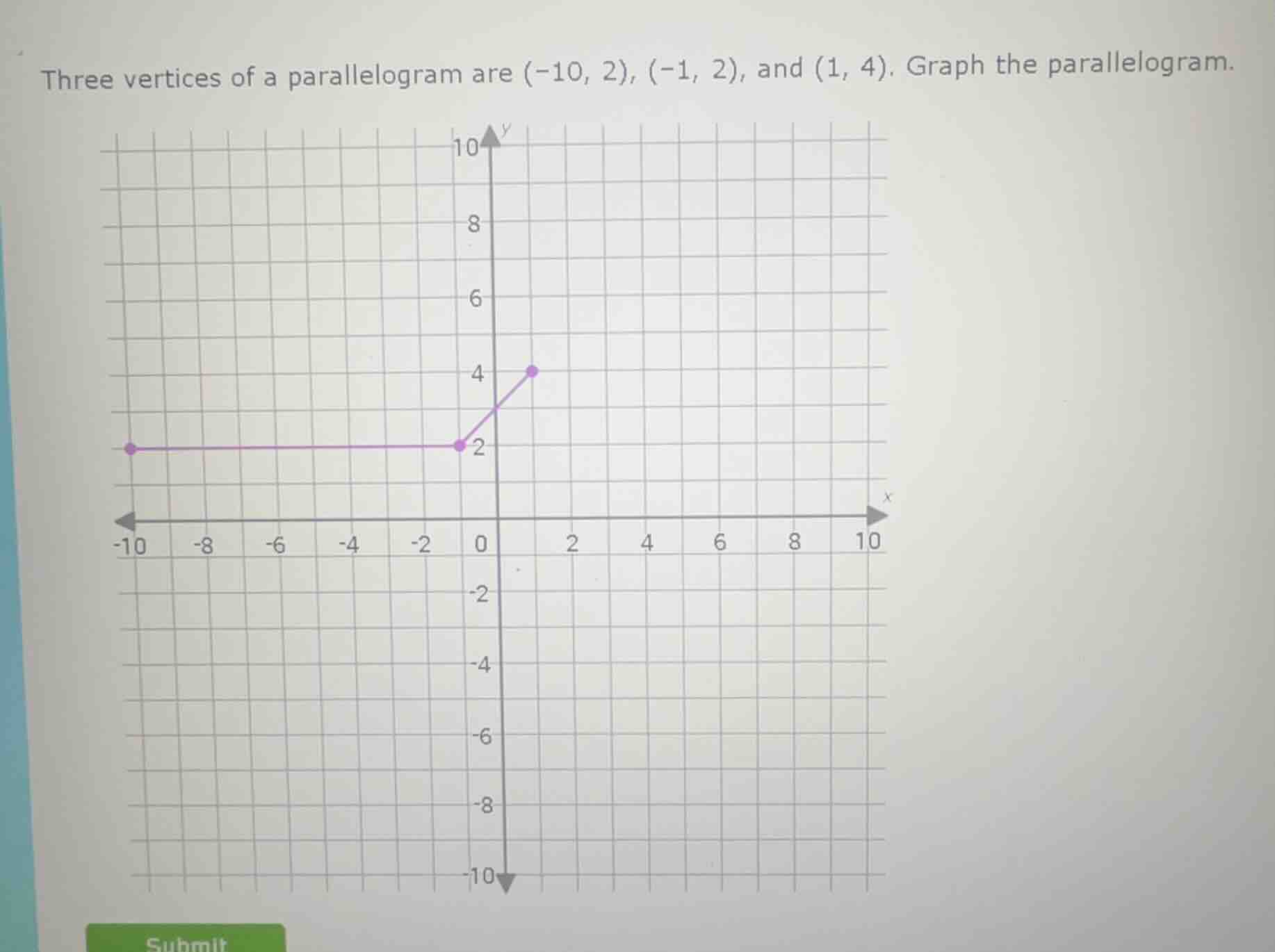
three vertices of a parallelogram are (-10, 2), (-1, 2), and (1, 4). graph the parallelogram.
Step1: Recall parallelogram property
In a parallelogram, opposite sides are equal and parallel, so the vector between two vertices equals the vector between the other pair of vertices. We first find the possible 4th vertex.
Step2: Calculate vector 1: (-1,2) to (-10,2)
Vector: $(-10 - (-1), 2 - 2) = (-9, 0)$
Add this vector to (1,4): $(1 + (-9), 4 + 0) = (-8, 4)$
Step3: Calculate vector 2: (-1,2) to (1,4)
Vector: $(1 - (-1), 4 - 2) = (2, 2)$
Add this vector to (-10,2): $(-10 + 2, 2 + 2) = (-8, 4)$
Step4: Plot and connect all points
Plot vertices $(-10, 2)$, $(-1, 2)$, $(1, 4)$, $(-8, 4)$, then connect them in order to form the parallelogram.

Snap & solve any problem in the app
Get step-by-step solutions on Sovi AI
Photo-based solutions with guided steps
Explore more problems and detailed explanations
The fourth vertex of the parallelogram is $(-8, 4)$. When plotted, the parallelogram has vertices at $(-10, 2)$, $(-1, 2)$, $(1, 4)$, and $(-8, 4)$, with opposite sides parallel and equal in length.