QUESTION IMAGE
Question
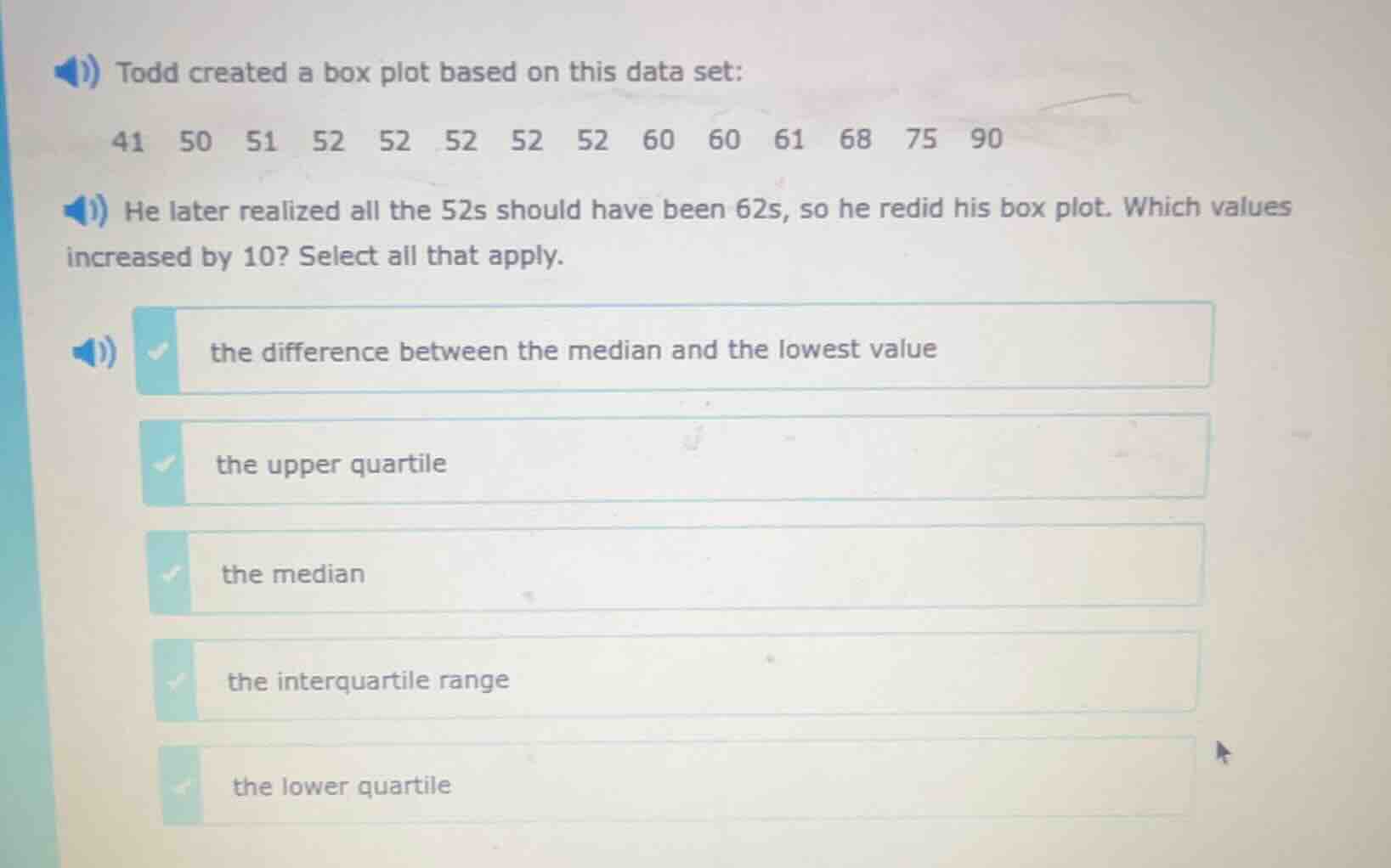
todd created a box plot based on this data set:
41 50 51 52 52 52 52 52 60 60 61 68 75 90
he later realized all the 52s should have been 62s, so he redid his box plot. which values increased by 10? select all that apply.
- the difference between the median and the lowest value
- the upper quartile
- the median
- the interquartile range
- the lower quartile
Step1: Analyze original data
Original data: \(41, 50, 51, 52, 52, 52, 52, 52, 60, 60, 61, 68, 75, 90\) (14 data points).
- Median (Q2): For \(n = 14\), median is average of 7th and 8th terms. 7th = 52, 8th = 52, so median = 52.
- Lower quartile (Q1): First 7 terms: \(41, 50, 51, 52, 52, 52, 52\). Median of these (4th term) = 52.
- Upper quartile (Q3): Last 7 terms: \(52, 60, 60, 61, 68, 75, 90\). Median of these (4th term) = 61.
- Interquartile range (IQR): \(Q3 - Q1 = 61 - 52 = 9\).
- Difference (median - lowest): \(52 - 41 = 11\).
Step2: Analyze corrected data (52s → 62s)
Corrected data: \(41, 50, 51, 62, 62, 62, 62, 62, 60, 60, 61, 68, 75, 90\) (sort: \(41, 50, 51, 60, 60, 61, 62, 62, 62, 62, 62, 68, 75, 90\)).
- Median (Q2): Average of 7th and 8th terms. 7th = 62, 8th = 62, so median = 62 (increased by \(62 - 52 = 10\)).
- Lower quartile (Q1): First 7 terms: \(41, 50, 51, 60, 60, 61, 62\). Median (4th term) = 60 (original Q1 was 52, change is \(60 - 52 = 8\), not 10).
- Upper quartile (Q3): Last 7 terms: \(62, 62, 62, 68, 75, 90\)? Wait, no—last 7 terms of 14: positions 8–14: \(62, 62, 62, 68, 75, 90\)? Wait, sorted data: positions 1 - 14: 1:41, 2:50, 3:51, 4:60, 5:60, 6:61, 7:62, 8:62, 9:62, 10:62, 11:62, 12:68, 13:75, 14:90. Last 7 terms: positions 8–14: 8:62, 9:62, 10:62, 11:62, 12:68, 13:75, 14:90. Median of these (4th term, position 11) = 62 (original Q3 was 61, increased by \(62 - 61 = 1\)? Wait, no—wait, last 7 terms: positions 8–14: terms are [62, 62, 62, 62, 68, 75, 90] (wait, position 8:62, 9:62, 10:62, 11:62, 12:68, 13:75, 14:90). Median (4th term) is position 8 + 3 = 11th? Wait, no—for \(n = 7\) (last 7 terms), median is 4th term (index 3 if 0 - based, or 4th term 1 - based). So 1 - based: 8th term (position 8) is 62, 9th:62, 10th:62, 11th:62, 12th:68, 13th:75, 14th:90. So last 7 terms (positions 8–14) are 62, 62, 62, 62, 68, 75, 90. Median (4th term) is 62 (original Q3 was 61? Wait no, original last 7 terms were 52, 60, 60, 61, 68, 75, 90. So 4th term was 61. Now, with 52s → 62s, the last 7 terms start from the 8th term of original data (which was 52, now 62). So sorted corrected data: 41, 50, 51, 60, 60, 61, 62, 62, 62, 62, 62, 68, 75, 90. So first 7 terms (positions 1–7): 41, 50, 51, 60, 60, 61, 62 → Q1 (4th term) = 60. Last 7 terms (positions 8–14): 62, 62, 62, 62, 62, 68, 75, 90? Wait, no—14 terms, so first 7 (1–7) and last 7 (8–14). So positions 8–14: 62 (8), 62 (9), 62 (10), 62 (11), 62 (12), 68 (13), 75 (14), 90? Wait, no, original data after correction: 14 terms: 41, 50, 51, 62, 62, 62, 62, 62, 60, 60, 61, 68, 75, 90. Wait, I made a mistake in sorting. Let's sort correctly:
Original data (before correction): [41, 50, 51, 52, 52, 52, 52, 52, 60, 60, 61, 68, 75, 90] (sorted: same as given, since it's already sorted? Wait no—wait, 41, 50, 51, 52, 52, 52, 52, 52, 60, 60, 61, 68, 75, 90. Yes, sorted.
After changing 52s to 62s: [41, 50, 51, 62, 62, 62, 62, 62, 60, 60, 61, 68, 75, 90]. Now sort this:
41, 50, 51, 60, 60, 61, 62, 62, 62, 62, 62, 68, 75, 90. Yes, that's correct.
So:
- First 7 terms (positions 1–7): 41, 50, 51, 60, 60, 61, 62 → Q1 is the median of these (4th term) = 60.
- Last 7 terms (positions 8–14): 62, 62, 62, 62, 62, 68, 75, 90? Wait, no—14 terms, so positions 8–14: 8:62, 9:62, 10:62, 11:62, 12:68, 13:75, 14:90. Wait, that's 7 terms (8–14: 7 terms). So median of last 7 terms (Q3) is the 4th term (position 11: 62? Wait no—positions 8 (1st of last 7), 9 (2nd), 10 (3rd), 11 (4th), 12 (5th), 13 (6th), 14 (7th). So 4th term is position 11: 62. Wait, original Q3 was 61 (position 11 in origina…

Snap & solve any problem in the app
Get step-by-step solutions on Sovi AI
Photo-based solutions with guided steps
Explore more problems and detailed explanations
Step1: Analyze original data
Original data: \(41, 50, 51, 52, 52, 52, 52, 52, 60, 60, 61, 68, 75, 90\) (14 data points).
- Median (Q2): For \(n = 14\), median is average of 7th and 8th terms. 7th = 52, 8th = 52, so median = 52.
- Lower quartile (Q1): First 7 terms: \(41, 50, 51, 52, 52, 52, 52\). Median of these (4th term) = 52.
- Upper quartile (Q3): Last 7 terms: \(52, 60, 60, 61, 68, 75, 90\). Median of these (4th term) = 61.
- Interquartile range (IQR): \(Q3 - Q1 = 61 - 52 = 9\).
- Difference (median - lowest): \(52 - 41 = 11\).
Step2: Analyze corrected data (52s → 62s)
Corrected data: \(41, 50, 51, 62, 62, 62, 62, 62, 60, 60, 61, 68, 75, 90\) (sort: \(41, 50, 51, 60, 60, 61, 62, 62, 62, 62, 62, 68, 75, 90\)).
- Median (Q2): Average of 7th and 8th terms. 7th = 62, 8th = 62, so median = 62 (increased by \(62 - 52 = 10\)).
- Lower quartile (Q1): First 7 terms: \(41, 50, 51, 60, 60, 61, 62\). Median (4th term) = 60 (original Q1 was 52, change is \(60 - 52 = 8\), not 10).
- Upper quartile (Q3): Last 7 terms: \(62, 62, 62, 68, 75, 90\)? Wait, no—last 7 terms of 14: positions 8–14: \(62, 62, 62, 68, 75, 90\)? Wait, sorted data: positions 1 - 14: 1:41, 2:50, 3:51, 4:60, 5:60, 6:61, 7:62, 8:62, 9:62, 10:62, 11:62, 12:68, 13:75, 14:90. Last 7 terms: positions 8–14: 8:62, 9:62, 10:62, 11:62, 12:68, 13:75, 14:90. Median of these (4th term, position 11) = 62 (original Q3 was 61, increased by \(62 - 61 = 1\)? Wait, no—wait, last 7 terms: positions 8–14: terms are [62, 62, 62, 62, 68, 75, 90] (wait, position 8:62, 9:62, 10:62, 11:62, 12:68, 13:75, 14:90). Median (4th term) is position 8 + 3 = 11th? Wait, no—for \(n = 7\) (last 7 terms), median is 4th term (index 3 if 0 - based, or 4th term 1 - based). So 1 - based: 8th term (position 8) is 62, 9th:62, 10th:62, 11th:62, 12th:68, 13th:75, 14th:90. So last 7 terms (positions 8–14) are 62, 62, 62, 62, 68, 75, 90. Median (4th term) is 62 (original Q3 was 61? Wait no, original last 7 terms were 52, 60, 60, 61, 68, 75, 90. So 4th term was 61. Now, with 52s → 62s, the last 7 terms start from the 8th term of original data (which was 52, now 62). So sorted corrected data: 41, 50, 51, 60, 60, 61, 62, 62, 62, 62, 62, 68, 75, 90. So first 7 terms (positions 1–7): 41, 50, 51, 60, 60, 61, 62 → Q1 (4th term) = 60. Last 7 terms (positions 8–14): 62, 62, 62, 62, 62, 68, 75, 90? Wait, no—14 terms, so first 7 (1–7) and last 7 (8–14). So positions 8–14: 62 (8), 62 (9), 62 (10), 62 (11), 62 (12), 68 (13), 75 (14), 90? Wait, no, original data after correction: 14 terms: 41, 50, 51, 62, 62, 62, 62, 62, 60, 60, 61, 68, 75, 90. Wait, I made a mistake in sorting. Let's sort correctly:
Original data (before correction): [41, 50, 51, 52, 52, 52, 52, 52, 60, 60, 61, 68, 75, 90] (sorted: same as given, since it's already sorted? Wait no—wait, 41, 50, 51, 52, 52, 52, 52, 52, 60, 60, 61, 68, 75, 90. Yes, sorted.
After changing 52s to 62s: [41, 50, 51, 62, 62, 62, 62, 62, 60, 60, 61, 68, 75, 90]. Now sort this:
41, 50, 51, 60, 60, 61, 62, 62, 62, 62, 62, 68, 75, 90. Yes, that's correct.
So:
- First 7 terms (positions 1–7): 41, 50, 51, 60, 60, 61, 62 → Q1 is the median of these (4th term) = 60.
- Last 7 terms (positions 8–14): 62, 62, 62, 62, 62, 68, 75, 90? Wait, no—14 terms, so positions 8–14: 8:62, 9:62, 10:62, 11:62, 12:68, 13:75, 14:90. Wait, that's 7 terms (8–14: 7 terms). So median of last 7 terms (Q3) is the 4th term (position 11: 62? Wait no—positions 8 (1st of last 7), 9 (2nd), 10 (3rd), 11 (4th), 12 (5th), 13 (6th), 14 (7th). So 4th term is position 11: 62. Wait, original Q3 was 61 (position 11 in original data: original data positions 8–14: 52, 60, 60, 61, 68, 75, 90 → 4th term (position 11) is 61. Now, corrected last 7 terms: 62, 62, 62, 62, 68, 75, 90 → 4th term (position 11) is 62. So Q3 increased by \(62 - 61 = 1\)? Wait, no—wait, original last 7 terms: positions 8–14: terms are 52 (8), 60 (9), 60 (10), 61 (11), 68 (12), 75 (13), 90 (14). So Q3 is 61 (4th term). Corrected last 7 terms: positions 8–14: 62 (8), 62 (9), 62 (10), 62 (11), 68 (12), 75 (13), 90 (14). So Q3 is 62 (4th term). So Q3 increased by \(62 - 61 = 1\)? Wait, that can't be. Wait, no—original data: after sorting, the 8th term is 52, 9th:52, 10th:52, 11th:52, 12th:60, 13th:60, 14th:61? Wait, no! I messed up the original data sorting. Oh no, critical mistake. Let's re - sort original data correctly:
Original data: 41, 50, 51, 52, 52, 52, 52, 52, 60, 60, 61, 68, 75, 90. Let's count the terms: 14 terms. So positions 1 - 14:
1:41, 2:50, 3:51, 4:52, 5:52, 6:52, 7:52, 8:52, 9:60, 10:60, 11:61, 12:68, 13:75, 14:90. Ah! Here's the mistake. I had the 9th term as 60, which is correct, but the 8th term is 52, 9th:60, 10th:60, 11th:61, etc. So original Q1 (first 7 terms: positions 1 - 7: 41, 50, 51, 52, 52, 52, 52 → median (4th term) is 52.
Original Q3 (last 7 terms: positions 8 - 14: 52, 60, 60, 61, 68, 75, 90 → median (4th term, position 11) is 61.
Original median (positions 7 and 8: 52 and 52 → median 52.
Now, corrected data: change 52s (positions 4 - 8) to 62s. So corrected data: 41, 50, 51, 62, 62, 62, 62, 62, 60, 60, 61, 68, 75, 90. Now sort this:
41, 50, 51, 60, 60, 61, 62, 62, 62, 62, 62, 68, 75, 90.
Now:
- First 7 terms (positions 1 - 7): 41, 50, 51, 60, 60, 61, 62 → median (4th term) is 60 (Q1).
- Last 7 terms (positions 8 - 14): 62, 62, 62, 62, 68, 75, 90 → median (4th term, position 11) is 62 (Q3).
- Median (positions 7 and 8: 62 and 62 → median 62 (increased by 10: 62 - 52 = 10).
- IQR: Q3 - Q1 = 62 - 60 = 2 (original IQR: 61 - 52 = 9 → changed, not increased by 10).
- Difference (median - lowest): 62 - 41 = 21 (original: 52 - 41 = 11 → increased by 10: 21 - 11 = 10).
- Upper quartile (Q3): 62 (original 61 → increased by 1? Wait no—wait, original last 7 terms: positions 8 - 14 in original data (sorted) are 52 (8), 60 (9), 60 (10), 61 (11), 68 (12), 75 (13), 90 (14). So Q3 is 61. Corrected last 7 terms: positions 8 - 14 in corrected (sorted) data: 62 (8), 62 (9), 62 (10), 62 (11), 68 (12), 75 (13), 90 (14). So Q3 is 62. Wait, but the 52s were in positions 4 - 8 of original data. When we change them to 62s, the last 7 terms now include the 62s (positions 4 - 8 in original become 62s, which are now in the middle of the sorted corrected data). Wait, I think the key is: the 52s (5 values) are in the middle of the data. When we increase them by 10, the median (which was among the 52s) will increase by 10. The upper quartile: original upper quartile was 61 (from the upper half, which included 52, 60, 60, 61...). After changing 52s to 62s, the upper quartile is now 62 (since the upper half now includes 62s instead of 52s). Wait, no—let's re - evaluate:
Original data (sorted): [41, 50, 51, 52, 52, 52, 52, 52, 60, 60, 61, 68, 75, 90]
- Lower half (first 7 terms: positions 1 - 7): [41, 50, 51, 52, 52, 52, 52] → Q1 = 52 (4th term).
- Upper half (last 7 terms: positions 8 - 14): [52, 60, 60, 61, 68, 75, 90] → Q3 = 61 (4th term).
Corrected data (sorted): [41, 50, 51, 60, 60, 61, 62, 62, 62, 62, 62, 68, 75, 90]
- Lower half (first 7 terms: positions 1 - 7): [41, 50, 51, 60, 60, 61, 62] → Q1 = 60 (4th term).
- Upper half (last 7 terms: positions 8 - 14): [62, 62, 62, 62, 68, 75, 90] → Q3 = 62 (4th term).
Now, let's check each option:
- the difference between the median and the lowest value:
- Original: \(52 - 41 = 11\).