QUESTION IMAGE
Question
total surface area- triangular prism
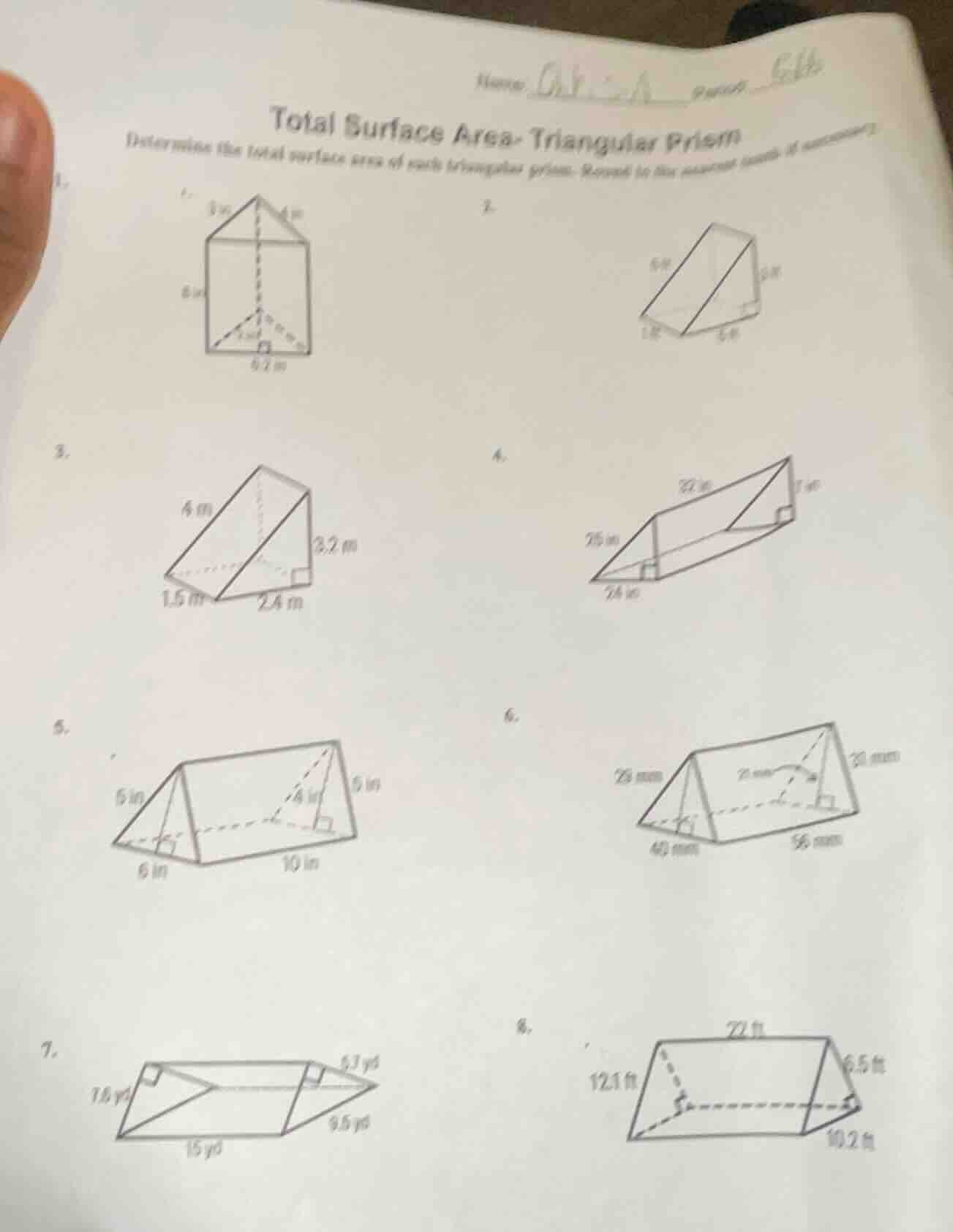
determine the total surface area of each triangular prism. round to the nearest tenth if necessary.
1.
image of a triangular prism with dimensions 3 m, 4 m, 6.2 m, 8 m
2.
image of a triangular prism with dimensions 5 ft, 3 ft, 1 ft, 5 ft
3.
image of a triangular prism with dimensions 4 m, 3.2 m, 1.5 m, 2.4 m
4.
image of a triangular prism with dimensions 32 in, 25 in, 24 in, 7 in
5.
image of a triangular prism with dimensions 5 in, 4 in, 5 in, 6 in, 10 in
6.
image of a triangular prism with dimensions 28 mm, 20 mm, 40 mm, 56 mm, 22 mm
7.
image of a triangular prism with dimensions 1.8 yd, 15 yd, 9.5 yd, 5.1 yd
8.
image of a triangular prism with dimensions 12.1 ft, 72 ft, 6.5 ft, 10.2 ft
Let's solve the first problem (triangular prism with triangle sides 3m, 4m, 5m? Wait, the base triangle: let's check the first figure. The triangular base has base 6.2 m? Wait, no, the first prism: the triangular face has sides 3m, 4m, and height? Wait, maybe the triangular base is a right triangle with legs 3m and 4m, so hypotenuse 5m. Then the length of the prism (the rectangular part) is 8m? Wait, the figure shows a triangular prism with triangular base (right triangle, legs 3m, 4m, hypotenuse 5m) and the length of the prism (the distance between the two triangular bases) is 8m? Wait, no, the rectangular faces: the three rectangles. Wait, the formula for the total surface area (TSA) of a triangular prism is \( TSA = 2 \times \text{Area of triangular base} + \text{Perimeter of triangular base} \times \text{length of prism} \).
Let's take problem 1:
Step 1: Find the area of the triangular base.
The triangular base is a right triangle with legs 3m and 4m? Wait, no, the base of the triangle is 6.2 m? Wait, maybe I misread. Wait, the first figure: the triangular face has a base of 6.2 m, and height? Wait, the dashed line is 3m? Wait, the triangle: base 6.2 m, height 3m? Wait, no, the right triangle with legs 3m and 4m (since 3-4-5 triangle), so area of triangle is \( \frac{1}{2} \times 3 \times 4 = 6 \, m^2 \). Then the two triangular bases: \( 2 \times 6 = 12 \, m^2 \).
Step 2: Find the perimeter of the triangular base.
Perimeter of triangle: 3 + 4 + 5 = 12 m (since 3-4-5 right triangle).
Step 3: Find the lateral surface area (perimeter × length of prism).
The length of the prism (the distance between the two triangles) is 8m (from the rectangular face height). So lateral surface area: \( 12 \times 8 = 96 \, m^2 \).
Step 4: Total Surface Area.
Add the two triangular areas and the lateral surface area: \( 12 + 96 = 108 \, m^2 \)? Wait, but wait, maybe the base of the triangle is 6.2 m? Wait, maybe I misread the figure. Wait, the first figure: the triangular base has base 6.2 m, and the height of the triangle is 3m? Wait, no, the dashed line is 3m, and the base is 6.2 m? Wait, maybe the triangular base is not a 3-4-5 triangle. Let's re-examine.
Wait, the first prism: the triangular face has a base of 6.2 m, and the height (altitude) of the triangle is 3m? Then area of triangle is \( \frac{1}{2} \times 6.2 \times 3 = 9.3 \, m^2 \). Then two triangular bases: \( 2 \times 9.3 = 18.6 \, m^2 \).
Perimeter of triangular base: let's see, the sides of the triangle: 3m, 4m, and 6.2 m? Wait, 3 + 4 = 7, which is more than 6.2, so possible. Wait, 3m, 4m, 6.2m? Then perimeter is 3 + 4 + 6.2 = 13.2 m.
Length of prism: 8m (from the rectangular face height). Then lateral surface area: 13.2 × 8 = 105.6 m².
Total surface area: 18.6 + 105.6 = 124.2 m²? Wait, maybe I made a mistake. Alternatively, maybe the triangular base is a right triangle with base 6.2 m and height 3m, and the other sides are 3m and 4m? No, 3-4-5 is a right triangle, but 3² + 4² = 5², not 6.2². So maybe the base of the triangle is 6.2 m, height 3m, and the two equal sides? No, it's a scalene triangle. Wait, maybe the figure is a triangular prism with triangular base (base 6.2 m, height 3m) and the three rectangular faces: one with length 8m and width 3m, one with 8m and 4m, one with 8m and 6.2m. Then:
Area of two triangles: \( 2 \times \frac{1}{2} \times 6.2 \times 3 = 18.6 \, m^2 \).
Area of three rectangles: \( (3 \times 8) + (4 \times 8) + (6.2 \times 8) = 24 + 32 + 49.6 = 105.6 \, m^2 \).
Total surface area: 18.6 + 105.6 = 124.2 m².
But maybe the triang…
Step1: Calculate area of triangular base.
The triangular base is a right triangle with legs \( 3 \, m \) and \( 4 \, m \).
Area of one triangle: \( \frac{1}{2} \times 3 \times 4 = 6 \, m^2 \).
Step2: Calculate area of two triangular bases.
Two triangles: \( 2 \times 6 = 12 \, m^2 \).
Step3: Calculate perimeter of triangular base.
Perimeter of triangle: \( 3 + 4 + 5 = 12 \, m \) (since \( 3^2 + 4^2 = 5^2 \), it’s a 3-4-5 right triangle).
Step4: Calculate lateral surface area (perimeter × length of prism).
Length of prism (distance between triangles) is \( 8 \, m \).
Lateral surface area: \( 12 \times 8 = 96 \, m^2 \).
Step5: Calculate total surface area.
Total surface area: \( 12 + 96 = 108 \, m^2 \).

Snap & solve any problem in the app
Get step-by-step solutions on Sovi AI
Photo-based solutions with guided steps
Explore more problems and detailed explanations
The total surface area of the triangular prism is \( \boldsymbol{108} \) square meters.