QUESTION IMAGE
Question
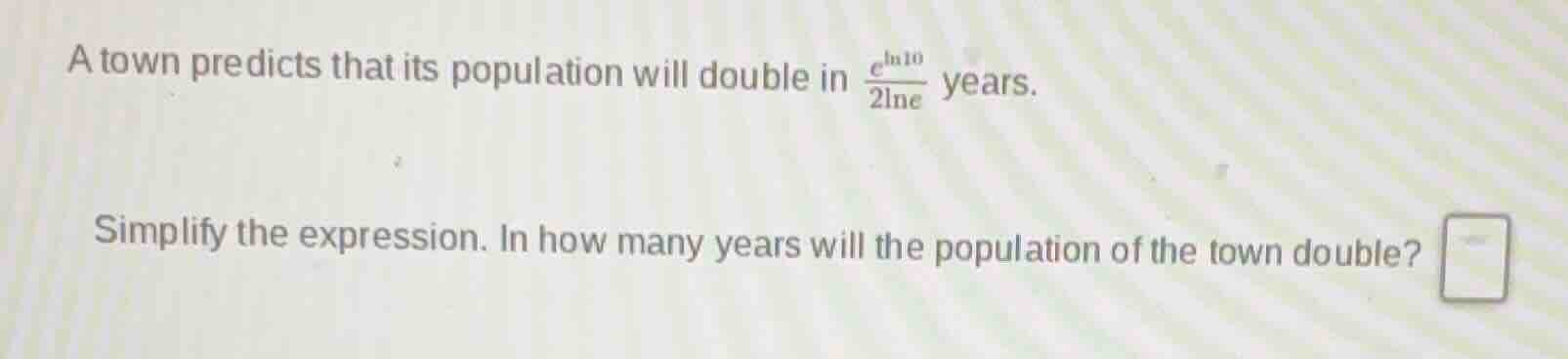
a town predicts that its population will double in \\(\frac{e^{\ln 10}}{2\ln e}\\) years. simplify the expression. in how many years will the population of the town double?
Step1: Recall logarithm and exponential properties
We know that \( e^{\ln x}=x \) (inverse property of exponential and natural logarithm) and \( \ln e = 1 \) (since \( \log_a a=1 \) for any base \( a>0,a
eq1 \)).
Step2: Simplify numerator and denominator
- For the numerator: \( e^{\ln 10} \), using the property \( e^{\ln x}=x \), we get \( e^{\ln 10}=10 \).
- For the denominator: \( 2\ln e \), since \( \ln e = 1 \), then \( 2\ln e=2\times1 = 2 \).
Step3: Simplify the fraction
Now we have the fraction \( \frac{e^{\ln 10}}{2\ln e}=\frac{10}{2} \).
Step4: Calculate the result
\( \frac{10}{2}=5 \).

Snap & solve any problem in the app
Get step-by-step solutions on Sovi AI
Photo-based solutions with guided steps
Explore more problems and detailed explanations
The population of the town will double in 5 years.