QUESTION IMAGE
Question
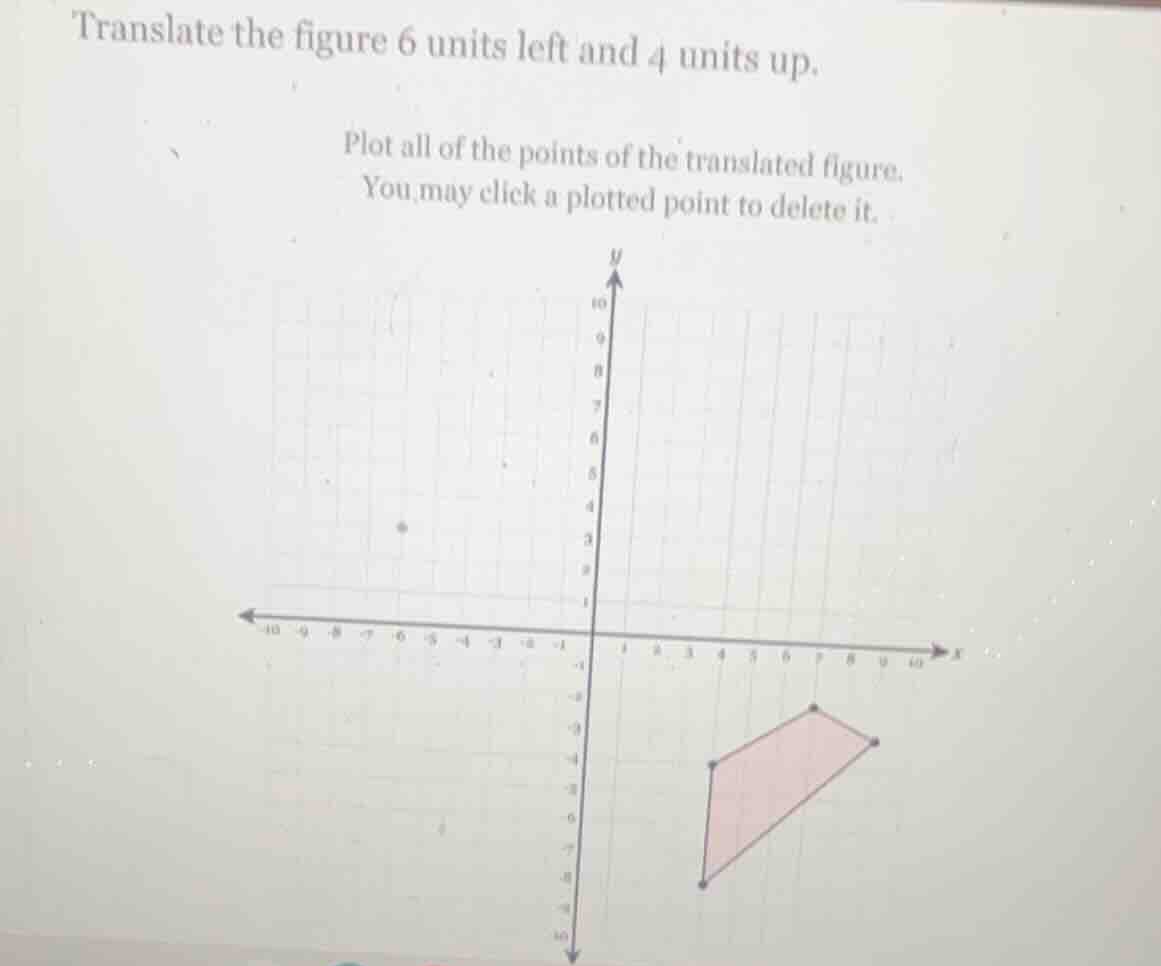
translate the figure 6 units left and 4 units up. plot all of the points of the translated figure. you may click a plotted point to delete it.
To solve the problem of translating the figure 6 units left and 4 units up, we first need to identify the coordinates of the original vertices of the figure. Let's assume the original vertices (from the graph) are:
- Let's find the original coordinates (estimating from the graph):
- Let's say the bottom vertex is at \((4, -9)\)
- The left vertex is at \((4, -4)\)
- The top vertex is at \((7, -3)\)
- The right vertex is at \((9, -4)\) (these are approximate coordinates based on the graph; we'll adjust as needed)
Step 1: Recall the translation rules
For a translation of \( h \) units left/right and \( k \) units up/down, the new coordinates \((x', y')\) of a point \((x, y)\) are given by:
\[
x' = x - h \quad (\text{left by } h \text{ units})
\]
\[
y' = y + k \quad (\text{up by } k \text{ units})
\]
Here, \( h = 6 \) (left) and \( k = 4 \) (up).
Step 2: Translate each vertex
- Bottom vertex: \((4, -9)\)
New \( x \)-coordinate: \( 4 - 6 = -2 \)
New \( y \)-coordinate: \( -9 + 4 = -5 \)
Translated point: \((-2, -5)\)
- Left vertex: \((4, -4)\)
New \( x \)-coordinate: \( 4 - 6 = -2 \)
New \( y \)-coordinate: \( -4 + 4 = 0 \)
Translated point: \((-2, 0)\)
- Top vertex: \((7, -3)\)
New \( x \)-coordinate: \( 7 - 6 = 1 \)
New \( y \)-coordinate: \( -3 + 4 = 1 \)
Translated point: \((1, 1)\)
- Right vertex: \((9, -4)\)
New \( x \)-coordinate: \( 9 - 6 = 3 \)
New \( y \)-coordinate: \( -4 + 4 = 0 \)
Translated point: \((3, 0)\)
Step 3: Plot the translated points
Plot the points \((-2, -5)\), \((-2, 0)\), \((1, 1)\), and \((3, 0)\) on the coordinate plane. These points form the translated figure.
(Note: If the original coordinates were different, adjust the calculations accordingly. The key is to subtract 6 from the \( x \)-coordinate and add 4 to the \( y \)-coordinate for each vertex.)

Snap & solve any problem in the app
Get step-by-step solutions on Sovi AI
Photo-based solutions with guided steps
Explore more problems and detailed explanations
To solve the problem of translating the figure 6 units left and 4 units up, we first need to identify the coordinates of the original vertices of the figure. Let's assume the original vertices (from the graph) are:
- Let's find the original coordinates (estimating from the graph):
- Let's say the bottom vertex is at \((4, -9)\)
- The left vertex is at \((4, -4)\)
- The top vertex is at \((7, -3)\)
- The right vertex is at \((9, -4)\) (these are approximate coordinates based on the graph; we'll adjust as needed)
Step 1: Recall the translation rules
For a translation of \( h \) units left/right and \( k \) units up/down, the new coordinates \((x', y')\) of a point \((x, y)\) are given by:
\[
x' = x - h \quad (\text{left by } h \text{ units})
\]
\[
y' = y + k \quad (\text{up by } k \text{ units})
\]
Here, \( h = 6 \) (left) and \( k = 4 \) (up).
Step 2: Translate each vertex
- Bottom vertex: \((4, -9)\)
New \( x \)-coordinate: \( 4 - 6 = -2 \)
New \( y \)-coordinate: \( -9 + 4 = -5 \)
Translated point: \((-2, -5)\)
- Left vertex: \((4, -4)\)
New \( x \)-coordinate: \( 4 - 6 = -2 \)
New \( y \)-coordinate: \( -4 + 4 = 0 \)
Translated point: \((-2, 0)\)
- Top vertex: \((7, -3)\)
New \( x \)-coordinate: \( 7 - 6 = 1 \)
New \( y \)-coordinate: \( -3 + 4 = 1 \)
Translated point: \((1, 1)\)
- Right vertex: \((9, -4)\)
New \( x \)-coordinate: \( 9 - 6 = 3 \)
New \( y \)-coordinate: \( -4 + 4 = 0 \)
Translated point: \((3, 0)\)
Step 3: Plot the translated points
Plot the points \((-2, -5)\), \((-2, 0)\), \((1, 1)\), and \((3, 0)\) on the coordinate plane. These points form the translated figure.
(Note: If the original coordinates were different, adjust the calculations accordingly. The key is to subtract 6 from the \( x \)-coordinate and add 4 to the \( y \)-coordinate for each vertex.)