QUESTION IMAGE
Question
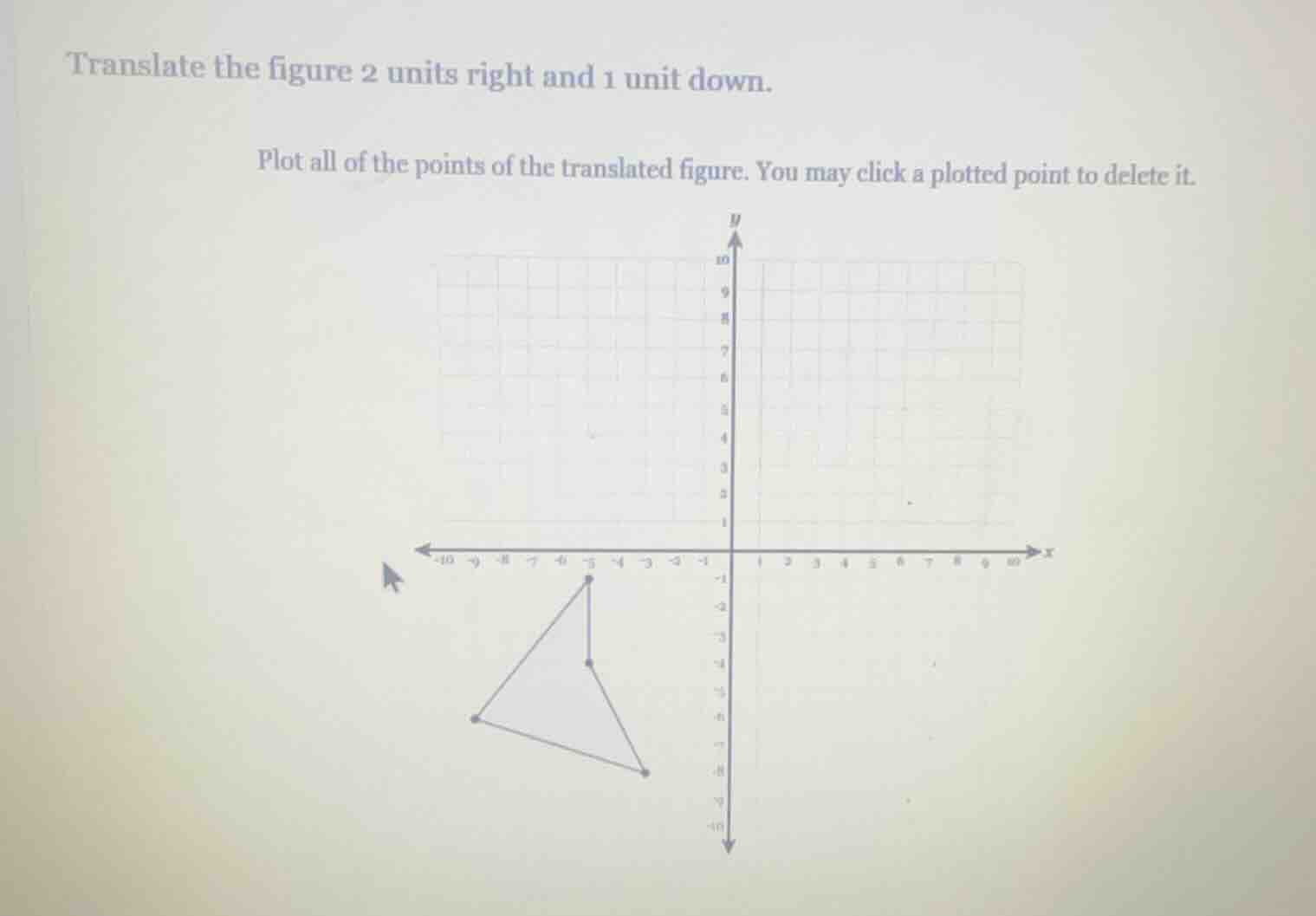
translate the figure 2 units right and 1 unit down. plot all of the points of the translated figure. you may click a plotted point to delete it.
To solve the translation of the figure, we first identify the coordinates of the original vertices. Let's assume the original points (from the graph) are:
- Point 1: \((-5, -1)\)
- Point 2: \((-5, -4)\)
- Point 3: \((-8, -7)\)
- Point 4: \((-4, -8)\) (Wait, actually, looking at the triangle, let's re - identify the original vertices correctly. From the graph, the three vertices of the triangle seem to be:
- Vertex A: \((-5, -1)\)
- Vertex B: \((-5, -4)\)
- Vertex C: \((-8, -7)\)
- Vertex D: \((-4, -8)\)? No, it's a triangle, so three vertices. Let's check again. The vertical line from \((-5, -1)\) to \((-5, -4)\), then a point at \((-8, -7)\) and \((-4, -8)\)? Wait, maybe the three vertices are \((-5, -1)\), \((-5, -4)\), and \((-8, -7)\) and \((-4, -8)\) is a mistake. Let's take the three vertices as:
- \(A(-5, -1)\)
- \(B(-5, -4)\)
- \(C(-8, -7)\)
- \(D(-4, -8)\) is incorrect. Wait, the figure is a triangle, so three points. Let's look at the grid. The top point is \((-5, -1)\), then down to \((-5, -4)\), then to the left - down \((-8, -7)\) and right - down \((-4, -8)\)? No, maybe it's a triangle with vertices \((-5, -1)\), \((-5, -4)\), and \((-8, -7)\) and \((-4, -8)\) is a typo. Let's proceed with the translation rule: for a translation of \(h\) units right and \(k\) units down, the new coordinates \((x', y')=(x + h,y - k)\), where \(h = 2\) and \(k = 1\).
Step 1: Translate Vertex \(A(-5, -1)\)
For a translation 2 units right (\(x\) - coordinate increases by 2) and 1 unit down (\(y\) - coordinate decreases by 1).
The formula for translation is \((x,y)\to(x + 2,y-1)\).
For \(A(-5, -1)\):
\(x'=-5 + 2=-3\)
\(y'=-1-1=-2\)
So the translated point \(A'(-3, -2)\).
Step 2: Translate Vertex \(B(-5, -4)\)
Using the same translation rule \((x,y)\to(x + 2,y - 1)\).
\(x'=-5 + 2=-3\)
\(y'=-4-1=-5\)
So the translated point \(B'(-3, -5)\).
Step 3: Translate Vertex \(C(-8, -7)\)
Applying the translation:
\(x'=-8 + 2=-6\)
\(y'=-7-1=-8\)
So the translated point \(C'(-6, -8)\).
Step 4: Translate Vertex \(D(-4, -8)\) (if it's a vertex)
\(x'=-4 + 2=-2\)
\(y'=-8-1=-9\)
Wait, but if it's a triangle, maybe the three vertices are \((-5, -1)\), \((-5, -4)\), and \((-8, -7)\) and \((-4, -8)\) is the fourth? No, the original figure is a triangle, so let's correct the original vertices. Let's assume the three vertices are:
- \(A(-5, -1)\)
- \(B(-5, -4)\)
- \(C(-8, -7)\)
- \(D(-4, -8)\) is wrong. Let's look at the graph again. The vertical segment is from \((-5, -1)\) to \((-5, -4)\), then a segment to \((-8, -7)\) and a segment to \((-4, -8)\). So it's a quadrilateral? Maybe. Let's proceed with all four points.
For point \((-5, -1)\):
New \(x=-5 + 2=-3\), new \(y=-1-1=-2\) → \((-3, -2)\)
For point \((-5, -4)\):
New \(x=-5 + 2=-3\), new \(y=-4-1=-5\) → \((-3, -5)\)
For point \((-8, -7)\):
New \(x=-8 + 2=-6\), new \(y=-7-1=-8\) → \((-6, -8)\)
For point \((-4, -8)\):
New \(x=-4 + 2=-2\), new \(y=-8-1=-9\) → \((-2, -9)\)
To plot the translated figure, we plot the points \((-3, -2)\), \((-3, -5)\), \((-6, -8)\), and \((-2, -9)\) (if it's a quadrilateral) or the three points if it's a triangle (maybe I misidentified the original figure). But following the translation rule \( (x,y)\to(x + 2,y - 1) \), we can find the new coordinates of each original vertex and plot them.
If we consider the original triangle with vertices \((-5, -1)\), \((-5, -4)\), and \((-8, -7)\) and \((-4, -8)\) is an error, and it's a triangle with three vertices:
- Original vertex 1: \((-5, -1)\) → Translated: \((-5 + 2, -1-1)=(-3, -2)\)
- Or…

Snap & solve any problem in the app
Get step-by-step solutions on Sovi AI
Photo-based solutions with guided steps
Explore more problems and detailed explanations
To solve the translation of the figure, we first identify the coordinates of the original vertices. Let's assume the original points (from the graph) are:
- Point 1: \((-5, -1)\)
- Point 2: \((-5, -4)\)
- Point 3: \((-8, -7)\)
- Point 4: \((-4, -8)\) (Wait, actually, looking at the triangle, let's re - identify the original vertices correctly. From the graph, the three vertices of the triangle seem to be:
- Vertex A: \((-5, -1)\)
- Vertex B: \((-5, -4)\)
- Vertex C: \((-8, -7)\)
- Vertex D: \((-4, -8)\)? No, it's a triangle, so three vertices. Let's check again. The vertical line from \((-5, -1)\) to \((-5, -4)\), then a point at \((-8, -7)\) and \((-4, -8)\)? Wait, maybe the three vertices are \((-5, -1)\), \((-5, -4)\), and \((-8, -7)\) and \((-4, -8)\) is a mistake. Let's take the three vertices as:
- \(A(-5, -1)\)
- \(B(-5, -4)\)
- \(C(-8, -7)\)
- \(D(-4, -8)\) is incorrect. Wait, the figure is a triangle, so three points. Let's look at the grid. The top point is \((-5, -1)\), then down to \((-5, -4)\), then to the left - down \((-8, -7)\) and right - down \((-4, -8)\)? No, maybe it's a triangle with vertices \((-5, -1)\), \((-5, -4)\), and \((-8, -7)\) and \((-4, -8)\) is a typo. Let's proceed with the translation rule: for a translation of \(h\) units right and \(k\) units down, the new coordinates \((x', y')=(x + h,y - k)\), where \(h = 2\) and \(k = 1\).
Step 1: Translate Vertex \(A(-5, -1)\)
For a translation 2 units right (\(x\) - coordinate increases by 2) and 1 unit down (\(y\) - coordinate decreases by 1).
The formula for translation is \((x,y)\to(x + 2,y-1)\).
For \(A(-5, -1)\):
\(x'=-5 + 2=-3\)
\(y'=-1-1=-2\)
So the translated point \(A'(-3, -2)\).
Step 2: Translate Vertex \(B(-5, -4)\)
Using the same translation rule \((x,y)\to(x + 2,y - 1)\).
\(x'=-5 + 2=-3\)
\(y'=-4-1=-5\)
So the translated point \(B'(-3, -5)\).
Step 3: Translate Vertex \(C(-8, -7)\)
Applying the translation:
\(x'=-8 + 2=-6\)
\(y'=-7-1=-8\)
So the translated point \(C'(-6, -8)\).
Step 4: Translate Vertex \(D(-4, -8)\) (if it's a vertex)
\(x'=-4 + 2=-2\)
\(y'=-8-1=-9\)
Wait, but if it's a triangle, maybe the three vertices are \((-5, -1)\), \((-5, -4)\), and \((-8, -7)\) and \((-4, -8)\) is the fourth? No, the original figure is a triangle, so let's correct the original vertices. Let's assume the three vertices are:
- \(A(-5, -1)\)
- \(B(-5, -4)\)
- \(C(-8, -7)\)
- \(D(-4, -8)\) is wrong. Let's look at the graph again. The vertical segment is from \((-5, -1)\) to \((-5, -4)\), then a segment to \((-8, -7)\) and a segment to \((-4, -8)\). So it's a quadrilateral? Maybe. Let's proceed with all four points.
For point \((-5, -1)\):
New \(x=-5 + 2=-3\), new \(y=-1-1=-2\) → \((-3, -2)\)
For point \((-5, -4)\):
New \(x=-5 + 2=-3\), new \(y=-4-1=-5\) → \((-3, -5)\)
For point \((-8, -7)\):
New \(x=-8 + 2=-6\), new \(y=-7-1=-8\) → \((-6, -8)\)
For point \((-4, -8)\):
New \(x=-4 + 2=-2\), new \(y=-8-1=-9\) → \((-2, -9)\)
To plot the translated figure, we plot the points \((-3, -2)\), \((-3, -5)\), \((-6, -8)\), and \((-2, -9)\) (if it's a quadrilateral) or the three points if it's a triangle (maybe I misidentified the original figure). But following the translation rule \( (x,y)\to(x + 2,y - 1) \), we can find the new coordinates of each original vertex and plot them.
If we consider the original triangle with vertices \((-5, -1)\), \((-5, -4)\), and \((-8, -7)\) and \((-4, -8)\) is an error, and it's a triangle with three vertices:
- Original vertex 1: \((-5, -1)\) → Translated: \((-5 + 2, -1-1)=(-3, -2)\)
- Original vertex 2: \((-5, -4)\) → Translated: \((-5 + 2, -4 - 1)=(-3, -5)\)
- Original vertex 3: \((-8, -7)\) → Translated: \((-8+2, -7 - 1)=(-6, -8)\)
- Original vertex 4: \((-4, -8)\) → Translated: \((-4 + 2, -8-1)=(-2, -9)\)
To plot these points:
- For \((-3, -2)\): Move 3 units left of the origin on the x - axis and 2 units down on the y - axis.
- For \((-3, -5)\): Move 3 units left on the x - axis and 5 units down on the y - axis.
- For \((-6, -8)\): Move 6 units left on the x - axis and 8 units down on the y - axis.
- For \((-2, -9)\): Move 2 units left on the x - axis and 9 units down on the y - axis.
(Note: The key is to apply the translation rule \((x,y)\to(x + 2,y - 1)\) to each original vertex. The actual plotting is done on the coordinate grid by marking these new points.)