QUESTION IMAGE
Question
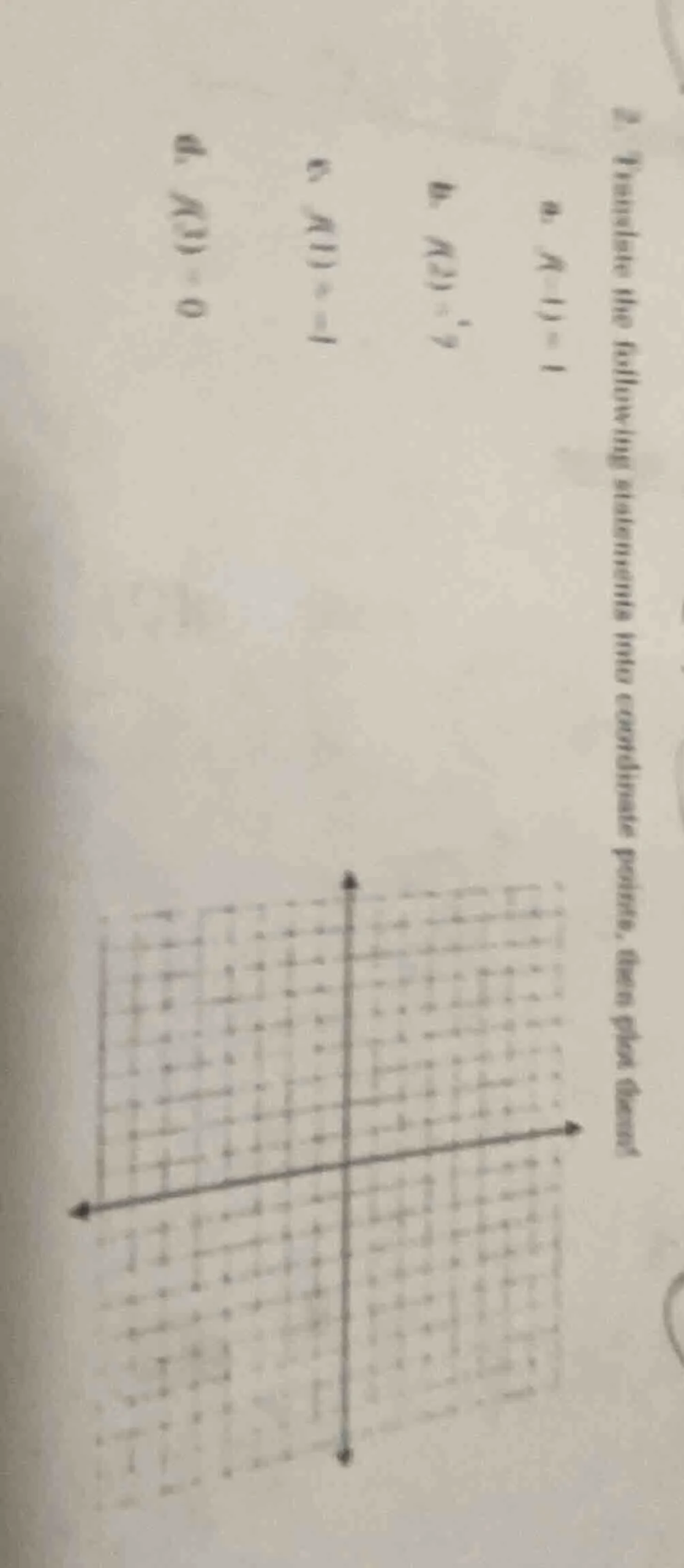
- translate the following statements into coordinate points, then plot them:
a. ( f(-1) = 1 )
b. ( f(2) = 7 )
c. ( f(1) = -1 )
d. ( f(3) = 0 )
Step1: Understand the notation
The notation \( f(x) = y \) means the coordinate point is \( (x, y) \).
Step2: Isolate for part a
For \( f(-1) = 1 \), the \( x \)-value is \( -1 \) and the \( y \)-value is \( 1 \), so the coordinate point is \( (-1, 1) \).
Step3: Isolate for part b
For \( f(2) = 7 \), the \( x \)-value is \( 2 \) and the \( y \)-value is \( 7 \), so the coordinate point is \( (2, 7) \).
Step4: Isolate for part c
For \( f(1) = -1 \), the \( x \)-value is \( 1 \) and the \( y \)-value is \( -1 \), so the coordinate point is \( (1, -1) \).
Step5: Isolate for part d
For \( f(3) = 0 \), the \( x \)-value is \( 3 \) and the \( y \)-value is \( 0 \), so the coordinate point is \( (3, 0) \).
Step6: Plotting (brief)
To plot, find the \( x \)-coordinate on the horizontal axis and the \( y \)-coordinate on the vertical axis, then mark the point. For \( (-1, 1) \), move 1 unit left on \( x \)-axis and 1 unit up on \( y \)-axis. For \( (2, 7) \), move 2 units right on \( x \)-axis and 7 units up on \( y \)-axis. For \( (1, -1) \), move 1 unit right on \( x \)-axis and 1 unit down on \( y \)-axis. For \( (3, 0) \), move 3 units right on \( x \)-axis and stay on the \( x \)-axis (since \( y = 0 \)).

Snap & solve any problem in the app
Get step-by-step solutions on Sovi AI
Photo-based solutions with guided steps
Explore more problems and detailed explanations
- a. Coordinate point: \( (-1, 1) \)
- b. Coordinate point: \( (2, 7) \)
- c. Coordinate point: \( (1, -1) \)
- d. Coordinate point: \( (3, 0) \)
(For plotting, use the coordinate points above to mark on the given graph.)