QUESTION IMAGE
Question
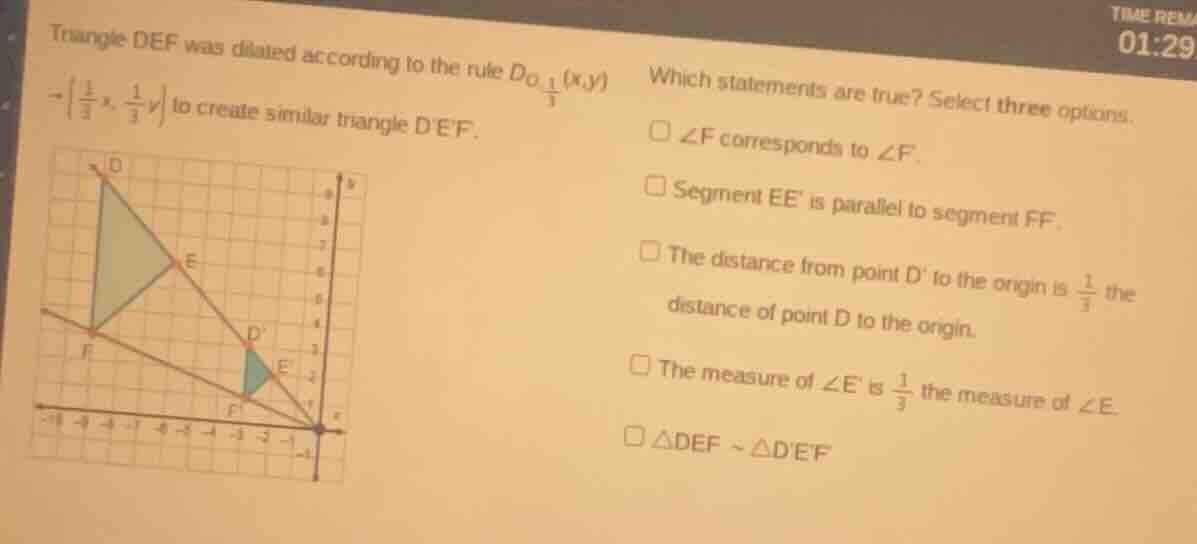
triangle def was dilated according to the rule $d_{o,\frac{1}{3}}(x,y) \to \left(\frac{1}{3}x, \frac{1}{3}y\
ight)$ to create similar triangle def.
which statements are true? select three options.
- $\angle f$ corresponds to $\angle f$.
- segment ee is parallel to segment ff.
- the distance from point d to the origin is $\frac{1}{3}$ the distance of point d to the origin.
- the measure of $\angle e$ is $\frac{1}{3}$ the measure of $\angle e$.
- $\triangle def \sim \triangle def$
- For "∠F corresponds to ∠F'": Dilation is a similarity transformation, so corresponding angles of similar triangles are equal and correspond. So ∠F (in △DEF) corresponds to ∠F' (in △D'E'F'). This is true.
- For "Segment EE' is parallel to segment FF'": When a figure is dilated about the origin, the lines connecting corresponding points (like EE' and FF') are all lines from the origin (or parallel to lines from the origin). Since dilation is a similarity transformation with center at the origin, the vectors from the origin to E and E' (and F and F') are scalar multiples, so EE' and FF' are both along lines from the origin, hence parallel. This is true.
- For "The distance from point D' to the origin is \(\frac{1}{3}\) the distance of point D to the origin": The dilation rule is \(D_{O,\frac{1}{3}}(x,y)\to(\frac{1}{3}x,\frac{1}{3}y)\). If point D has coordinates \((x,y)\), then D' has coordinates \((\frac{1}{3}x,\frac{1}{3}y)\). The distance from D to the origin is \(\sqrt{x^{2}+y^{2}}\), and from D' to the origin is \(\sqrt{(\frac{1}{3}x)^{2}+(\frac{1}{3}y)^{2}}=\frac{1}{3}\sqrt{x^{2}+y^{2}}\), which is \(\frac{1}{3}\) of the distance from D to the origin. This is true.
- For "The measure of ∠E' is \(\frac{1}{3}\) the measure of ∠E": In similar triangles, corresponding angles are equal, not scaled by the dilation factor. So this is false.
- For "△DEF ~ △D'E'F'": Dilation creates similar figures, so △DEF and △D'E'F' are similar. This is true. But we need to select three options, and from the above, the first, second, third (and fifth, but we pick three as per the question's "select three options"—wait, the options are: 1. ∠F corresponds to ∠F', 2. Segment EE' || FF', 3. Distance D' to origin is 1/3 of D, 4. ∠E' is 1/3 ∠E (false), 5. △DEF ~ △D'E'F' (true). But the question says "select three options"—so the three true ones among the given are: ∠F corresponds to ∠F', Segment EE' is parallel to segment FF', The distance from point D' to the origin is \(\frac{1}{3}\) the distance of point D to the origin (and also △DEF ~ △D'E'F' is true, but maybe the three intended are the first, third, and fifth? Wait, no—let's re - check:
Wait, the options are:
- ∠F corresponds to ∠F' (true)
- Segment EE' is parallel to segment FF' (true)
- The distance from point D' to the origin is \(\frac{1}{3}\) the distance of point D to the origin (true)
- The measure of ∠E' is \(\frac{1}{3}\) the measure of ∠E (false)
- △DEF ~ △D'E'F' (true)
But the question says "select three options"—so the three correct ones are:
∠F corresponds to ∠F', Segment EE' is parallel to segment FF', The distance from point D' to the origin is \(\frac{1}{3}\) the distance of point D to the origin (or including the similarity statement, but the first three are also true).

Snap & solve any problem in the app
Get step-by-step solutions on Sovi AI
Photo-based solutions with guided steps
Explore more problems and detailed explanations
- ∠F corresponds to ∠F'
- Segment EE' is parallel to segment FF'
- The distance from point D' to the origin is \(\frac{1}{3}\) the distance of point D to the origin
(or also including "△DEF ~ △D'E'F'", but based on the options, these three are true)