QUESTION IMAGE
Question
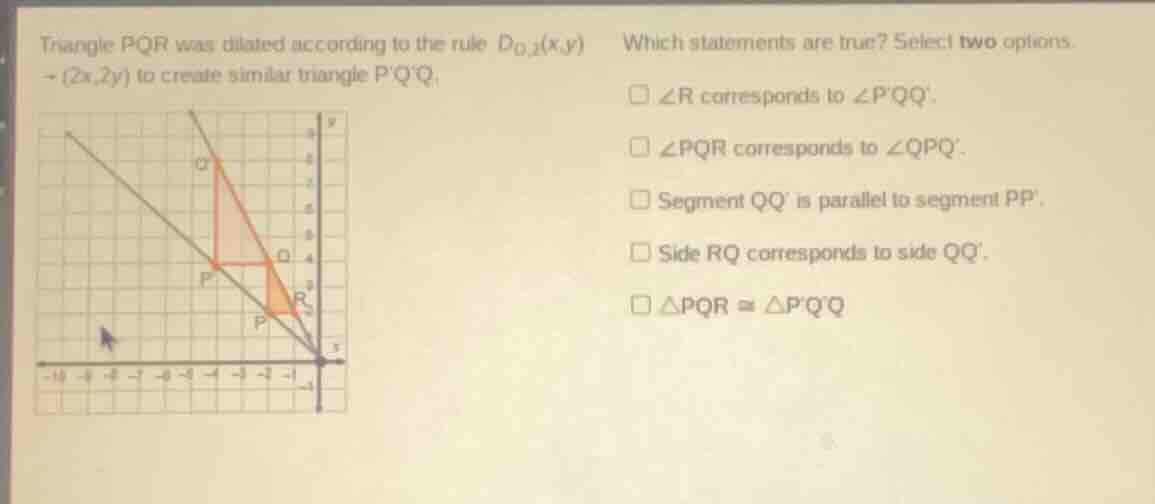
triangle pqr was dilated according to the rule ( d_{o,2}(x,y) \to (2x,2y) ) to create similar triangle ( pqq ). which statements are true? select two options.
( square ) ( angle r ) corresponds to ( angle pqq ).
( square ) ( angle pqr ) corresponds to ( angle qpq ).
( square ) segment ( qq ) is parallel to segment ( pp ).
( square ) side ( rq ) corresponds to side ( qq ).
( square ) ( \triangle pqr cong \triangle pqq )
Brief Explanations
- Analyze Angle Correspondence: In a dilation, corresponding angles are equal. For \( \angle PQR \) and \( \angle QPQ' \): Since dilation is a similarity transformation, the angles of the original triangle and the dilated triangle are congruent. \( \angle PQR \) (a right angle in \( \triangle PQR \)) corresponds to \( \angle QPQ' \) (a right angle in \( \triangle P'Q'Q \)) as the dilation preserves angle measures. For \( \angle R \), it should correspond to \( \angle Q' \) (not \( \angle P'QQ' \)), so the first statement is false.
- Analyze Parallel Segments: When a figure is dilated about the origin with a scale factor \( k \), the lines connecting corresponding points (like \( PP' \) and \( QQ' \)) are all rays from the origin, and since they have the same slope (as they are both along lines from the origin), segments \( QQ' \) and \( PP' \) are parallel. This is because the vector from \( P \) to \( P' \) and from \( Q \) to \( Q' \) are scalar multiples (due to dilation), so their direction vectors are parallel, making the segments parallel.
- Analyze Side Correspondence: Side \( RQ \) in \( \triangle PQR \) should correspond to side \( Q'Q \)? No, in similar triangles, corresponding sides are in proportion. \( RQ \) corresponds to \( Q'P' \) (or other corresponding sides based on angle correspondence), not \( QQ' \). So the fourth statement is false.
- Analyze Congruence: Dilation with a scale factor of 2 (since \( D_{0,2}(x,y)\to(2x,2y) \)) creates a similar triangle, not a congruent one (congruent requires scale factor 1). So \( \triangle PQR \) is similar to \( \triangle P'Q'Q \), not congruent, so the fifth statement is false.
- Re - check Angle Correspondence for the Second Statement: As established, \( \angle PQR \) (right angle) corresponds to \( \angle QPQ' \) (right angle) because dilation preserves angle measures, so this statement is true. And the parallel segments statement is also true.

Snap & solve any problem in the app
Get step-by-step solutions on Sovi AI
Photo-based solutions with guided steps
Explore more problems and detailed explanations
B. \( \angle PQR \) corresponds to \( \angle QPQ' \)
C. Segment \( QQ' \) is parallel to segment \( PP' \)