QUESTION IMAGE
Question
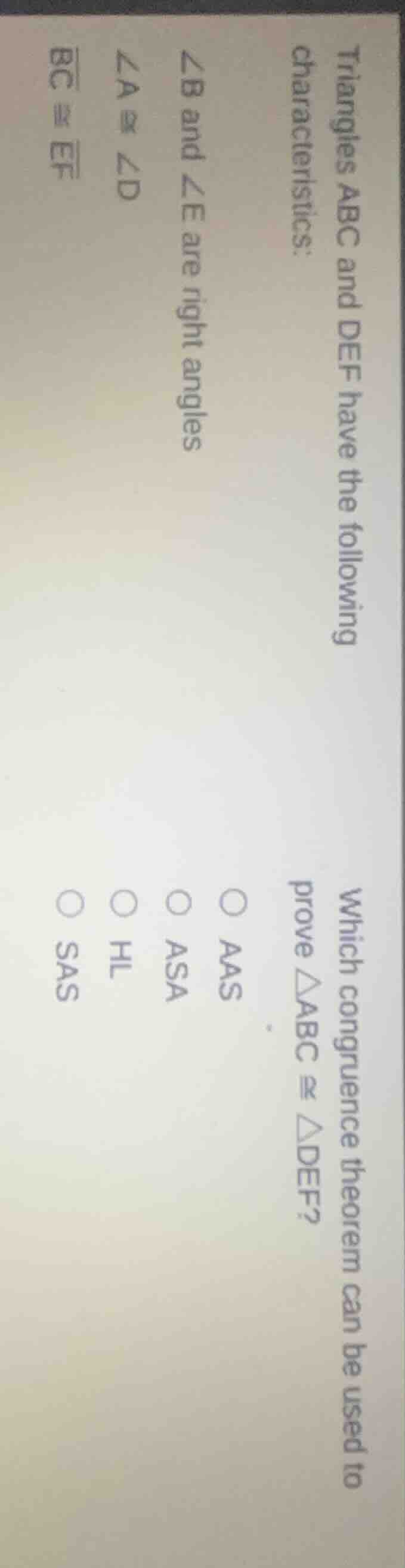
triangles abc and def have the following characteristics:
∠b and ∠e are right angles
∠a ≅ ∠d
\\(overline{bc} \cong overline{ef}\\)
which congruence theorem can be used to prove \\(\triangle abc \cong \triangle def\\)?
\\(\circ\\) aas
\\(\circ\\) asa
\\(\circ\\) hl
\\(\circ\\) sas
Step1: Identify given congruent parts
We know:
- $\angle B = \angle E = 90^\circ$ (right angles, so $\angle B \cong \angle E$)
- $\angle A \cong \angle D$
- $\overline{BC} \cong \overline{EF}$
Step2: Match to congruence theorem
AAS (Angle-Angle-Side) states that if two angles and a non-included side of one triangle are congruent to the corresponding two angles and non-included side of another triangle, the triangles are congruent. Here, two pairs of angles ($\angle B \cong \angle E$, $\angle A \cong \angle D$) and a non-included side ($\overline{BC} \cong \overline{EF}$) are congruent, which fits AAS.

Snap & solve any problem in the app
Get step-by-step solutions on Sovi AI
Photo-based solutions with guided steps
Explore more problems and detailed explanations
A. AAS