QUESTION IMAGE
Question
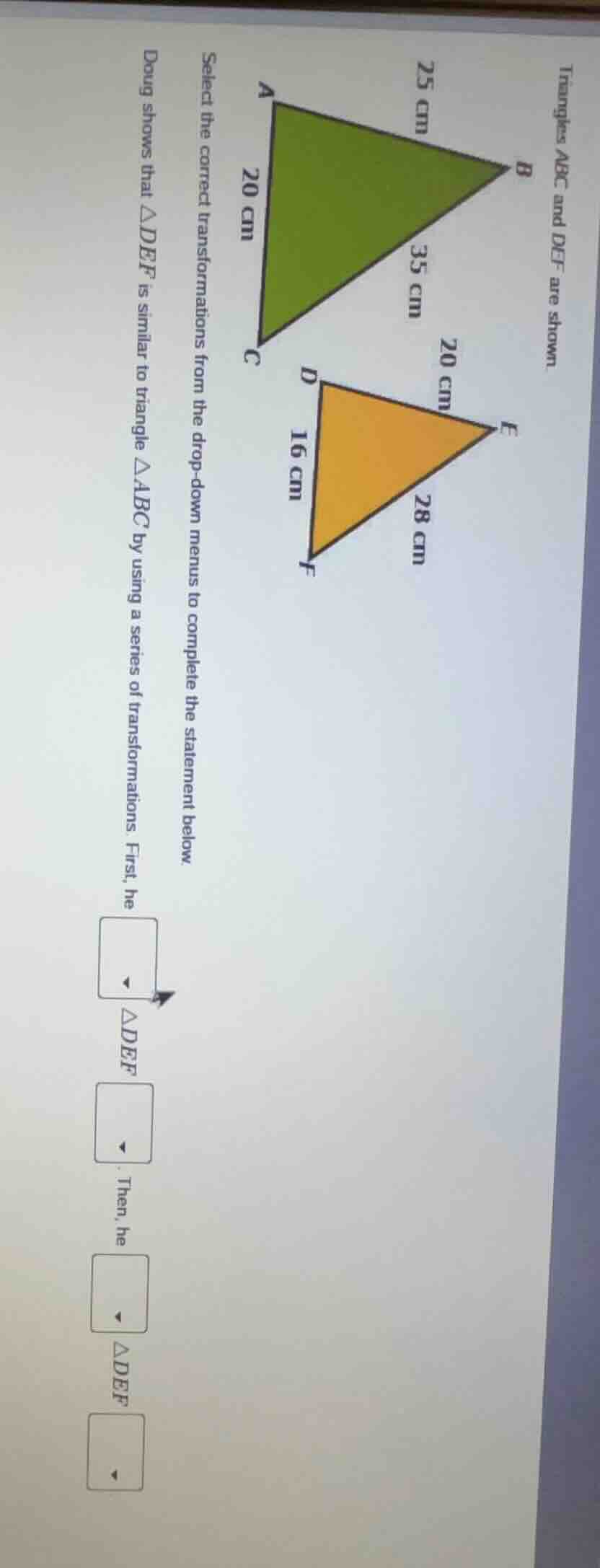
triangles abc and def are shown.
select the correct transformations from the drop - down menus to complete the statement below
doug shows that △def is similar to triangle △abc by using a series of transformations. first, he
△def
. then, he
△def
Step1: Find the scale factor
First, we identify the corresponding sides. Let's list the side lengths:
- For $\triangle ABC$: $AB = 25$ cm, $BC = 35$ cm, $AC = 20$ cm.
- For $\triangle DEF$: $DE = 20$ cm, $EF = 28$ cm, $DF = 16$ cm.
We check the ratios of corresponding sides. Let's take $AC$ (20 cm) in $\triangle ABC$ and $DF$ (16 cm) in $\triangle DEF$? Wait, no, maybe better to find which sides correspond. Let's see the ratios:
$\frac{DE}{AB}=\frac{20}{25}=\frac{4}{5}$, $\frac{EF}{BC}=\frac{28}{35}=\frac{4}{5}$, $\frac{DF}{AC}=\frac{16}{20}=\frac{4}{5}$. Wait, no, wait: Wait, $AC = 20$, $DF = 16$: $\frac{16}{20}=\frac{4}{5}$. $DE = 20$, $AB = 25$: $\frac{20}{25}=\frac{4}{5}$. $EF = 28$, $BC = 35$: $\frac{28}{35}=\frac{4}{5}$. Wait, actually, if we consider scaling $\triangle ABC$ to $\triangle DEF$, the scale factor is $\frac{4}{5}$? Wait, no, maybe $\triangle DEF$ is a scaled version of $\triangle ABC$ or vice versa. Wait, let's check the other way: $\frac{AB}{DE}=\frac{25}{20}=\frac{5}{4}$, $\frac{BC}{EF}=\frac{35}{28}=\frac{5}{4}$, $\frac{AC}{DF}=\frac{20}{16}=\frac{5}{4}$. Ah, so the scale factor from $\triangle DEF$ to $\triangle ABC$ is $\frac{5}{4}$, or from $\triangle ABC$ to $\triangle DEF$ is $\frac{4}{5}$.
So first, to show similarity, we can dilate $\triangle DEF$ by a scale factor. Wait, the problem is about transforming $\triangle DEF$ to be similar to $\triangle ABC$. Wait, the question is: Doug shows that $\triangle DEF$ is similar to $\triangle ABC$ by using a series of transformations. First, he [transformation 1] $\triangle DEF$ [how], then he [transformation 2] $\triangle DEF$ [how].
Wait, the common transformations for similarity are dilation (scaling) and then maybe translation, rotation, reflection (rigid transformations). Since similarity allows for dilation and rigid motions.
First, let's find the scale factor. Let's take the sides:
For $\triangle DEF$: sides 20, 28, 16.
For $\triangle ABC$: sides 25, 35, 20.
Notice that $20 \times \frac{5}{4}=25$, $28 \times \frac{5}{4}=35$, $16 \times \frac{5}{4}=20$. So the scale factor to go from $\triangle DEF$ to $\triangle ABC$ is $\frac{5}{4}$. So first, he can dilate $\triangle DEF$ by a scale factor of $\frac{5}{4}$. Then, since after dilation, the triangles are similar (same shape, different size), but to align them, he might need to rotate or reflect (rigid transformation) to match the orientation.
So the first transformation is a dilation. Let's confirm:
Dilation of $\triangle DEF$ with scale factor $\frac{5}{4}$: each side length is multiplied by $\frac{5}{4}$. So $DE = 20 \times \frac{5}{4}=25$ (matches $AB$), $EF = 28 \times \frac{5}{4}=35$ (matches $BC$), $DF = 16 \times \frac{5}{4}=20$ (matches $AC$). Then, after dilation, the triangle has the same side lengths as $\triangle ABC$, but maybe different orientation. Then, a rigid transformation (rotation, reflection, translation) can be applied to map the dilated $\triangle DEF$ to $\triangle ABC$.
So the first transformation is "dilates" $\triangle DEF$ by a scale factor of $\frac{5}{4}$, then maybe "rotates" or "reflects" or "translates" to align.
But since the problem is about the drop-down menus (which we can't see, but based on the process), the key is:
- First, dilate $\triangle DEF$ by a scale factor (to make the sides proportional to $\triangle ABC$). The scale factor here is $\frac{5}{4}$ (since $20 \times \frac{5}{4}=25$, $28 \times \frac{5}{4}=35$, $16 \times \frac{5}{4}=20$).
- Then, apply a rigid transformation (rotation, reflection, translation) to map the dilated t…

Snap & solve any problem in the app
Get step-by-step solutions on Sovi AI
Photo-based solutions with guided steps
Explore more problems and detailed explanations
To show $\triangle DEF \sim \triangle ABC$, Doug first dilates $\triangle DEF$ by a scale factor of $\boldsymbol{\frac{5}{4}}$ (since $\frac{20 \times \frac{5}{4}}{20}=\frac{25}{20}$, etc.), then applies a rigid transformation (rotation, reflection, or translation) to align the dilated $\triangle DEF$ with $\triangle ABC$. The key transformation steps involve dilation (to achieve proportional sides) followed by a rigid motion (to match orientation/position).