QUESTION IMAGE
Question
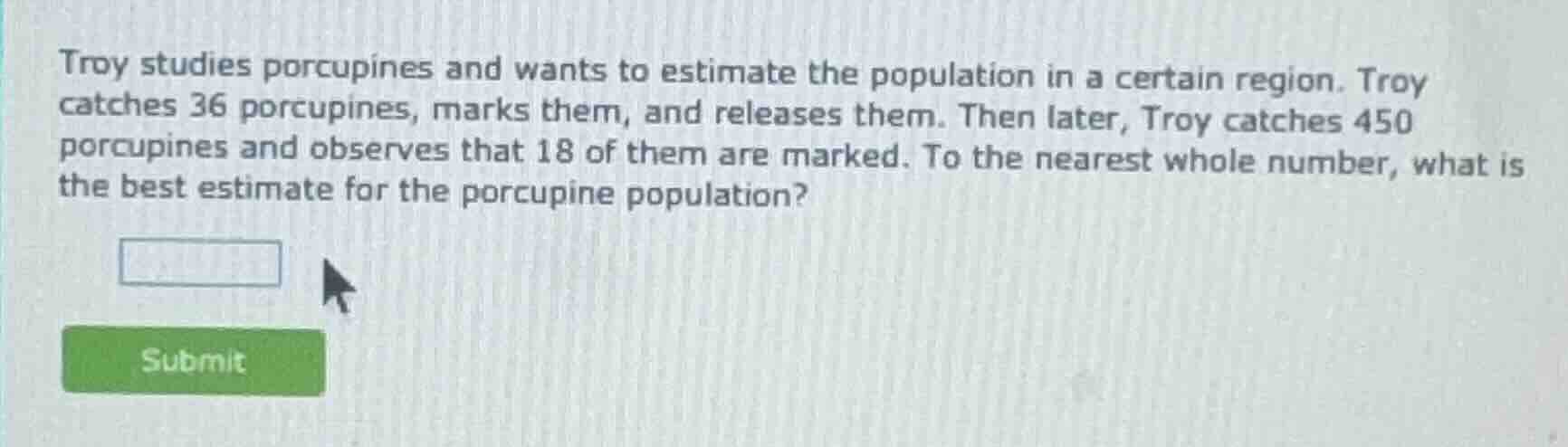
troy studies porcupines and wants to estimate the population in a certain region. troy catches 36 porcupines, marks them, and releases them. then later, troy catches 450 porcupines and observes that 18 of them are marked. to the nearest whole number, what is the best estimate for the porcupine population?
Step1: Set up proportion
Let \( N \) be the total population. The proportion of marked porcupines in the first catch to total population should equal the proportion of marked porcupines in the second catch to the second catch size. So \(\frac{36}{N}=\frac{18}{450}\).
Step2: Solve for \( N \)
Cross - multiply: \( 18N = 36\times450 \). Then \( N=\frac{36\times450}{18} \). First, calculate \( 36\div18 = 2 \), then \( 2\times450=900 \).

Snap & solve any problem in the app
Get step-by-step solutions on Sovi AI
Photo-based solutions with guided steps
Explore more problems and detailed explanations
900